Executive Summary
Artificial intelligence is rapidly moving beyond simple chatbots and automation into Agentic AI—AI systems that can reason, make decisions, and execute tasks with minimal human intervention. While the technology is advancing quickly, one challenge remains constant: AI is only as reliable as the data and context it receives. For ServiceNow-powered organisations, that context comes from a trusted Configuration Management Database (CMDB).
In our previous blog, we explored the best practices for building and maintaining a healthy CMDB. This article takes the next strategic step by explaining why that trusted CMDB has become the essential foundation for Agentic AI, enterprise governance, and executive decision-making. You'll learn why organisations that invest in CMDB quality today will be far better positioned to scale AI safely, confidently, and responsibly.
Introduction
In our previous article, "10 CMDB Best Practices Every ServiceNow Leader Should Implement in 2026," we focused on the operational fundamentals of maintaining a healthy Configuration Management Database (CMDB). We explored topics such as business-critical services, Discovery, Service Mapping, governance, ownership, duplicate reduction, and measuring CMDB health. Those practices remain essential. However, the conversation has evolved.
Today, organisations are no longer asking whether they should adopt AI. They are asking how to scale AI safely while maintaining governance, trust, and operational control.
This is where a trusted CMDB becomes far more than an IT asset register. It becomes the operational intelligence layer that provides AI with the business context it needs to make informed decisions. Without that trusted foundation, even the most advanced AI systems risk making recommendations based on incomplete, outdated, or inaccurate information.
Simply put, if data is the fuel for AI, then the CMDB is the map that tells AI where to go.
What Agentic AI Means in a ServiceNow Context
Agentic AI refers to AI systems that can understand goals, make decisions, plan actions, and complete work with limited human intervention. Instead of simply responding to prompts, these AI agents actively execute business tasks.
How it works in ServiceNow
Within the ServiceNow platform, AI agents can support activities such as incident management, change analysis, service operations, employee support, and workflow orchestration. Rather than operating in isolation, these agents rely on enterprise data to understand how applications, infrastructure, business services, and users are connected.
That context largely comes from the CMDB.
Why this matters to executives
AI cannot make reliable decisions without understanding the environment in which it operates. If an AI agent recommends restarting a server without knowing that it supports a revenue-generating customer application, the business risk is significant. The better the operational context, the better the AI decisions.
The CMDB as the Single Source of Operational Truth
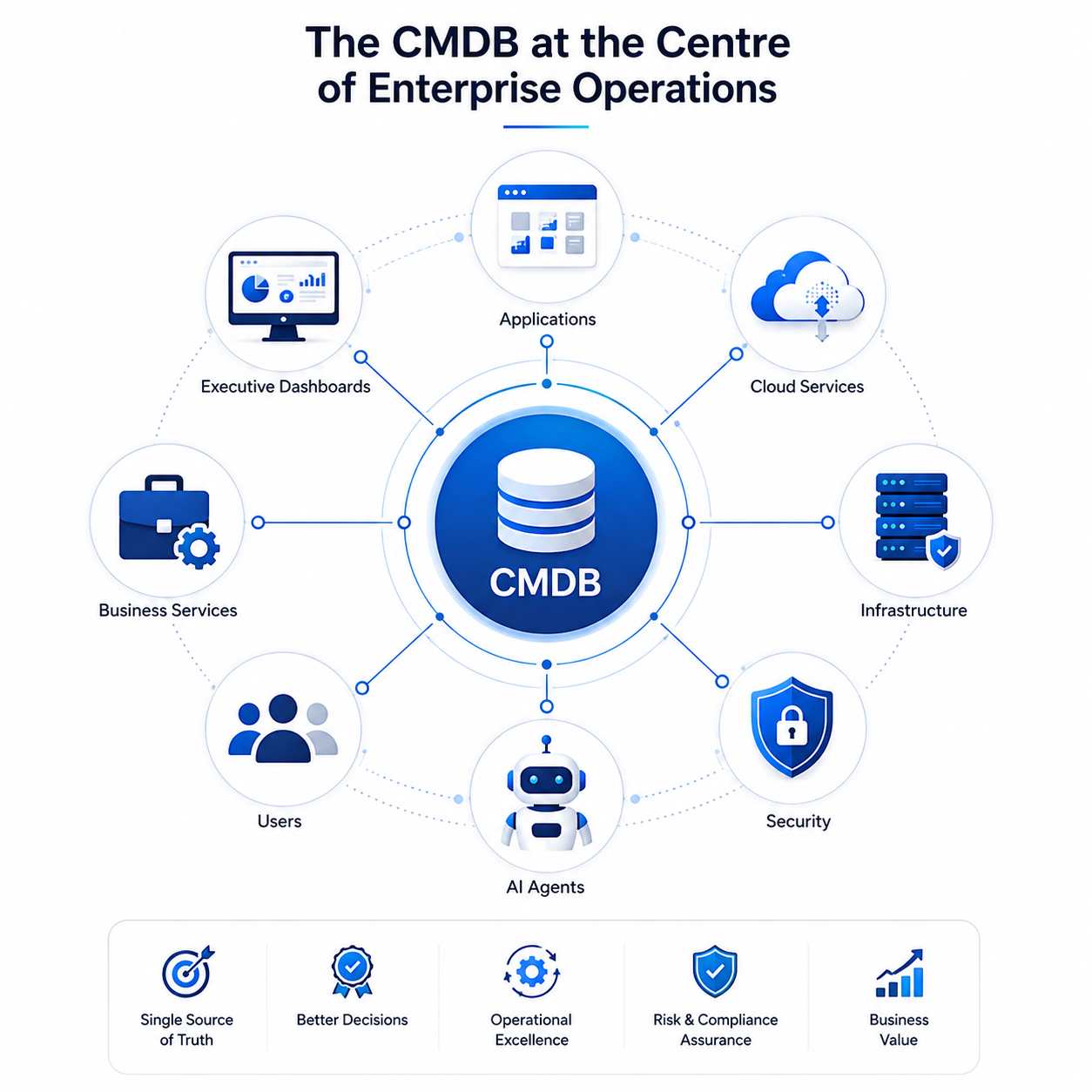
A trusted CMDB is a central repository that stores accurate information about an organisation's technology assets, business services, applications, infrastructure, and their relationships.
How it works in ServiceNow
ServiceNow continuously updates the CMDB through Discovery, Service Mapping, integrations, and governance processes. This creates a living model of the enterprise rather than a static inventory. Instead of simply knowing that a server exists, ServiceNow understands:
- Which applications it supports
- Which business services depend on it
- Which teams own it
- Which customers could be affected by changes
This creates operational context.
Why this matters to executives
Executives make decisions based on business impact rather than infrastructure details.
A trusted CMDB enables leadership teams to answer questions such as:
- Which business services are most critical?
- Which systems create the greatest operational risk?
- Which technology investments support strategic objectives?
- What will happen if this application fails?
Without trusted operational data, AI cannot answer these questions accurately either.
Relationship Data Is the Map AI Uses to Understand Business Impact
Relationship data describes how different technology components depend on one another. It transforms individual assets into a connected operational model.
How it works in ServiceNow
Service Mapping automatically identifies dependencies between applications, databases, servers, containers, cloud resources, and business services. Rather than viewing systems individually, ServiceNow builds an end-to-end service map. This enables AI to understand the potential "blast radius" of operational changes.
For example, restarting a database server may appear to be a minor technical activity. However, relationship data may reveal that it supports multiple customer-facing services, financial systems, and employee applications. The AI can then evaluate business impact before recommending action.
Why this matters to executives
Business leaders rarely ask whether a server is healthy.
They ask:
- Which customers will be affected?
- What revenue is at risk?
- Which services require immediate recovery?
- Which teams should respond?
Relationship data provides AI with the business understanding required to answer these questions confidently.
Data Quality, Ownership and Governance Are the Gatekeepers of Safe AI
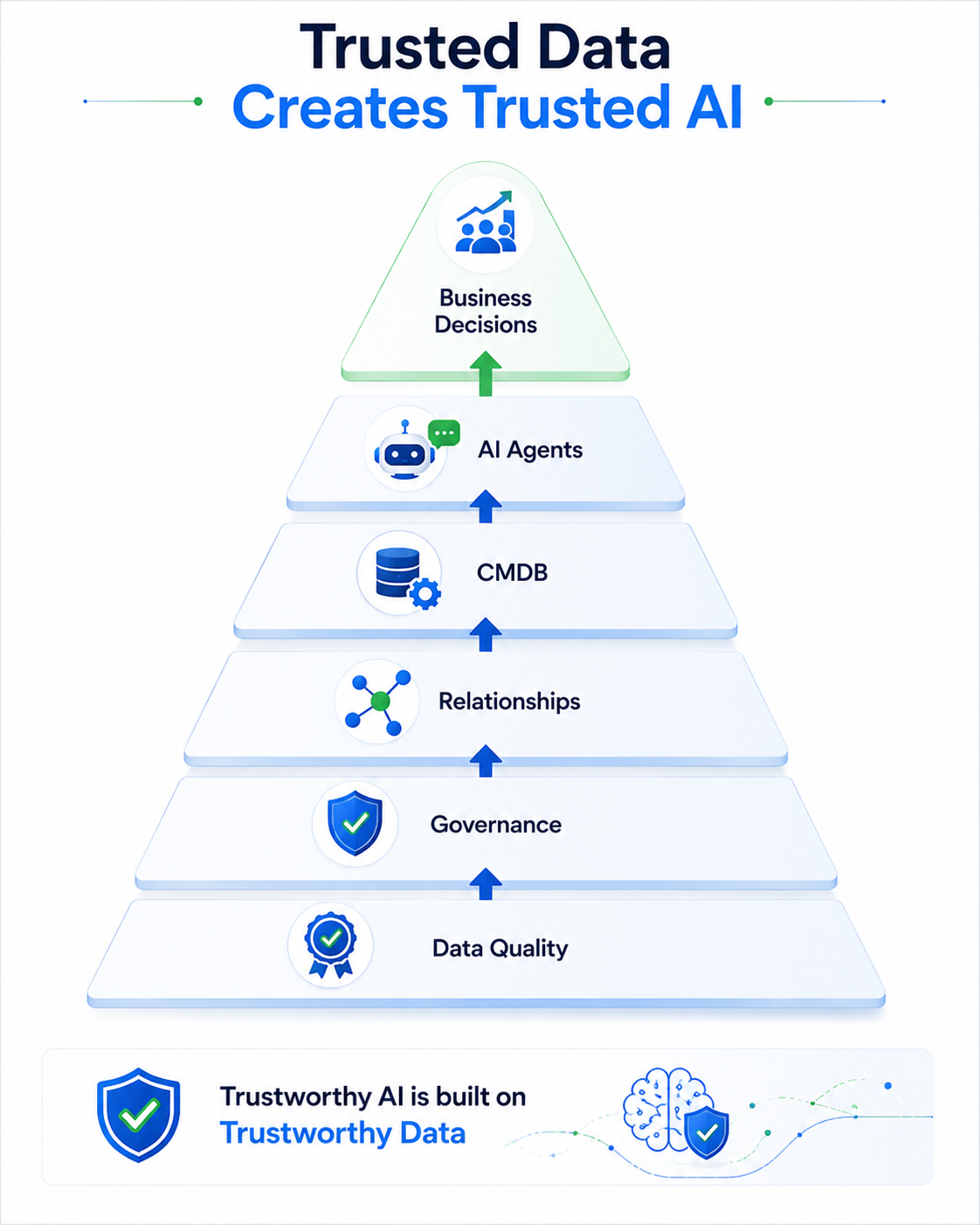
Data quality refers to the accuracy, completeness, consistency, and reliability of information stored within the CMDB. Governance establishes accountability for maintaining that quality.
How it works in ServiceNow
A healthy CMDB depends on clear ownership, automated discovery, validation processes, governance policies, and continuous monitoring. Configuration Items (CIs) should have defined owners responsible for maintaining their accuracy. Governance ensures the CMDB evolves alongside the business rather than gradually becoming outdated.
Why this matters to executives
Poor data quality creates poor AI outcomes. If ownership is unclear or relationships are inaccurate, AI recommendations become less reliable. Executives should view governance as an enabler of trustworthy AI rather than an administrative exercise. High-quality data reduces operational risk, improves audit confidence, and supports responsible AI adoption.
From AI Pilots to Enterprise AI: Why Governance Matters
Many organisations begin with isolated AI experiments. Enterprise AI requires consistent governance, visibility, and operational oversight across the organisation.
How it works in ServiceNow
As organisations deploy more AI capabilities, governance becomes increasingly important. ServiceNow's AI governance capabilities, including concepts such as AI Control Tower, provide visibility into AI usage, policies, risks, models, and operational performance. However, governance is only effective when AI operates using trusted enterprise data. That trusted data starts with the CMDB.
Why this matters to executives
Scaling AI without governance increases operational, security, and compliance risks.
Scaling AI with trusted operational data enables organisations to:
- Maintain visibility
- Reduce risk
- Improve decision quality
- Accelerate innovation responsibly
The strongest AI strategies are built on governance—not assumptions.
Practical Questions Every Executive Should Be Asking
Executive leadership should regularly challenge their teams with questions such as:
- Can we trust our CMDB to support AI-driven decisions?
- Who owns the quality of our operational data?
- Do we understand the relationships between our critical business services?
- Could our AI agents accurately assess business impact during an outage?
- How quickly can we identify affected services after infrastructure changes?
- Are we governing AI with the same discipline we apply to cybersecurity and financial controls?
- What evidence demonstrates that our CMDB remains accurate over time?
These questions shift the conversation from technology implementation to strategic business resilience.
Business Outcomes Leaders Can Expect
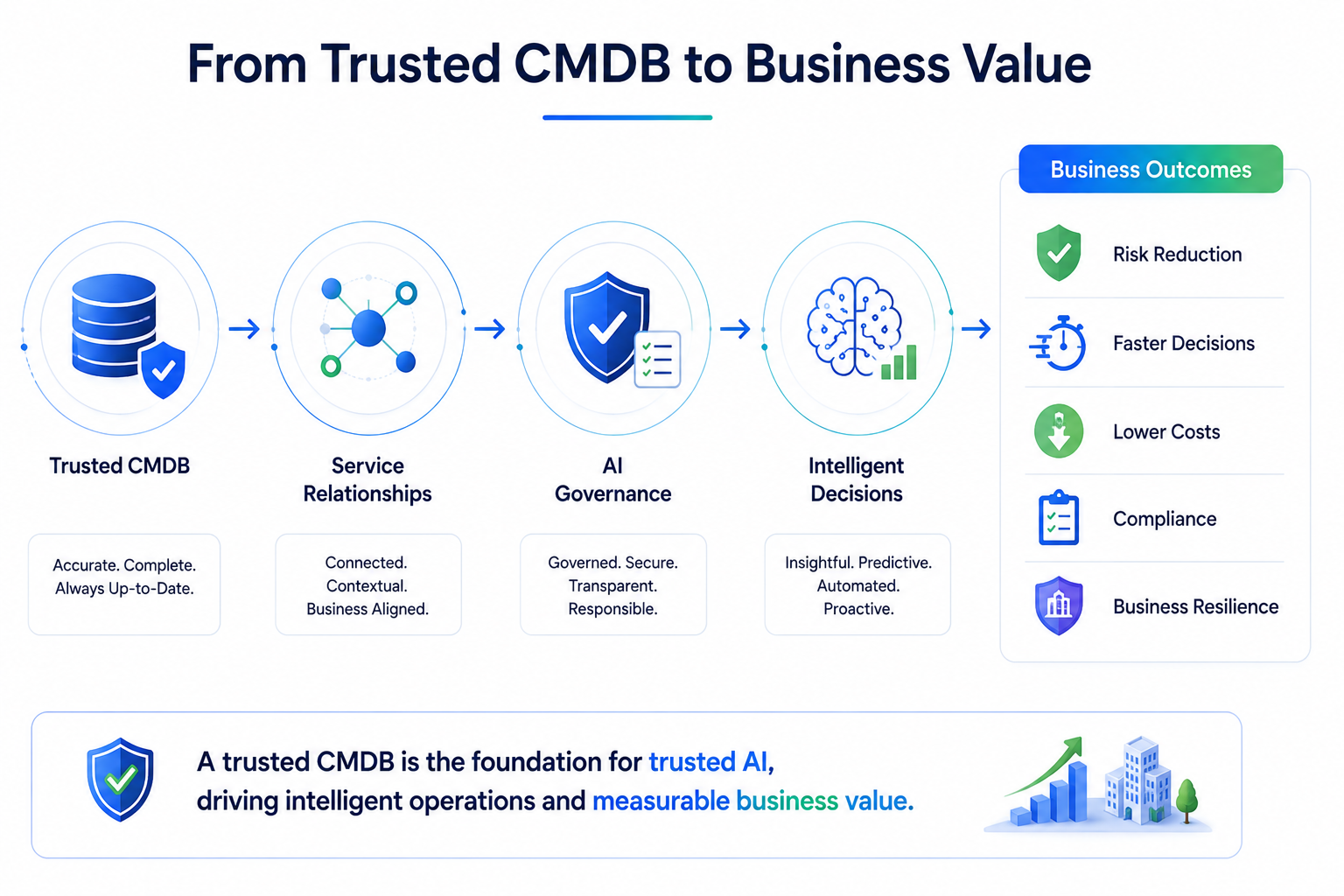
When organisations combine a trusted CMDB with strong governance and AI capabilities, the benefits extend well beyond IT operations.
Leaders can expect:
- Faster and more informed executive decisions
- Lower operational risk
- Improved change success rates
- Better incident prioritisation
- Greater visibility across technology investments
- Stronger audit readiness
- More confident AI governance
- Reduced cost of operational disruption
- Increased organisational resilience
Perhaps most importantly, AI becomes a trusted operational partner rather than an experimental technology.
Conclusion
The conversation around CMDB has fundamentally changed. It is no longer just an operational database maintained by IT teams. It has become the trusted operational foundation upon which enterprise AI depends. As organisations adopt Agentic AI, governance, automation, and intelligent decision-making, the quality of their CMDB will increasingly determine the quality of their AI outcomes. Leaders who treat CMDB health as a strategic business investment, not simply an IT hygiene project, will be better positioned to deploy AI safely, govern it responsibly, and realise sustainable business value.
In 2026 and beyond, the question is no longer whether your organisation is ready for AI. The more important question is whether your data foundation is ready to support it.
Key Takeaways
- A trusted CMDB is the operational foundation that enables Agentic AI to make accurate, context-aware, and business-aligned decisions.
- Relationship data, governance, and ownership are just as important as AI models when scaling enterprise AI safely and responsibly.
- Organisations that invest in CMDB quality today will be better equipped to reduce risk, improve decision-making, and realise long-term value from AI initiatives.