Executive Summary
Artificial Intelligence is no longer an experimental technology. It is rapidly becoming a core component of enterprise operations, customer service, employee productivity, decision-making, and digital transformation.
However, while many organisations are accelerating AI adoption, few have established the governance structures required to scale AI responsibly. As a result, executives are increasingly facing concerns around operational risk, inconsistent outcomes, poor adoption, regulatory compliance, and unclear accountability. The challenge is not the technology itself. The challenge is governance. As organisations move beyond pilot projects and isolated use cases, a new operating model becomes essential: an AI-First Centre of Excellence (COE).
An AI Centre of Excellence provides the governance framework, accountability model, performance standards, and continuous improvement mechanisms needed to scale AI safely while delivering measurable business value. For CIOs, CTOs, Chief Digital Officers, and transformation leaders, the question is no longer whether to implement AI. The question is whether the organisation is prepared to govern AI at enterprise scale.
Why AI Governance Has Become a Board-Level Priority
Historically, technology governance focused on systems, applications, infrastructure, and cybersecurity. AI introduces a fundamentally different challenge. Traditional software is deterministic. Given the same inputs, it produces the same outputs. AI systems are probabilistic.
Probabilistic AI
Probabilistic AI refers to systems that generate outcomes based on patterns and probabilities rather than fixed rules. As a result, outputs can vary depending on context, data quality, prompts, and user interactions. This creates a new governance challenge. An AI solution that performs effectively today may produce different results six months later due to changes in business processes, customer behaviour, knowledge content, data quality, or operational conditions. Without governance, AI performance gradually deteriorates. This is why leading organisations are moving away from project-based AI implementations and towards enterprise AI operating models.
The Current State of Enterprise AI Maturity
Many organisations currently operate within one of three maturity stages.
Stage 1: AI Experimentation
Characteristics:
- Isolated use cases
- Limited governance
- Department-led initiatives
- Minimal business accountability
Common risks:
- Inconsistent outputs
- Low adoption rates
- Unclear ownership
Stage 2: AI Expansion
Characteristics:
- Multiple AI initiatives
- Growing investment
- Increasing executive attention
Common risks:
- Duplicate efforts
- Conflicting standards
- Governance gaps
- Escalating operational risk
Stage 3: AI Governance at Scale
Characteristics:
- Formal AI operating model
- Defined governance framework
- Shared accountability
- Continuous performance monitoring
Benefits:
- Faster deployment
- Improved adoption
- Reduced operational risk
- Stronger ROI
The majority of organisations currently sit between Stages 1 and 2. The challenge is transitioning successfully to Stage 3.
What Is an AI Centre of Excellence?
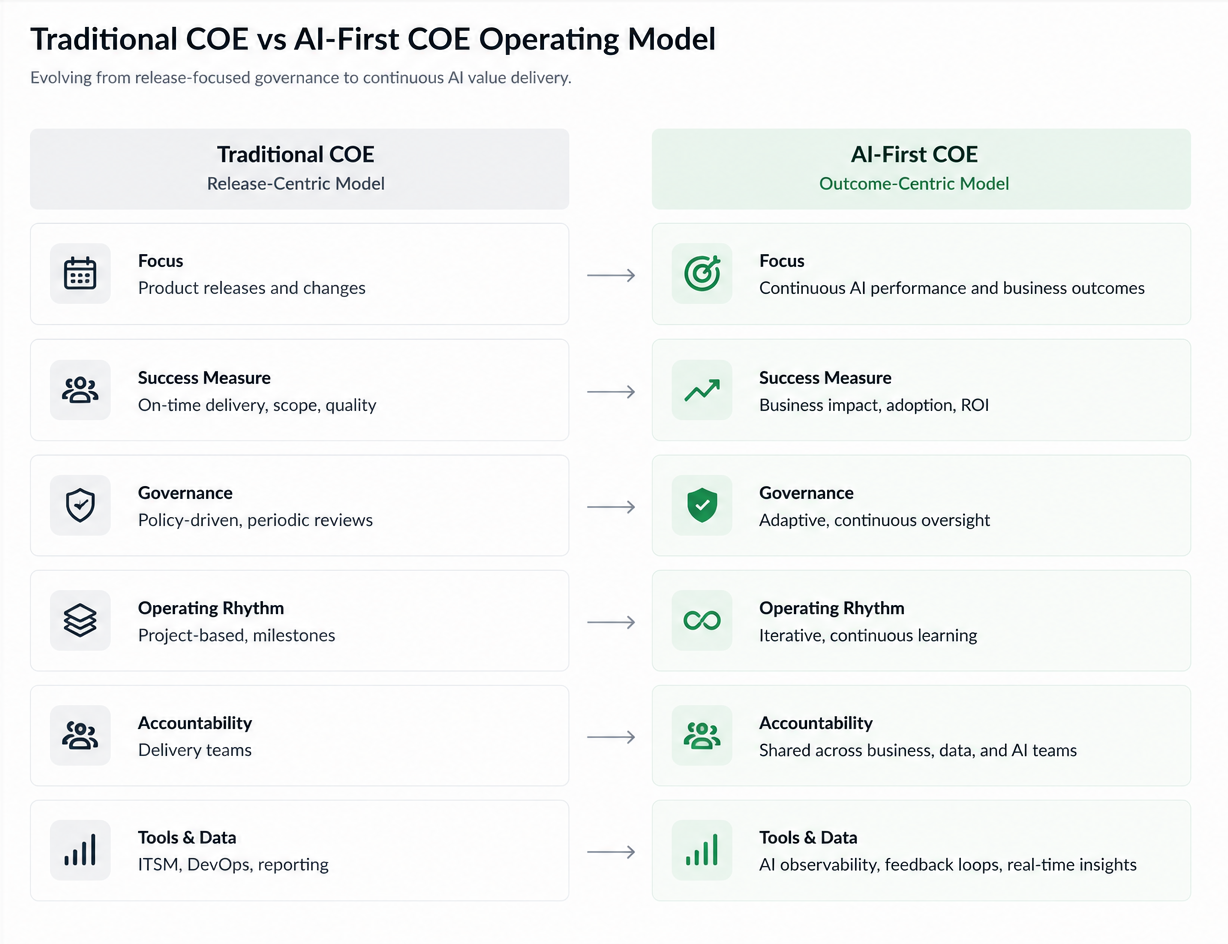
An AI Centre of Excellence is not a project management office. Nor is it simply an IT governance committee. Instead, it functions as an enterprise operating model that establishes how AI is governed, measured, monitored, and continuously improved.
A mature AI COE typically oversees four critical domains:
1. Strategy and Value Management
Responsible for:
- AI roadmap oversight
- Business value measurement
- Investment prioritisation
- Executive governance
2. Business Engagement and Delivery
Responsible for:
- Stakeholder alignment
- Change management
- Adoption programmes
- Training initiatives
3. Platform Architecture and Operations
Responsible for:
- Technical governance
- AI architecture standards
- Data governance
- Platform performance
4. Innovation and Continuous Improvement
Responsible for:
- Identifying new use cases
- Monitoring emerging technologies
- Scaling successful initiatives
Together, these functions create a repeatable framework for AI growth.
Why Traditional Governance Models Fail
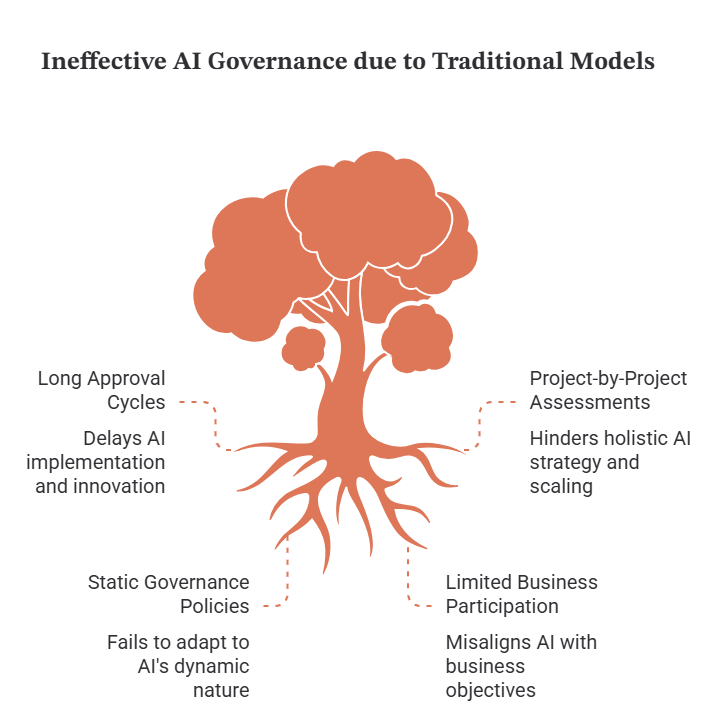
Many organisations attempt to manage AI using governance structures designed for traditional software projects. This approach creates friction.
Traditional governance models typically involve:
- Long approval cycles
- Project-by-project assessments
- Static governance policies
- Limited business participation
AI requires a different approach.
Definition: Continuous Calibration
Continuous Calibration refers to the ongoing monitoring, evaluation, adjustment, and optimisation of AI systems to ensure outputs remain aligned with business objectives and operational requirements.
Unlike traditional software, AI performance must be continuously assessed. Governance becomes a dynamic process rather than a periodic review exercise.
AI Governance Is Now a Business Capability
One of the most significant shifts occurring in enterprise AI is the transfer of accountability. Historically, technology quality was owned primarily by IT teams. AI changes that equation. Because AI outcomes are heavily influenced by business context, governance responsibility must be shared.
Shared Accountability Model
This shared model ensures AI is evaluated based on business outcomes rather than technical metrics alone.
Business Impact Analysis
A well-governed AI programme creates measurable business value across multiple dimensions.
Service Cost Optimisation
Benefits include:
- Reduced manual effort
- Faster case resolution
- Improved automation rates
- Lower support costs
Employee Experience
Benefits include:
- Reduced administrative burden
- Faster access to information
- Improved productivity
- Better decision support
Customer Experience
Benefits include:
- Faster response times
- Consistent service delivery
- Higher satisfaction levels
- Improved self-service capabilities
Risk Reduction
Benefits include:
- Enhanced compliance
- Stronger governance controls
- Improved auditability
- Reduced operational disruptions
Operational Risk Assessment
Without governance, AI introduces several enterprise risks.
Risk 1: Poor Data Quality
AI systems are only as effective as the information they consume.
Poor data quality can result in:
- Incorrect recommendations
- Reduced trust
- Inaccurate outputs
Risk 2: Knowledge Decay
Knowledge bases evolve constantly.
If AI systems rely on outdated information, performance degrades rapidly.
Risk 3: Adoption Failure
Many AI initiatives fail not because of technology limitations but because users do not trust or understand the solution.
Risk 4: Governance Gaps
Undefined ownership often creates confusion around:
- Escalations
- Compliance
- Performance monitoring
- Accountability
Root Cause Analysis: Why AI Programmes Fail
Enterprise AI failures commonly stem from five root causes:
- Lack of executive sponsorship
- Poor governance frameworks
- Limited business engagement
- Inadequate change management
- Absence of continuous evaluation
Interestingly, technology is rarely the primary cause. Governance is.
Benchmark Comparison
Leading AI organisations typically demonstrate the following characteristics:
High Performers
Capability
Low Performers
The gap between high and low performers is rarely technical capability.
It is governance maturity.
Quick Wins Register
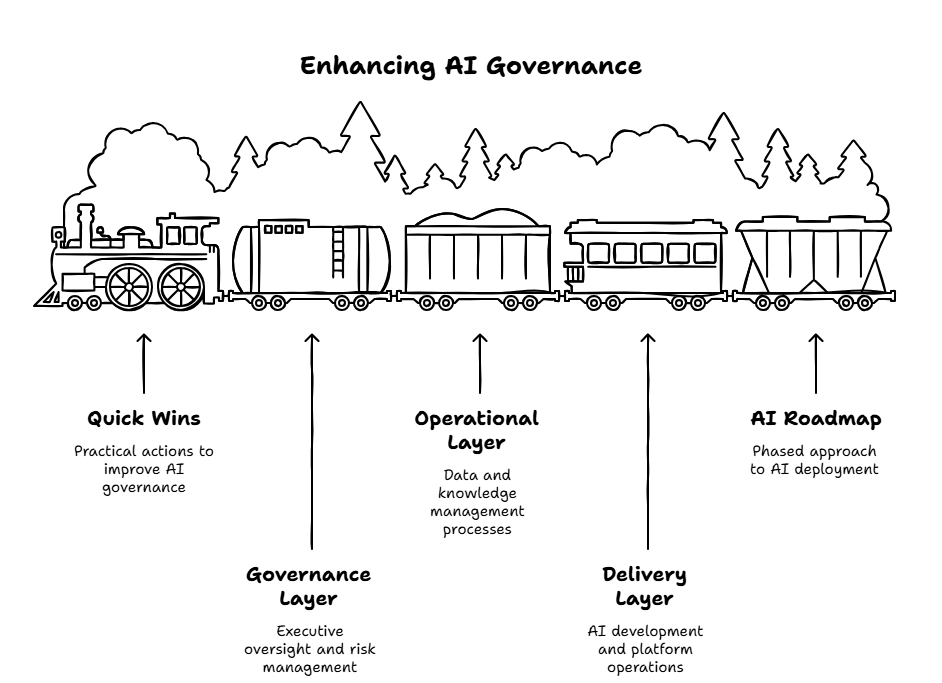
Organisations looking to improve AI governance can begin with several practical actions.
Quick Win #1
Assign ownership for:
- Data governance
- Knowledge governance
- AI performance monitoring
- Change management
Quick Win #2
Create executive AI KPIs including:
- Adoption rates
- Productivity gains
- Customer satisfaction
- Cost reduction
Quick Win #3
Establish monthly governance reviews focused on:
- Performance trends
- Risk assessment
- Opportunity identification
Target Operating Model Recommendations
A future-state AI operating model should include:
Governance Layer
- Executive steering committee
- AI Centre of Excellence
- Risk and compliance oversight
Operational Layer
- Data management
- Knowledge management
- Evaluation processes
- Change management
Delivery Layer
- AI development
- Platform operations
- Continuous optimisation
This structure enables scalable and repeatable AI deployment across the enterprise.
AI Roadmap for Enterprise Leaders
Phase 1: Foundation
- Establish governance framework
- Define ownership
- Create baseline policies
Phase 2: Crawl
- Launch pilot use cases
- Implement monitoring
- Begin adoption programmes
Phase 3: Walk
- Expand automation
- Standardise governance
- Formalise KPIs
Phase 4: Run
- Scale AI across business units
- Implement advanced governance controls
Phase 5: Fly
- Enable autonomous AI capabilities
- Optimise continuously
- Drive enterprise-wide innovation
Three Key Takeaways for Executives
1. AI Governance Is Now a Business Capability, Not an IT Function
Successful AI programmes require collaboration between business leaders, process owners, and technology teams.
2. AI Quality Ownership Must Be Shared Between Business and Technology Teams
AI outcomes are influenced by business context, data quality, operational processes, and technical design.
3. Organisations with Structured AI Governance Scale Faster and Reduce Risk
A formal AI Centre of Excellence accelerates adoption, improves performance, reduces operational risk, and creates a foundation for long-term AI maturity.
This article is designed as the flagship pillar piece in the three-part Tinyloop AI Governance & Maturity Series and can be internally linked to the future articles on AI Governance Pipelines and AI Maturity Models.