Many organizations today are asking the same question

We know AI is important but where do we actually start?
For some businesses, the challenge is not technology.
It’s understanding how AI fits into operations, customer experience, governance, and day-to-day decision-making. Because the reality is:
You cannot simply “switch on AI” and expect enterprise outcomes.
- AI needs connected systems.
- It needs trusted data.
- It needs operational context.
And most importantly, it needs a business strategy behind it.
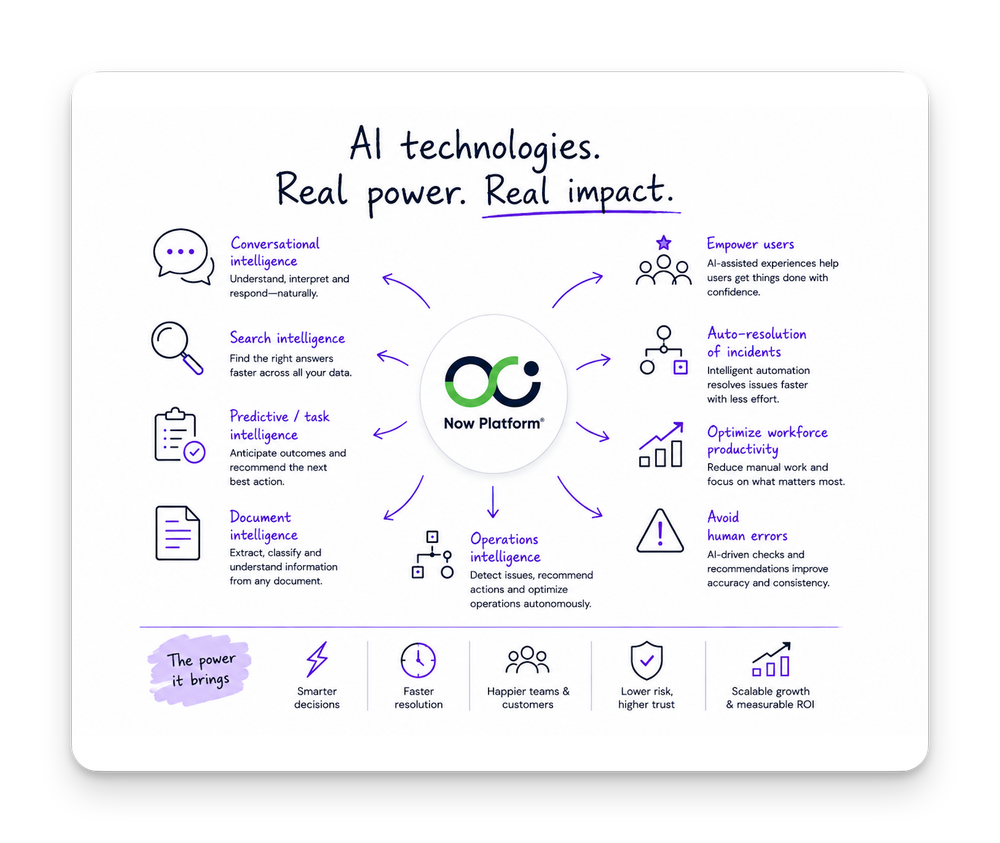
AI Vision in the Now Platform
FAQ
01/02
So why are organisations investing in AI now?
Because leaders are under pressure to do more with less and Teams are overwhelmed with manual work. Customers expect faster responses and Operations are becoming more complex. And decision-making is often slowed down by disconnected systems and fragmented information.
Organisations are looking for ways to:
- Improve productivity without increasing overheads
- Respond faster to changing business needs
- Reduce operational inefficiencies
- Deliver better employee and customer experiences
- Create scalable and intelligent digital operations
AI has become the catalyst that helps make this possible but only when it is implemented correctly.
Where does AI actually create value?
The answer is not in isolated tools.
The real value comes when AI is embedded into operational workflows and enterprise services. Imagine:
- Employees resolving issues faster with AI-assisted recommendations
- Customers receiving intelligent self-service experiences
- Service teams automatically identifying risks before incidents escalate
- Repetitive operational tasks being handled autonomously
- Leaders gaining real-time operational insights across the business
This is where AI moves from experimentation to measurable business outcomes.
So what does successful AI adoption actually require?
It requires more than deploying a new technology platform and building an intelligent operational foundation where:
- Systems are connected
- Workflows are standardised
- Data is trusted
- Governance is established
- Business policies are clearly defined
- AI operates within enterprise controls and context
This is why AI readiness has become just as important as AI capability.
01/03

But here’s the challenge many organisations face …
Most businesses were not originally designed for AI. Over time, systems became fragmented and Processes evolved independently. Knowledge became siloed and Teams adopted disconnected platforms.
As a result, many organizations now struggle with:
- Inconsistent workflows
- Duplicate data
- Manual approvals and bottlenecks
- Limited visibility across operations
- Low confidence in automation outcomes
And this creates a critical problem:
AI can only be as effective as the operational foundation beneath it.
How we can help?
Where can AI create the greatest business value?
We help identify high-impact opportunities where AI can improve productivity, reduce operational effort, enhance customer experiences, and accelerate decision-making. Our focus is on practical business outcomes not just technology adoption.
Which operational areas should be prioritised first?
We assess your current operational maturity and identify the workflows, services, and teams that will deliver the fastest and most measurable value from AI adoption. This helps organizations avoid low-value experimentation and focus on strategic impact.
Is the organisation ready for enterprise AI adoption?
Our AI readiness assessments evaluate your processes, data, integrations, governance, and operational structure to determine how prepared your organization is for scalable AI adoption and where foundational gaps exist.
How should governance and risk be managed?
We help establish governance frameworks, operational guardrails, and responsible AI practices to ensure AI is secure, compliant, transparent, and aligned with business and regulatory requirements.
What foundations need to be modernised before scaling AI?
Successful AI depends on connected systems, trusted data, streamlined workflows, and operational visibility. We help modernize these foundational capabilities to ensure AI can operate effectively across the enterprise.
How can AI outcomes be measured effectively?
We define measurable success criteria, KPIs, and value realisation frameworks that help organisations track adoption, operational improvements, productivity gains, and business impact over time.