
Executive Summary
As organisations continue their digital transformation journeys, the Configuration Management Database (CMDB) remains one of the most critical components of the ServiceNow platform. Yet many organisations still struggle with inaccurate data, poor governance, duplicate records, and disconnected service relationships. In 2026, CMDB success is no longer just about maintaining an inventory of assets. It is about creating a trusted data foundation that supports IT Operations, Security Operations, Change Management, AI initiatives, and the emerging world of Agentic AI. For CIOs, IT Directors, Service Owners, and Platform Leaders, the CMDB has become a strategic business asset. A healthy CMDB improves operational efficiency, reduces risk, accelerates incident resolution, enables automation, and provides the contextual intelligence required for AI-powered decision-making.
This article explores ten practical CMDB best practices that every ServiceNow leader should implement to build a trusted, scalable, and AI-ready CMDB.
Why CMDB Matters More Than Ever
What is a CMDB?
A Configuration Management Database (CMDB) is a central repository that stores information about an organisation's Configuration Items (CIs). These items include applications, servers, cloud resources, databases, network devices, and business services. In addition to storing information about these assets, the CMDB records the relationships between them, allowing organisations to understand how their technology environment supports critical business operations.
In simple terms, a CMDB helps answer three important questions. It tells you what technology assets your organisation owns, how those assets are connected, and which business services could be affected if a system changes or fails. This visibility enables IT teams to make informed decisions, respond to issues more effectively, and reduce the risk of unexpected service disruptions.
As ServiceNow continues to invest in artificial intelligence (AI), Knowledge Graphs, and Agentic AI, the quality of CMDB data has become increasingly important. A well-maintained CMDB is no longer just an operational tool—it is becoming a critical foundation for organisations looking to adopt AI-driven capabilities successfully.
1. Define a Clear CMDB Strategy
A CMDB strategy defines the purpose, scope, ownership, and expected outcomes of your CMDB programme. It provides a clear direction for how the CMDB will be developed, managed, and used across the organisation. Many organisations make the mistake of trying to populate every Configuration Item class from the beginning. While this may seem like a comprehensive approach, it often creates unnecessary complexity and leads to poor data quality. Instead, organisations should begin by establishing clear business objectives, assigning ownership for maintaining data, defining governance processes, setting measurable success criteria, and creating a roadmap for future expansion.
A well-planned CMDB strategy should support key business and IT processes, including Incident Management, Change Management, Risk Management, Service Mapping, and emerging AI initiatives. Without a clear strategy, the CMDB can quickly become a collection of outdated or unreliable information rather than a trusted source of truth that the business can depend on.
2. Start with Business-Critical Services
Business services represent the technology capabilities that enable an organisation to deliver important outcomes to its customers and employees. These services may include customer portals, payroll systems, enterprise resource planning (ERP) platforms, online banking applications, or patient management systems. These are the services that organisations rely on every day to operate effectively. Rather than attempting to discover and manage thousands of infrastructure components at the start, organisations should focus on mapping the business services that have the greatest impact on daily operations. Beginning with these critical services allows IT teams to demonstrate value more quickly while building a strong foundation for future CMDB growth.
This approach improves visibility into how business services are supported by technology, enables faster prioritisation of incidents, and helps stakeholders better understand the impact of system changes or outages. It also provides tangible business outcomes early in the programme, making it easier to gain executive support and secure continued investment in the CMDB initiative.
3. Build a Healthy CSDM Foundation
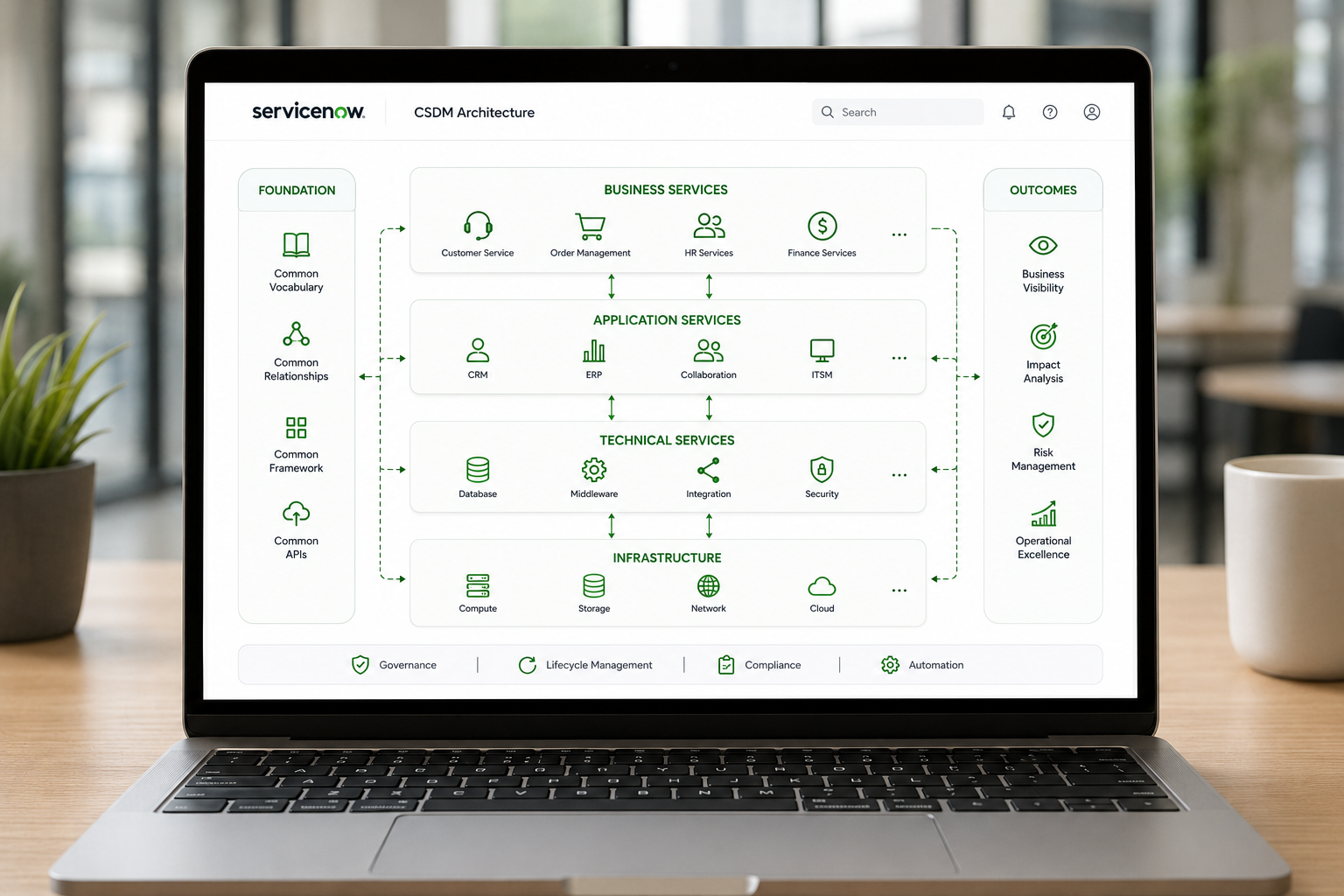
The Common Service Data Model (CSDM) is ServiceNow's framework for organising service-related data consistently across the platform.
CSDM provides standard structures for:
- Business applications
- Technical services
- Business services
- Application services
- Service offerings
A strong CSDM foundation creates consistency between:
Without CSDM alignment, organisations often create disconnected data structures that reduce reporting accuracy and automation effectiveness.
4. Improve Discovery Accuracy
ServiceNow Discovery is an automated capability that identifies infrastructure assets across your IT environment and populates the CMDB with Configuration Items (CIs) and their relationships. It can discover a wide range of technology assets, including servers, databases, network devices, cloud resources, and applications. By automatically collecting this information, Discovery reduces the need for manual data entry and helps keep the CMDB up to date.
However, Discovery is only as effective as its configuration. Many organisations experience challenges such as invalid or expired credentials, network segmentation that blocks communication, misconfigured MID Servers or probes, and missing integrations with cloud platforms. These issues can prevent Discovery from identifying assets accurately, resulting in incomplete or outdated CMDB data.
To improve Discovery accuracy, organisations should regularly validate credentials, review Discovery schedules, optimise cloud connectors, and establish processes for managing exceptions. Routine monitoring and maintenance help ensure that Discovery continues to identify assets reliably as the IT environment evolves. Accurate Discovery not only reduces manual effort but also improves the overall health of the CMDB, providing a more reliable foundation for IT operations, service management, and AI-driven initiatives.
5. Eliminate Duplicate Configuration Items
Duplicate Configuration Items (CIs) occur when the same technology asset is recorded multiple times in the CMDB. For example, a single server may appear as multiple records, an application could be entered more than once, or the same cloud resource may be discovered repeatedly from different data sources. These duplicates make it difficult to determine which record is accurate and can reduce confidence in the CMDB. An inaccurate CMDB can have significant consequences. Duplicate records often lead to incorrect reports, unreliable service maps, inaccurate change impact assessments, and security risks caused by incomplete or conflicting information. As organisations increasingly rely on the CMDB to support automation, AI, and operational decision-making, maintaining clean and consistent data becomes even more important.
ServiceNow provides several capabilities to help prevent duplicate records. The Identification and Reconciliation Engine (IRE) ensures that information from multiple discovery sources is consolidated into a single trusted record. Organisations should also establish clear data source rules and implement dashboards to monitor and identify duplicate Configuration Items. A clean CMDB provides a trusted source of information, enabling teams to make confident decisions based on accurate and reliable data.
6. Establish Ownership and Governance
CMDB governance is the process of defining how the CMDB is managed, maintained, and continuously improved. It establishes accountability by assigning responsibility for the quality and accuracy of Configuration Item data. Effective governance ensures that the CMDB remains reliable as the organisation grows and its technology environment becomes more complex. Every Configuration Item class should have clearly defined ownership. This typically includes a data owner who is responsible for the accuracy of the information, a process owner who ensures the CMDB supports business and IT processes effectively, and a technical steward who manages the ongoing maintenance of the data. Clearly defining these roles helps ensure that issues are addressed promptly and that the CMDB remains aligned with business objectives.
Strong governance also requires regular review meetings, data quality audits, agreed data standards, and clear escalation processes for resolving issues. These activities help maintain the integrity of the CMDB and prevent data quality from declining over time. This is where many organisations face their greatest challenge—not because the technology is inadequate, but because ownership and accountability are not clearly defined. When governance is supported by well-defined responsibilities and consistent processes, the CMDB becomes a trusted source of truth that supports operational excellence, informed decision-making, and long-term business success.
7. Measure CMDB Health Continuously
Definition
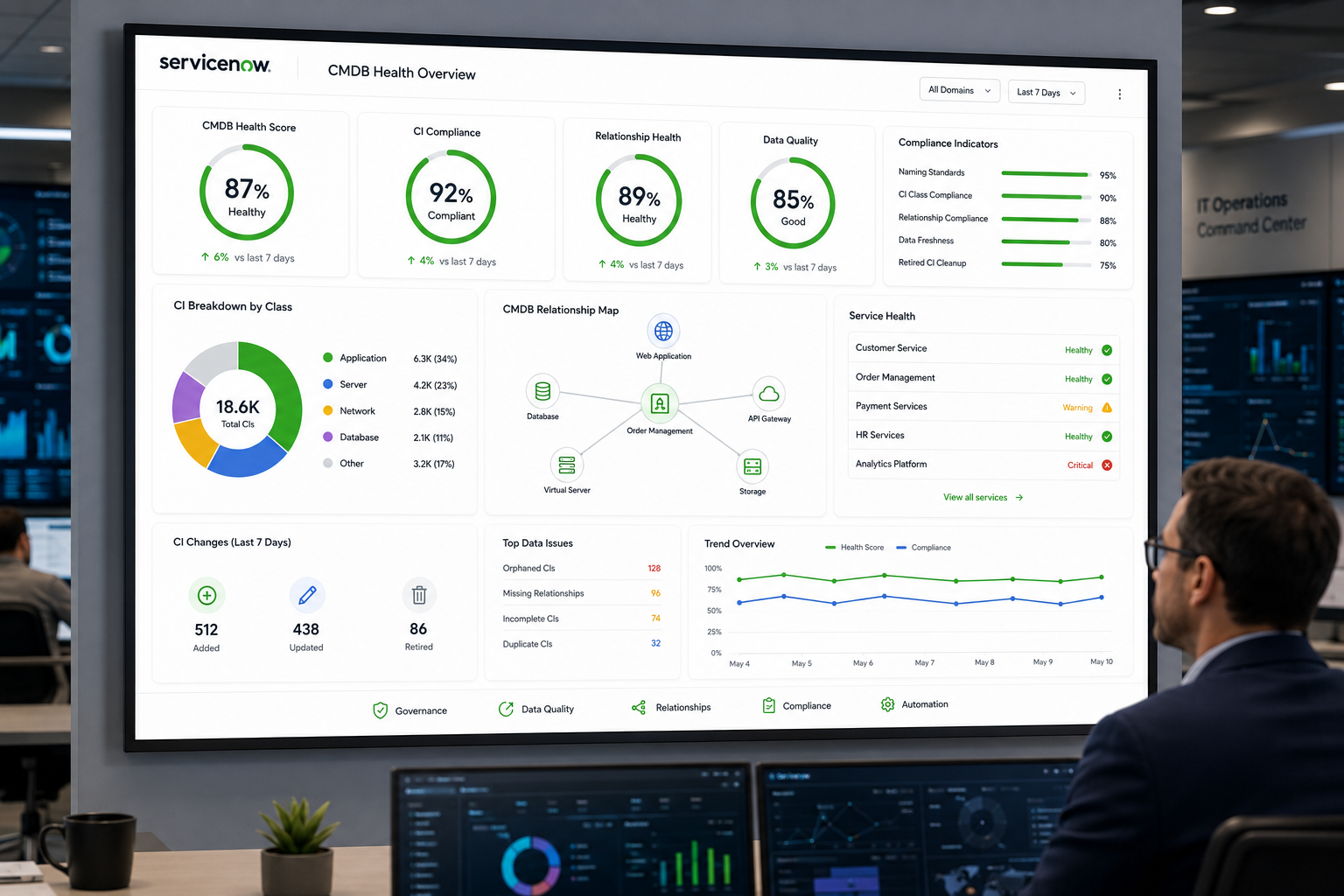
CMDB Health measures the quality and reliability of CMDB data. ServiceNow evaluates three primary dimensions:
Completeness
Are required attributes populated?
Correctness
Is the information accurate?
Compliance
Does the data align with governance standards?
Recommended KPIs include:
- Duplicate rate
- Orphan CI percentage
- Relationship completeness
- Discovery coverage
- CI ownership coverage
Continuous measurement transforms CMDB management from reactive to proactive.
Business Impact Analysis
A healthy CMDB delivers measurable business value that extends far beyond IT operations. When Configuration Item data is accurate, complete, and well-governed, organisations gain greater visibility into their technology environment and can make faster, more informed decisions. This enables IT teams to respond to incidents more efficiently, understand the impact of system changes, and reduce operational risks. Organisations with a well-maintained CMDB typically experience faster incident resolution because support teams can quickly identify affected systems and understand how they are connected. They also see fewer change-related failures, as accurate dependency information allows teams to assess potential impacts before implementing changes. In addition, a healthy CMDB improves service visibility by providing a clear view of the technology that supports critical business services, making it easier to manage performance and maintain service reliability. A trusted CMDB also strengthens an organisation's security posture by helping security teams identify assets more accurately, understand system relationships, and respond to vulnerabilities more effectively. Furthermore, reliable CMDB data creates more opportunities for automation, enabling organisations to streamline workflows, reduce manual effort, and improve operational efficiency.
Ultimately, a healthy CMDB provides the foundation for several key business outcomes. It enhances the employee experience by reducing service disruptions and improving the quality of IT support. It helps optimise service delivery costs by enabling more efficient operations and reducing unnecessary manual work. It also lowers operational risk by providing accurate information for incident, change, and risk management processes. As organisations continue to adopt artificial intelligence, a high-quality CMDB becomes even more valuable, serving as a critical foundation for AI maturity and enabling AI-driven insights, automation, and decision-making.
8. Automate Lifecycle Management
Lifecycle management is the process of ensuring that Configuration Items (CIs) remain accurate and up to date throughout their entire lifecycle. Every technology asset follows a journey, beginning with procurement, continuing through deployment, operation, and maintenance, and eventually reaching retirement. Keeping the CMDB aligned with each stage of this lifecycle is essential for maintaining accurate and reliable data. Many organisations struggle to keep Configuration Item information current because updates are often performed manually. As technology environments become more complex, manual processes can lead to outdated records, inconsistent data, and increased operational risk. An effective lifecycle management approach ensures that changes to Configuration Items are reflected in the CMDB as they occur, providing a trusted view of the organisation's technology landscape.
Automation plays a critical role in improving lifecycle management. ServiceNow can automatically create Configuration Item records when new assets are deployed, update lifecycle status as assets move through different stages, synchronise information with asset management systems, and trigger retirement workflows when assets are decommissioned. These automated processes reduce the need for manual intervention, minimise human error, and ensure that the CMDB remains accurate and consistent over time. By automating lifecycle management, organisations can improve data quality, increase operational efficiency, and build greater confidence in the information stored within the CMDB. A well-maintained and continuously updated CMDB provides a strong foundation for IT operations, service management, governance, and AI-driven capabilities, enabling organisations to make better decisions with reliable and timely information.
9. Integrate CMDB with ITSM, ITOM, SecOps and Change
Integration ensures CMDB data becomes actionable across ServiceNow workflows.
ITSM
Provides impact analysis for incidents and requests.
ITOM
Supports event management, discovery, and service mapping.
Security Operations
Enables vulnerability and threat prioritisation.
Change Management
Improves risk assessments before changes are implemented.
The more integrated the CMDB becomes, the greater the business value it delivers.
Operational Deliverables Supported by CMDB
A mature CMDB enables:
Root Cause Analysis: Identify affected services faster.
Incident Trend Analysis: Understand recurring technology issues.
SLA Analysis: Measure service performance accurately.
Process Pain Point Assessment: Identify workflow bottlenecks
Workflow Assessment: Improve process efficiency.
Platform Optimisation Opportunities: Reduce technical debt and redundant technologies.
10. Prepare the CMDB for AI and Agentic AI
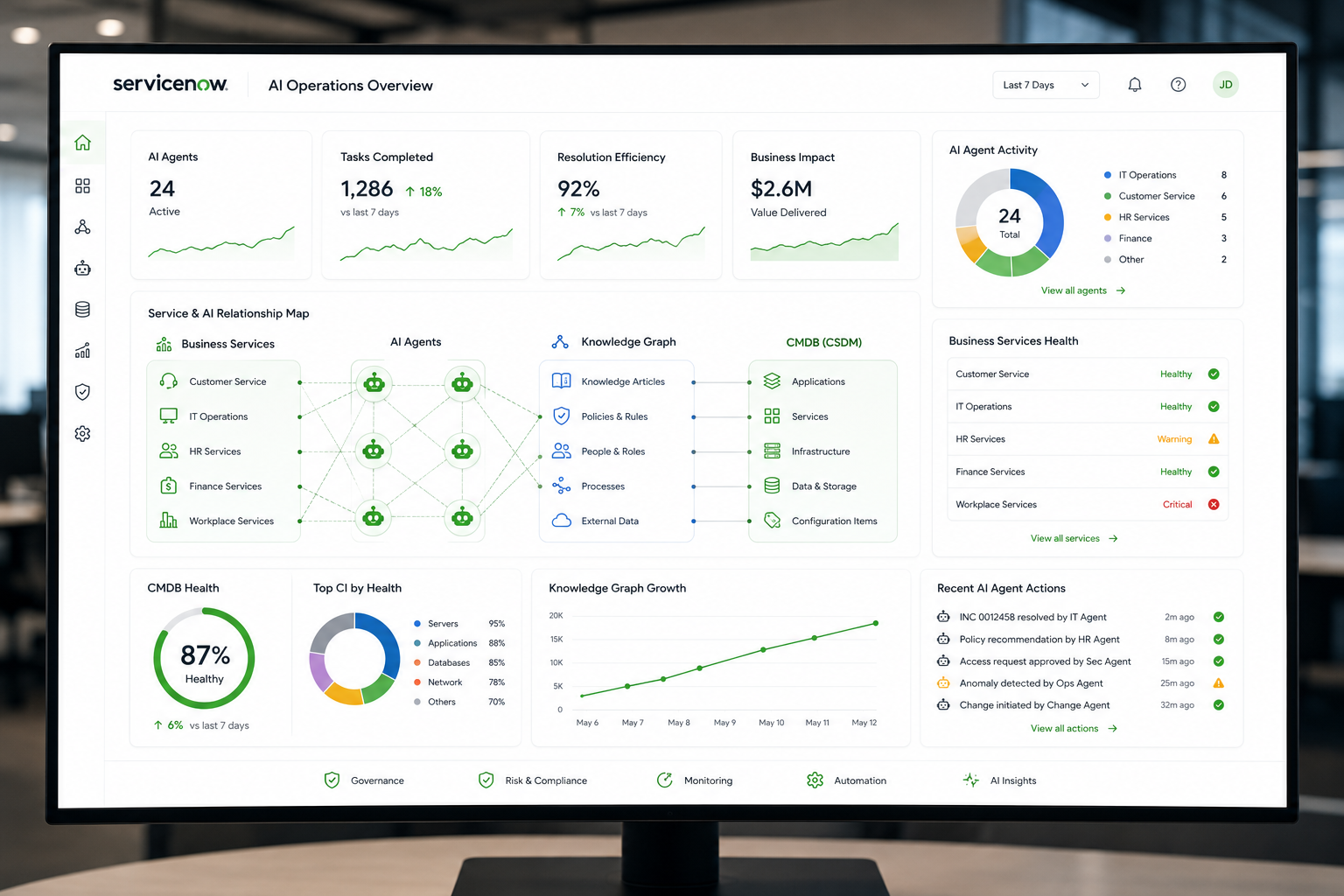
Agentic AI represents the next evolution of artificial intelligence. Unlike traditional Generative AI, which primarily creates content or responds to prompts, Agentic AI can make decisions, initiate workflows, and perform actions with minimal human intervention. To operate effectively, however, these AI systems require a deep understanding of the organisation's business and technology environment. This business context is what enables AI to make accurate, informed, and reliable decisions. A healthy CMDB provides much of this essential context. It works alongside the Knowledge Graph, Service Maps, service relationships, and workflow data to create a connected view of the organisation's technology landscape. Together, these capabilities help AI understand how systems interact, which business services they support, and how changes or incidents may affect the wider organisation. Without this contextual information, AI cannot accurately assess the impact of its decisions or automate complex business processes with confidence.
When the CMDB contains incomplete, outdated, or inaccurate information, the effectiveness of AI is significantly reduced. AI-generated recommendations become less reliable, automated workflows are more likely to produce incorrect results, and risk assessments may overlook critical dependencies or business impacts. As organisations increasingly adopt AI-driven operations, the quality of CMDB data becomes a key factor in determining the success of these initiatives. ServiceNow's long-term AI strategy places the CMDB at the centre of its intelligent platform. Capabilities such as the Knowledge Graph, AI Agents, AI Control Tower, and Workflow Data Fabric all depend on accurate and well-connected data to deliver meaningful insights and autonomous decision-making. The CMDB acts as the foundation that connects these capabilities, enabling AI to understand the relationships between technology, business services, and operational processes.
In many respects, the maturity of an organisation's CMDB is becoming a strong indicator of its overall AI maturity. Organisations with accurate, governed, and well-maintained CMDBs are better positioned to adopt advanced AI capabilities, automate business processes, improve operational efficiency, and make more confident, data-driven decisions.
Current State Maturity Assessment
Organisations should regularly assess the maturity of their CMDB to ensure it continues to support both current operations and future AI initiatives. A good starting point is to evaluate whether clear ownership has been established for the CMDB and whether business-critical services have been identified and mapped. These foundations help ensure that the information within the CMDB remains accurate, relevant, and aligned with business priorities. It is equally important to assess whether the Common Service Data Model (CSDM) has been fully adopted, whether ServiceNow Discovery covers the majority of the technology environment, and whether duplicate Configuration Items are actively monitored and managed. Organisations should also review their CMDB Health scores regularly to measure improvements in data quality and identify areas that require attention.
Another important consideration is how well the CMDB is integrated across the broader ServiceNow platform. A mature CMDB should support key business processes across IT Service Management (ITSM), IT Operations Management (ITOM), and Security Operations (SecOps), providing a consistent and trusted source of information for every team. Finally, organisations should evaluate whether their CMDB is actively supporting AI initiatives by providing the accurate, connected data needed for intelligent automation and AI-driven decision-making.
Organisations that can confidently answer "yes" to most of these questions are typically in a much stronger position to embrace AI-powered operations. They are more likely to have the reliable data, governance, and operational maturity needed to unlock the full value of ServiceNow's evolving AI capabilities while reducing risk and improving business outcomes.
Benchmark Comparison
High-performing organisations typically demonstrate
Capability
Mature Organisations
Less Mature Organisations
Service Mapping
Discovery Coverage
CSDM Adoption
AI Readiness
Formal ownership
>90%
Enterprise-wide
Automated
Continuous
High
Ad hoc management
<60%
Partial
Manual
Periodic
Low
Strategic Deliverables Enabled by a Mature CMDB
A trusted CMDB supports:
Quick Wins Register: Identify immediate improvement opportunities.
Prioritised Recommendations: Focus investment where business value is highest.
AI Opportunities Assessment: Determine where AI can automate processes.
Target Operating Model Recommendations: Align people, process, and technology.
Implementation Roadmap: Create a phased transformation plan.
Conclusion
In 2026, the CMDB is no longer just a technical repository; it is a strategic business asset. Organisations that invest in CMDB governance, Discovery accuracy, CSDM adoption, service mapping, and continuous health monitoring create a trusted foundation for operational excellence, service cost optimisation, and AI-driven transformation.
As ServiceNow advances toward the Autonomous Enterprise through Agentic AI, Knowledge Graphs, and intelligent workflow automation, the quality of your CMDB will increasingly determine the success of your AI initiatives. The question for ServiceNow leaders is no longer whether they need a CMDB. The question is whether their CMDB is healthy enough to support the future of AI, automation, and digital operations.
Key Takeaways
1. A healthy CMDB is the foundation of IT operations, governance, and AI readiness.
2. CSDM, Discovery, governance, and continuous health monitoring are essential for long-term CMDB success.
3. Organisations with trusted CMDB data are better positioned to adopt ServiceNow AI, Agentic AI, and Autonomous Enterprise capabilities.