Executive Summary
Artificial Intelligence has quickly moved from experimentation to enterprise priority. Boards are discussing it. Executives are investing in it. Employees are using it. Customers increasingly expect it. Yet despite significant investment, many organisations struggle to move beyond isolated AI pilots and achieve measurable business outcomes at scale.
The challenge is not access to AI technology. The challenge is organisational maturity. Many organisations mistakenly assume that implementing AI tools automatically creates AI maturity. In reality, AI maturity is achieved through governance, operational discipline, employee adoption, continuous evaluation, and a structured operating model. The most successful organisations understand that AI transformation is a journey rather than a technology deployment. They progress through defined maturity stages, gradually increasing AI capabilities while maintaining governance, accountability, and business alignment. This article explores the "Foundation to Fly" AI Maturity Model, a practical framework that helps organisations assess their current state, identify gaps, reduce operational risk, optimise service delivery, and accelerate digital transformation.
For CIOs, CTOs, Chief Digital Officers, and transformation leaders, AI maturity has become one of the most important indicators of long-term business competitiveness.
Why AI Maturity Matters
Many organisations are currently experiencing what could be described as the "AI Excitement Gap." Executives see extraordinary potential. Employees experiment with AI tools.
Technology teams deploy pilots. Yet business outcomes often fail to match expectations. The reason is simple. Technology adoption does not automatically create organisational maturity.
Definition: AI Maturity
AI Maturity refers to an organisation's ability to govern, manage, scale, measure, and continuously optimise AI capabilities to achieve sustainable business outcomes.
A mature AI organisation does not simply use AI. It systematically manages AI as a business capability. This distinction separates industry leaders from organisations struggling to scale.
The Five Stages of AI Maturity
A structured maturity framework provides a roadmap for sustainable AI growth.
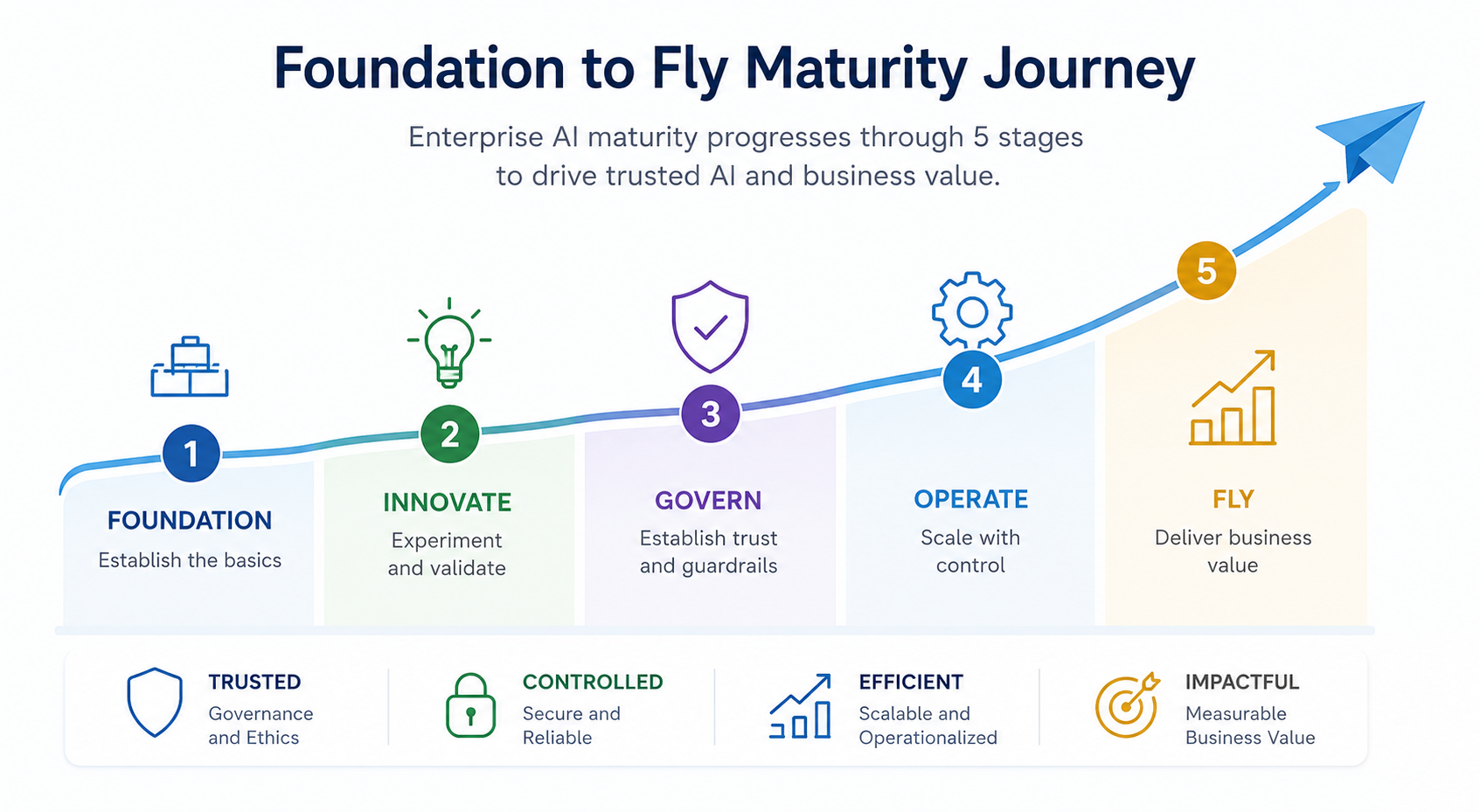
The maturity journey can be divided into five progressive stages:
- Foundation
- Crawl
- Walk
- Run
- Fly
Each stage builds upon the capabilities established in the previous stage. Skipping stages often introduces unnecessary risk.
Stage 1: Foundation
The Foundation stage is the first and most important step in an organisation’s AI journey. During this phase, the organisation prepares itself for successful AI adoption by establishing clear governance, leadership support, reliable data, knowledge management practices, security controls, and operating processes. Leaders assess the organisation’s current readiness by reviewing data quality, accountability, governance policies, and performance measurement capabilities. This stage also helps identify and reduce potential risks such as poor AI accuracy, compliance issues, and employee resistance. Although it may not be the most exciting phase, a strong foundation is essential for ensuring that future AI initiatives are successful, scalable, and sustainable.
Stage 2: Crawl
In the Crawl stage, organisations start using AI in a small and controlled way. They run pilot projects, test different ideas, and learn how AI works in real business situations. The goal is not to grow quickly, but to gain experience, identify challenges, and build repeatable processes for the future.
During this stage, human oversight is very important because AI outputs are checked before being used in important decisions. Employees may feel curious, but also uncertain about AI, so building trust is essential. Organisations often discover issues such as unclear ownership, inconsistent results, poor knowledge quality, and training gaps, which should be addressed early.
Stage 3: Walk
In the Walk stage, AI moves beyond experiments and becomes part of everyday business operations. Multiple departments begin using AI, and organisations start seeing measurable business benefits such as better efficiency, improved decision-making, and stronger collaboration across teams. Governance and performance monitoring also become more structured.
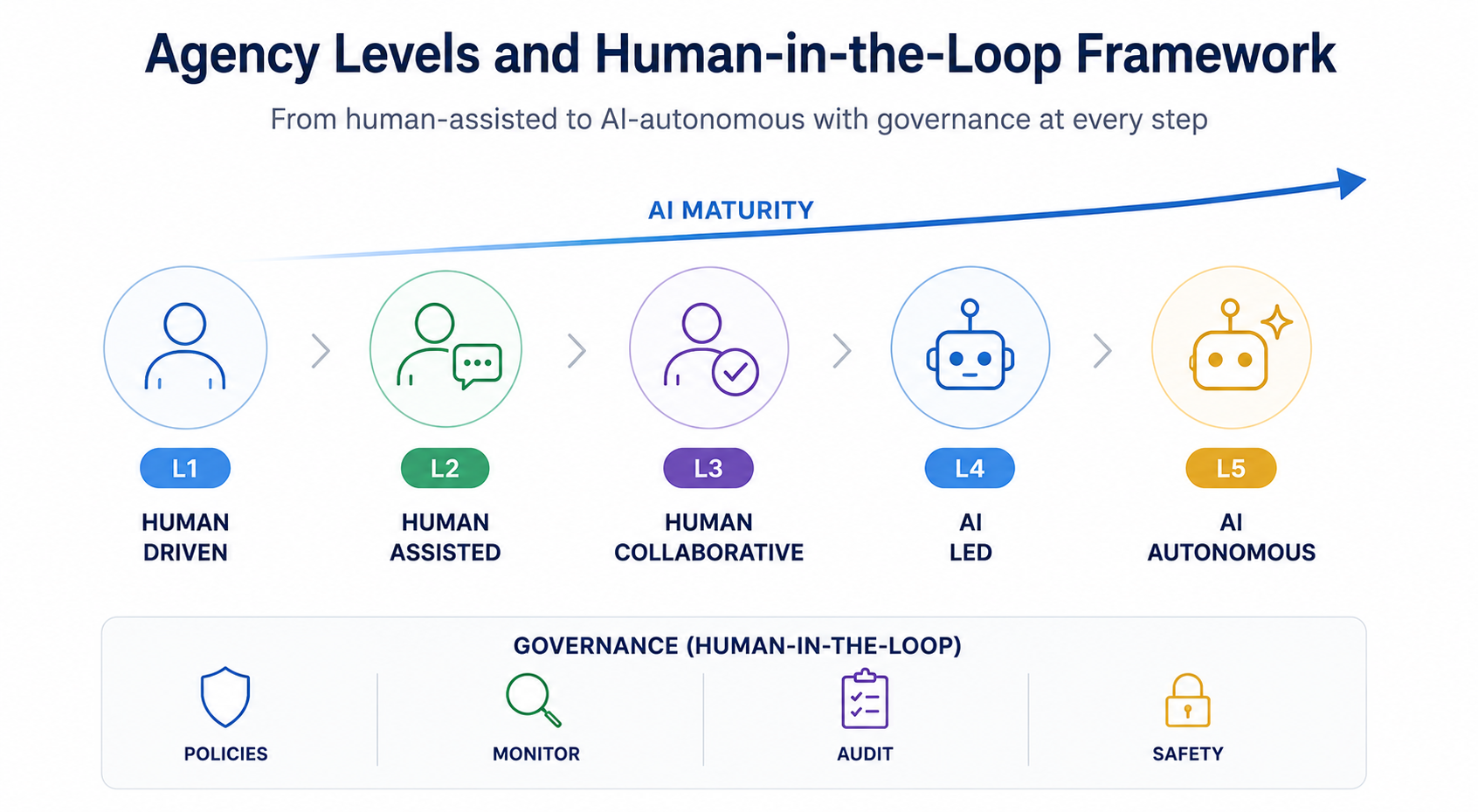
A key feature of this stage is Human-in-the-Loop (HITL), where people continue to review and approve important AI-generated outputs. This approach helps reduce risks, improve quality, support compliance, and increase user confidence. Successful organisations understand that AI works best when people and intelligent systems work together rather than replacing human judgment completely.
Stage 4: Run
The Run phase is when AI becomes part of everyday business operations across the organisation. AI is used by multiple departments to improve efficiency, support decision-making, and automate routine tasks. At this stage, organisations establish clear governance, business ownership, and performance monitoring to ensure AI delivers consistent value.
As AI usage grows, organisations develop stronger governance practices and operational processes. They regularly review performance through activities such as workflow assessments, service-level analysis, incident reviews, and risk evaluations. Governance becomes a normal part of daily operations rather than something that is only addressed when problems occur.
Organisations in the Run phase often experience positive results, including higher adoption rates, improved productivity, better service quality, and smoother business processes. However, they must also manage risks such as declining data quality, outdated knowledge, model drift, and overreliance on automation. Continuous monitoring is essential to maintain strong performance and minimise these risks.
Incident Trend Analysis
Organisations entering the Run phase often observe:
Positive Trends
- Increased adoption rates
- Reduced operational friction
- Higher service quality
- Improved productivity
Emerging Risks
- Model drift
- Knowledge decay
- Data quality degradation
- Automation bias
These risks require continuous monitoring. Maturity is not a destination. It is an ongoing discipline.
Stage 5: Fly
The Fly phase represents the highest level of AI maturity, where AI becomes a strategic business capability that helps drive innovation, growth, and competitive advantage. Organisations use AI to optimise operations, support predictive decision-making, and enable more autonomous workflows. To maintain effectiveness, AI systems are continuously monitored, adjusted, and improved through a process known as continuous calibration. Successful organisations increase AI autonomy gradually, based on strong governance, high-quality data, proven results, and employee readiness. This balanced and evidence-based approach allows organisations to maximise the benefits of AI while maintaining control, accountability, and trust.
Organisations Must Earn AI Autonomy
One of the most important lessons in AI governance is that autonomy should be earned rather than assumed.
Many organisations attempt to move directly toward autonomous AI capabilities.
This creates significant risk. A mature organisation gradually increases AI agency based on:
- Governance maturity
- Data quality
- Evaluation outcomes
- Employee readiness
- Operational performance
The path to autonomy should be progressive and evidence-based.
Benchmark Comparison
The difference between mature and immature AI organisations is often striking
Capability
Emerging Organisations
Mature Organisations
The gap is rarely technology. The gap is maturity.
Service Cost Optimisation Review
One of the strongest indicators of AI maturity is operational efficiency.
Mature organisations consistently achieve:
- Reduced service costs
- Faster issue resolution
- Improved workflow automation
- Better resource utilisation
AI maturity directly influences operational performance.
Future-State Operating Model Recommendations
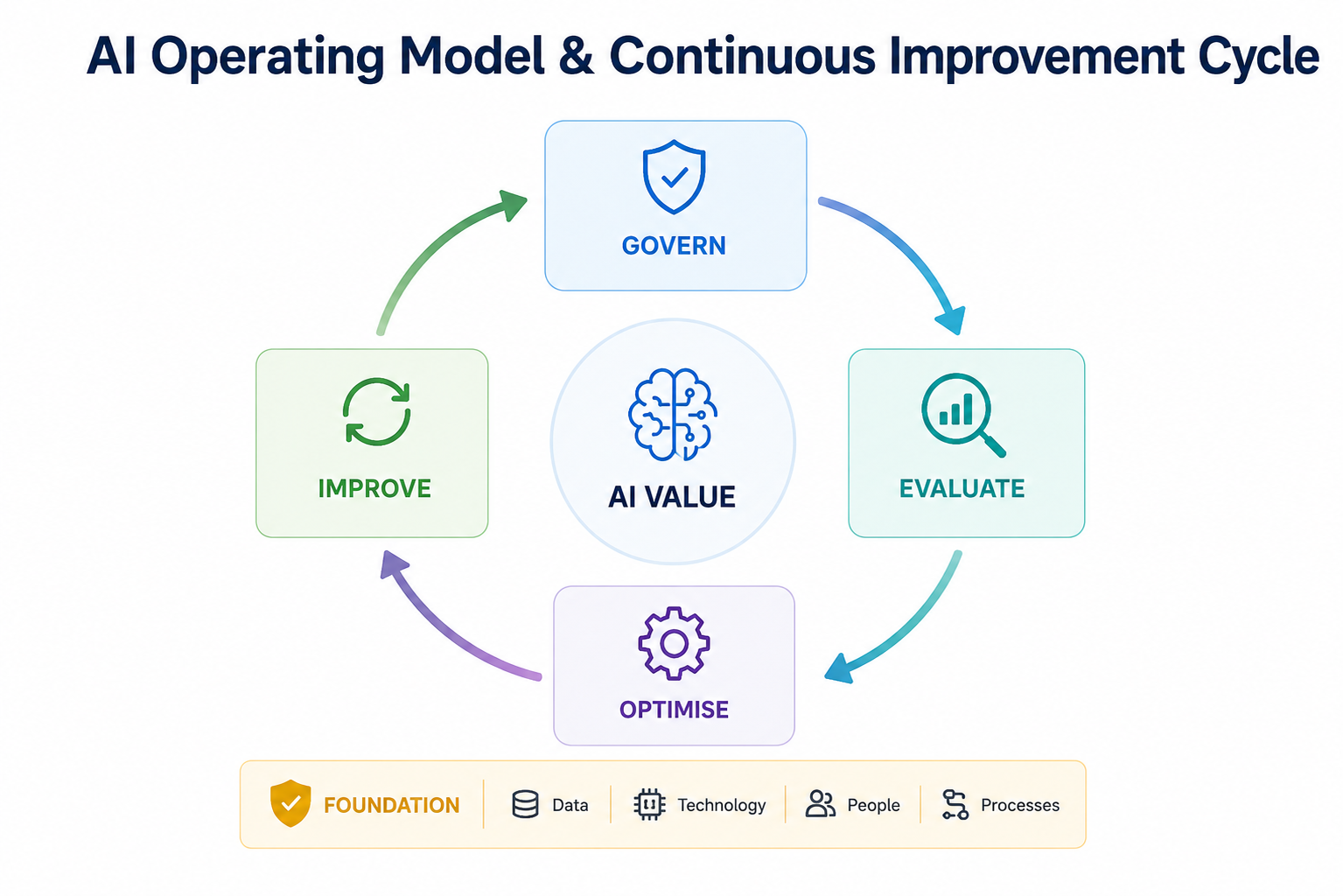
To accelerate maturity, organisations should establish a future-state operating model built around five pillars.
Governance
Governance should provide strong executive oversight, effective risk management, and robust compliance controls to ensure AI initiatives align with organisational objectives and regulatory requirements.
Data and Knowledge
Data and knowledge capabilities should focus on maintaining high data quality, establishing clear knowledge governance practices, and managing information throughout its lifecycle to support reliable and informed decision-making.
Technology
Technology should be built on scalable AI platforms, supported by a well-defined integration architecture and comprehensive security frameworks that enable innovation while protecting organisational assets.
People
People are central to successful AI adoption. Organisations should invest in training programmes, implement effective adoption strategies, and apply structured change management practices to build capability and encourage engagement.
Continuous Improvement
Continuous improvement should be driven by evaluation frameworks, ongoing performance monitoring, and optimisation processes that help organisations measure outcomes, identify opportunities, and enhance AI capabilities over time.
Together, these pillars create sustainable AI capability.
Quick Wins Register
Quick Win 1: Conduct an AI maturity assessment across business and technology functions.
Quick Win 2: Establish executive AI governance reviews.
Quick Win 3: Create AI adoption and trust metrics.
Quick Win 4: Develop AI evaluation scorecards.
Quick Win 5: Identify high-value automation opportunities.
These actions often deliver measurable improvements within the first 90 days.
AI Transformation Roadmap
Phase 1: Assess: Evaluate current AI maturity, governance, risks, and opportunities.
Phase 2: Establish: Implement governance frameworks and ownership models.
Phase 3: Standardise: Create repeatable processes for AI delivery and evaluation.
Phase 4: Scale: Expand AI capabilities across business units.
Phase 5: Optimise: Continuously improve performance, adoption, and business outcomes.
This roadmap enables sustainable transformation while reducing operational risk.
Conclusion
The future of AI belongs to organisations that combine innovation with discipline. Successful enterprises recognise that AI maturity is not determined by the sophistication of a model or the size of an investment. It is determined by governance, adoption, accountability, evaluation, and continuous improvement. The Foundation-to-Fly maturity model provides a practical framework for organisations seeking to scale AI safely while delivering measurable business value.
For executive leaders, the objective should not simply be deploying AI. The objective should be building an organisation capable of governing, managing, and continuously improving AI as a strategic business capability.
Three Key Takeaways for Executives
1. AI Maturity Is Achieved Through Governance and Continuous Calibration
Sustainable AI success requires ongoing evaluation, optimisation, and accountability rather than one-time implementation.
2. Organisations Should Earn AI Autonomy Rather Than Assume It
Higher levels of AI agency should be introduced progressively based on governance maturity, performance outcomes, and operational readiness.
3. Structured Maturity Frameworks Reduce Risk While Accelerating Innovation
A well-defined maturity model enables organisations to scale AI confidently, improve employee adoption, optimise costs, and maximise business value.
About This Series: Governing AI at Enterprise Scale with a Centre of Excellence and Innovation
This article is the third and final instalment in our three-part series, Governing AI at Scale – A Centre of Excellence and Innovation (CoEI) for Your AI Pipeline. The series explores how organisations can establish effective governance, operational controls, and scalable practices to realise the full value of AI while managing risk and maintaining compliance.
The first article, AI Governance at Scale: Why Every CIO Needs an AI Centre of Excellence Before Expanding AI, introduces the strategic rationale for establishing an AI Centre of Excellence as the foundation for enterprise-wide AI governance. The second article, The Six AI Pipelines Every Enterprise Must Govern to Scale AI Safely, examines the critical AI pipelines that organisations must oversee to ensure secure, compliant, and sustainable AI operations.
Building on these foundations, this third article presents the future-state operating model required to govern AI at scale. It outlines the organisational capabilities, governance structures, technology enablers, and continuous improvement practices needed to create a sustainable AI operating environment. Together, the three articles provide a practical framework for leaders seeking to establish a robust AI governance capability and successfully scale AI across the enterprise.