
Executive Summary
As organisations accelerate their adoption of Artificial Intelligence (AI), many leaders focus heavily on selecting the right Large Language Model (LLM), AI platform, or technology vendor. While these decisions are important, they are rarely the determining factor in long-term AI success.
The organisations achieving sustainable business outcomes from AI understand a critical truth: AI performance depends far more on governance than model selection. AI is not a single technology implementation. It is an interconnected ecosystem of data, knowledge, prompts, security controls, evaluation processes, and organisational change management. When any one of these components is poorly governed, AI performance declines, user trust erodes, and operational risks increase.
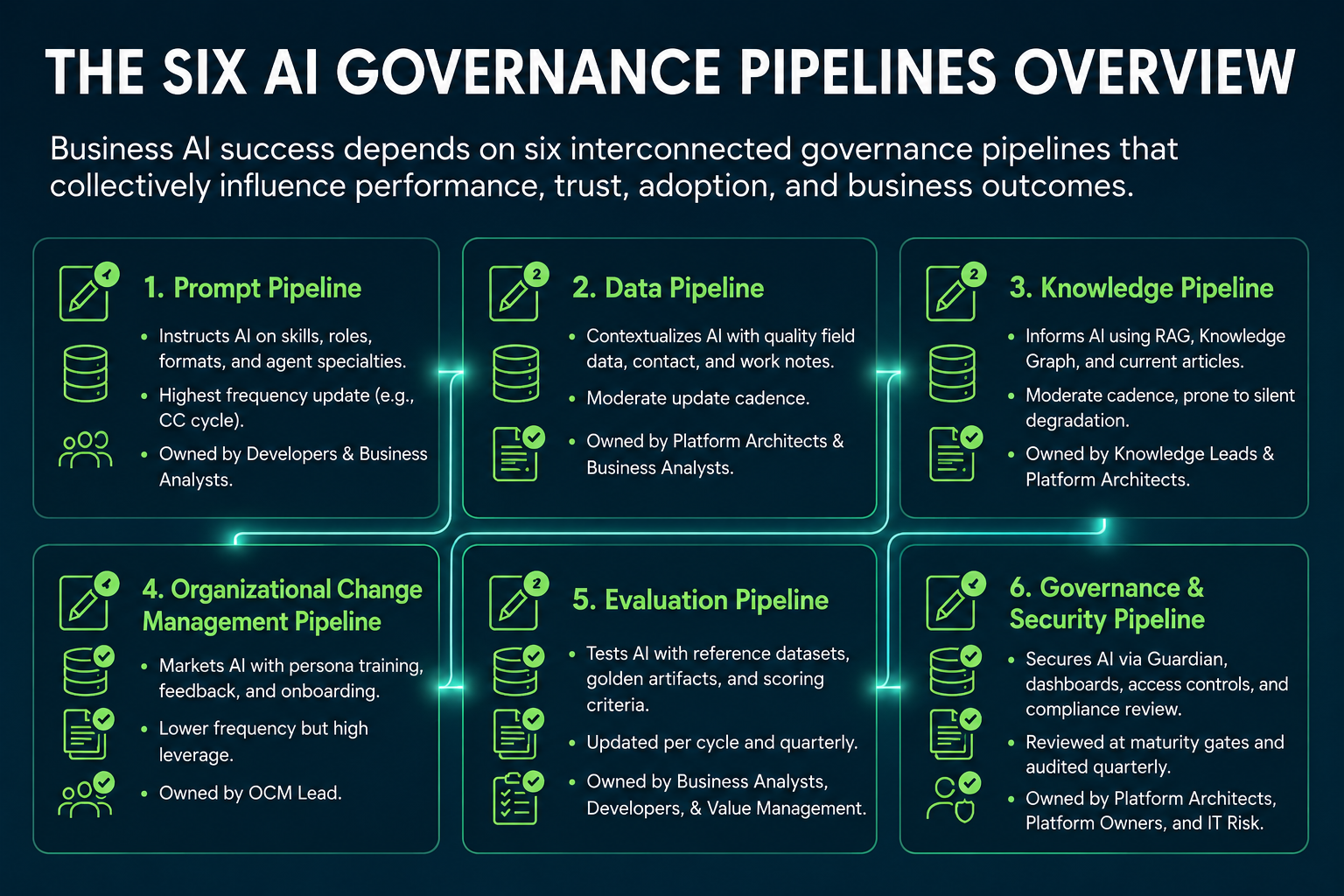
To scale AI safely and effectively, enterprises must manage six interconnected governance pipelines:
- Prompting Pipeline
- Data Pipeline
- Knowledge Pipeline
- Organisational Change Management (OCM) Pipeline
- Evaluation Pipeline
- Governance & Security Pipeline
Together, these pipelines form the foundation of a mature AI operating model that improves service delivery, enhances employee experience, optimises operational costs, and reduces enterprise risk.
For CIOs, CTOs, Chief Data Officers, and Digital Transformation leaders, governing these six pipelines is becoming one of the most important responsibilities in modern enterprise technology leadership.
Why Most AI Programmes Underperform
Many AI initiatives begin with strong momentum. Executive sponsorship is secured, pilot projects generate promising results, and proof-of-concept deployments demonstrate clear business value. Early success often creates excitement among stakeholders and raises expectations for enterprise-wide transformation. However, as organisations move beyond the pilot stage, many AI programmes begin to lose momentum. User adoption slows, confidence in AI-generated recommendations declines, and operational teams start questioning the reliability and consistency of outcomes. While these challenges are frequently attributed to the AI model itself, the underlying cause is rarely the technology. In most cases, performance deteriorates because the supporting governance structures have not matured alongside the AI deployment. Without effective oversight of the data, knowledge, prompting, evaluation, security, and organisational change processes that power AI systems, even the most advanced models struggle to deliver consistent, scalable, and trusted business outcomes.
Definition: AI Governance
AI Governance refers to the framework of policies, processes, accountability structures, controls, and monitoring mechanisms that ensure AI systems operate safely, ethically, effectively, and in alignment with business objectives. Without governance, AI becomes unpredictable. With governance, AI becomes scalable.
Current State AI Pipeline Assessment
Most enterprises fall into one of three governance maturity categories.
Emerging
Characteristics:
- Ad hoc AI initiatives
- Minimal governance
- Limited accountability
- Reactive issue management
Developing
Characteristics:
- Formal AI projects
- Initial governance controls
- Defined ownership structures
- Basic monitoring
Mature
Characteristics:
- Enterprise-wide governance
- Continuous evaluation
- Formal AI operating model
- Executive oversight
- Ongoing optimisation
The majority of organisations currently sit between Emerging and Developing maturity levels. This creates significant risk as AI adoption expands.
Pipeline 1: The Prompting Pipeline
Prompting is often misunderstood as simply writing instructions for AI. In reality, prompting has become an enterprise capability.
Definition: Prompt Engineering
Prompt Engineering is the process of designing, structuring, testing, and optimising instructions that guide AI systems toward accurate and useful outcomes.
Poor prompting often results in:
Inconsistent outputs
- Reduced productivity
- Increased user frustration
- Lower confidence in AI systems
Governance Considerations
Organisations should establish:
- Prompt standards
- Prompt libraries
- Testing frameworks
- Quality assurance processes
- Prompt ownership models
Leading enterprises increasingly treat prompts as strategic assets rather than temporary instructions.
Pipeline 2: The Data Pipeline
Data remains the foundation of every AI initiative.
Definition: Data Governance
Data Governance is the framework that ensures organisational data is accurate, consistent, secure, available, and properly managed throughout its lifecycle.
Even the most advanced AI systems cannot overcome poor-quality data.
Common challenges include:
- Incomplete records
- Duplicate information
- Inconsistent classifications
- Outdated content
Business Impact
Poor data governance can lead to:
- Incorrect recommendations
- Reduced automation accuracy
- Compliance concerns
- Loss of stakeholder trust
Operational Risk Assessment
Without strong data governance, organisations face:
- Increased incident rates
- Poor service outcomes
- Regulatory exposure
- Escalating support costs
Data quality directly influences AI reliability.
Pipeline 3: The Knowledge Pipeline
Knowledge is rapidly becoming one of the most valuable assets within modern enterprises.
AI systems rely heavily on organisational knowledge to deliver accurate and relevant outcomes.
Definition: Knowledge Management
Knowledge Management is the process of creating, organising, maintaining, and distributing organisational information to support business operations and decision-making.
Many organisations struggle with:
- Outdated knowledge articles
- Duplicate documentation
- Inconsistent information
- Fragmented repositories
Process Pain Point Assessment
Common issues include:
- Employees unable to find answers quickly
- Increased support volumes
- Reduced productivity
- Poor AI response quality
Effective knowledge governance creates a single source of truth that improves both employee and AI performance.
Pipeline 4: The Organisational Change Management Pipeline
Many AI implementations fail due to human factors rather than technical limitations.
Definition: Organisational Change Management (OCM)
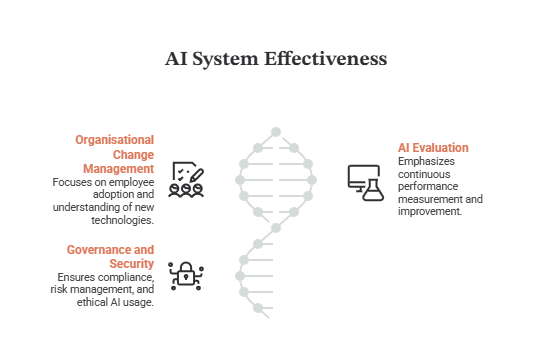
Organisational Change Management is a structured approach to helping employees adopt, understand, and effectively use new technologies and business processes.
Successful AI adoption requires:
Communication strategies
- Training programmes
- Executive sponsorship
- User engagement
- Adoption measurement
Employee Experience Analysis
When AI adoption is poorly managed:
- Employees resist change
- Productivity gains fail to materialise
- Trust decreases
- Technology investments underperform
Strong change management improves both user experience and business outcomes.
Pipeline 5: The Evaluation Pipeline
One of the most overlooked areas in AI governance is evaluation.
Many organisations deploy AI systems without establishing a framework for measuring performance over time.
Definition: AI Evaluation
AI Evaluation is the continuous process of measuring AI performance, accuracy, usefulness, compliance, and business value against predefined success criteria.
Evaluation should measure:
- Accuracy
- Relevance
- User satisfaction
- Business outcomes
- Risk indicators
SLA Analysis
Traditional service-level agreements often focus on system availability.
AI introduces new service metrics such as:
- Response quality
- Recommendation accuracy
- Hallucination rates
- User adoption rates
These metrics provide a more meaningful view of AI performance.
Pipeline 6: Governance and Security Pipeline
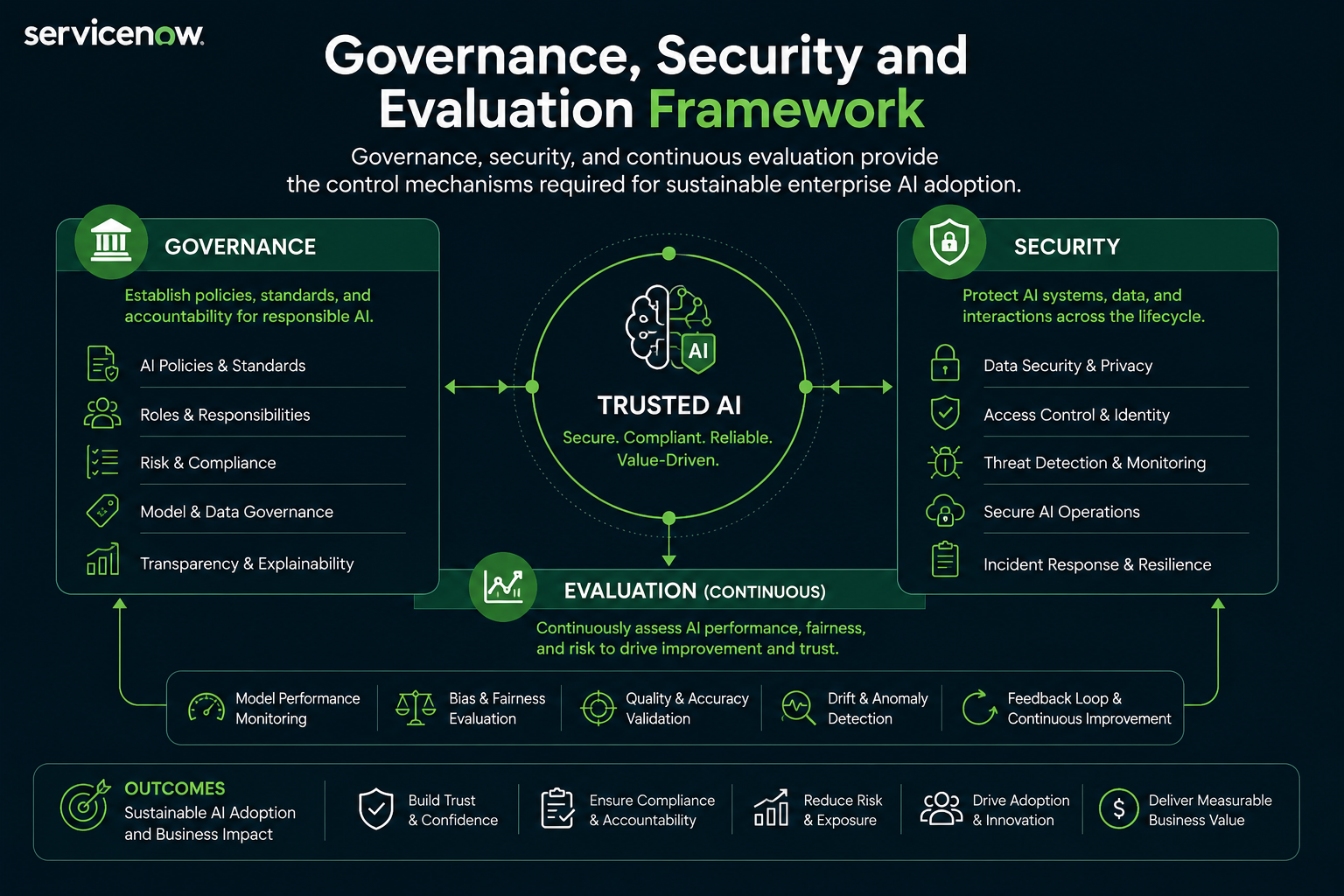
The Governance and Security Pipeline acts as the overarching control layer across all AI activities.
Definition: AI Security Governance
AI Security Governance refers to the policies, controls, risk management practices, and oversight mechanisms used to protect AI systems and organisational data.
This pipeline oversees:
- Compliance
- Risk management
- Ethical AI usage
- Security controls
- Audit readiness
Workflow Assessment
Governance controls should be embedded into workflows rather than treated as separate activities.
This enables:
- Faster decision-making
- Improved compliance
- Reduced operational friction
- Stronger accountability
Governance becomes an enabler rather than a barrier.
Business Impact Analysis
When all six pipelines are effectively governed, organisations achieve significant benefits.
Service Cost Optimisation
Benefits include:
- Reduced manual effort
- Increased automation
- Lower support costs
- Faster issue resolution
Employee Experience Improvements
Benefits include:
- Faster access to information
- Improved productivity
- Reduced administrative burden
- Better decision support
Customer Experience Improvements
Benefits include:
- Consistent service delivery
- Faster response times
- Improved self-service capabilities
- Higher satisfaction levels
Risk Reduction
Benefits include:
- Stronger compliance
- Improved governance
- Better auditability
- Reduced operational exposure
Incident Trend Analysis
A review of enterprise AI deployments often reveals recurring patterns.
High-performing organisations typically experience:
- Fewer AI-related incidents
- Faster issue resolution
- Higher adoption rates
- Better service outcomes
Organisations with weak governance commonly experience:
- Repeated knowledge issues
- Data quality incidents
- Adoption challenges
- Escalating operational costs
The difference is governance maturity.
Platform Optimisation Opportunities
Leaders seeking immediate improvements should focus on:
Opportunity 1
Standardise prompt engineering practices.
Opportunity 2
Implement enterprise knowledge governance.
Opportunity 3
Establish AI evaluation scorecards.
Opportunity 4
Create executive AI governance reviews.
Opportunity 5
Integrate AI metrics into operational dashboards.
These improvements often deliver measurable results within months.
AI Opportunities Assessment
Organisations with mature governance pipelines can confidently pursue:
- AI-powered service management
- Intelligent workflow automation
- Predictive operations
- Digital employee experience initiatives
- Enterprise knowledge assistants
Governance maturity becomes a competitive advantage.
Prioritised Recommendations
Immediate Priorities (0–3 Months)
- Establish AI governance ownership
- Define evaluation metrics
- Assess data quality
- Review knowledge repositories
Mid-Term Priorities (3–6 Months)
- Build prompt governance standards
- Launch adoption programmes
- Create governance dashboards
Long-Term Priorities (6–12 Months)
- Implement continuous evaluation
- Expand enterprise AI capabilities
- Formalise governance operating models
Governance Roadmap
Phase 1: Establish
Define governance structures, accountability, and success metrics.
Phase 2: Standardise
Implement repeatable processes across all six pipelines.
Phase 3: Measure
Continuously monitor performance, adoption, and risk indicators.
Phase 4: Optimise
Refine governance controls and improve operational efficiency.
Phase 5: Scale
Expand AI safely across business units and enterprise functions.
Conclusion
The future of enterprise AI will not be determined solely by technology vendors, model selection, or platform investments. Success will be determined by governance. The six governance pipelines: Prompting, Data, Knowledge, OCM, Evaluation, and Governance & Security, form the operational backbone of every successful AI programme. Organisations that govern these pipelines effectively improve service quality, optimise costs, enhance employee experience, and reduce operational risk. For executive leaders, the goal should not simply be deploying AI. The goal should be governing AI in a way that creates sustainable business value.
Three Key Takeaways for Executives
1. AI Performance Depends More on Governance Than Model Selection
The most successful AI programmes focus on governance, accountability, and continuous improvement rather than technology alone.
2. Data, Knowledge and Evaluation Pipelines Directly Influence AI Quality
High-quality AI outcomes depend on strong governance across the information ecosystem that supports AI.
3. Organisations That Manage All Six Pipelines Achieve Sustainable AI Outcomes
Governing Prompting, Data, Knowledge, OCM, Evaluation, and Governance & Security creates the foundation for scalable, trusted, and business-aligned AI.
This is the second part of a three-part series on AI governance, following "AI Governance at Scale: Why Every CIO Needs an AI Centre of Excellence Before Expanding AI" (published June 8, 2026), and preceding the upcoming third instalment on AI maturity models.