Executive Summary
Generative AI has shifted from an experimental technology to a core enterprise requirement. However, as organisations deploy multiple Large Language Models (LLMs) across various departments, they frequently run into what management consultants call "The AI Chasm": the gap between launching an AI pilot and realising measurable, compliant operational transformation. Many businesses find themselves managing fragmented AI tools, experiencing model drift, or facing compliance uncertainties. To achieve true ServiceNow optimisation, organisations require a structured framework that transitions them from scattered use cases to a centralised governance model. This comprehensive guide serves as an educational roadmap and management consulting framework for navigating this operational transformation. It details how to leverage ServiceNow’s AI Control Tower and Now Assist to build a secure, scalable, and value-driven intelligent enterprise.
The Realities of Enterprise GenAI
In the race to adopt generative AI, many companies deploy standalone tools across disconnected business functions. While a customer service team might use one LLM for drafting emails, the IT department might use an entirely separate model for summarising incident logs.
This ad-hoc implementation method creates several critical enterprise challenges:
- Shadow AI and Model Proliferation: Lacking a single ledger of active AI applications, IT leaders lose visibility into which data sets are being fed into which models.
- The "Black Box" Problem: Unmonitored models can hallucinate or experience data drift over time, outputting incorrect information without triggering an administrator alert.
- Untracked Costs and Squandered ROI: Token consumption fees can quickly escalate. Without a way to map usage to clear business metrics, calculating return on investment becomes difficult.
To resolve these friction points, organisations must treat AI not merely as an engineering feature, but as a core organisational capability requiring centralised governance.
Setting Up Your Foundation: Data Quality and the Unified Architecture
A common saying among AI advisors is: The quality of your AI outputs depends entirely on the structure of your enterprise data. GenAI cannot operate effectively in a silo; it requires deep context regarding your infrastructure, business services, and workflows.
This is where the ServiceNow platform offers a distinct architectural advantage. By anchoring your AI strategy to a unified data layer—specifically the Configuration Management Database (CMDB) and Common Service Data Model (CSDM) you provide your AI engines with a real-time, context-rich map of the entire enterprise. When a Generative AI agent attempts to resolve an infrastructure issue or fulfil an employee request, it doesn't just guess based on public internet data. It references internal system relationships, historical resolution paths, and established corporate compliance guardrails.
The Functional Capabilities: Decoupling the Five Core Skills
To operationalise AI successfully across your workforce, your advisory and implementation teams must understand the specific capabilities at their disposal. Within ServiceNow’s Now Assist framework, enterprise generative AI is broken down into five core skills designed to automate standard business workflows.
Rather than viewing GenAI as a vague, singular entity, breaking it down into these specific capabilities allows management consultants to precisely map technology solutions to distinct operational bottlenecks:
- Summarise: This skill reduces extensive documentation down to its essential points. It takes messy, long-form human logs—such as historical chat transcripts or multi-threaded incident histories—and distils them into a clear, actionable brief. This dramatically lowers the Mean Time to Resolution (MTTR) for service desk agents.
- Generate: This capability creates new content based on existing data points or natural language inputs. Common operational use cases include drafting step-by-step resolution playbooks, generating user-facing knowledge base articles from closed technical tickets, or writing automated customer communications.
- Resolve: This skill provides direct, intelligent responses to natural language queries from employees or customers. Instead of simply returning a list of links like a traditional search engine, it handles immediate end-to-end automation, such as triggering background subflows to reset a password or order hardware.
- Recommend: By analysing platform data in real time, this skill suggests proactive next steps to human agents. Examples include serving up chat reply recommendations during live customer service interactions or identifying duplicate incidents across global teams to prevent redundant troubleshooting.
- Custom: Built via the Now Assist Skill Kit, this framework allows organisations to develop, test, and deploy bespoke skills tailored to highly niche, proprietary business processes that fall outside out-of-the-box configurations.
The Blueprint for Strategic AI Governance
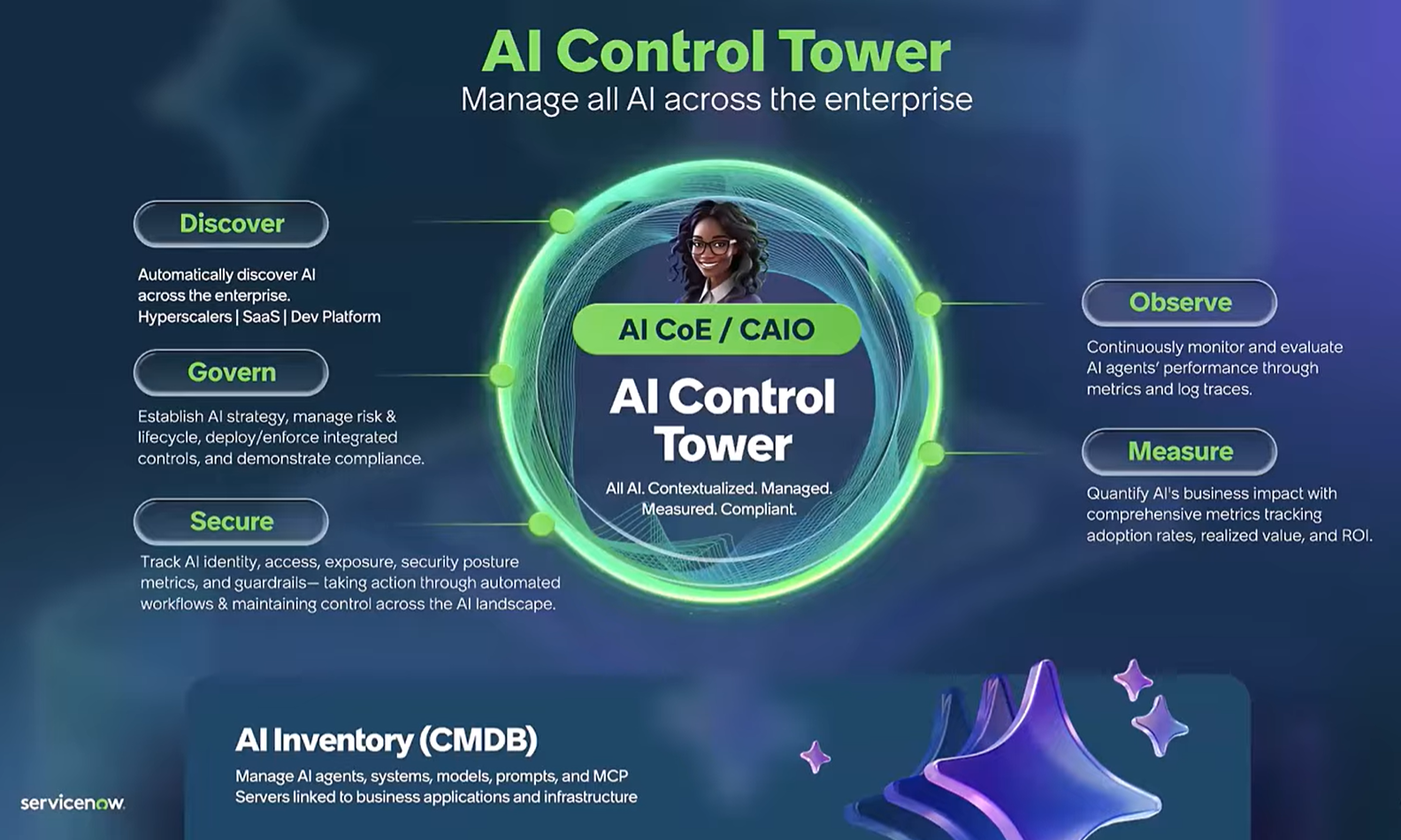
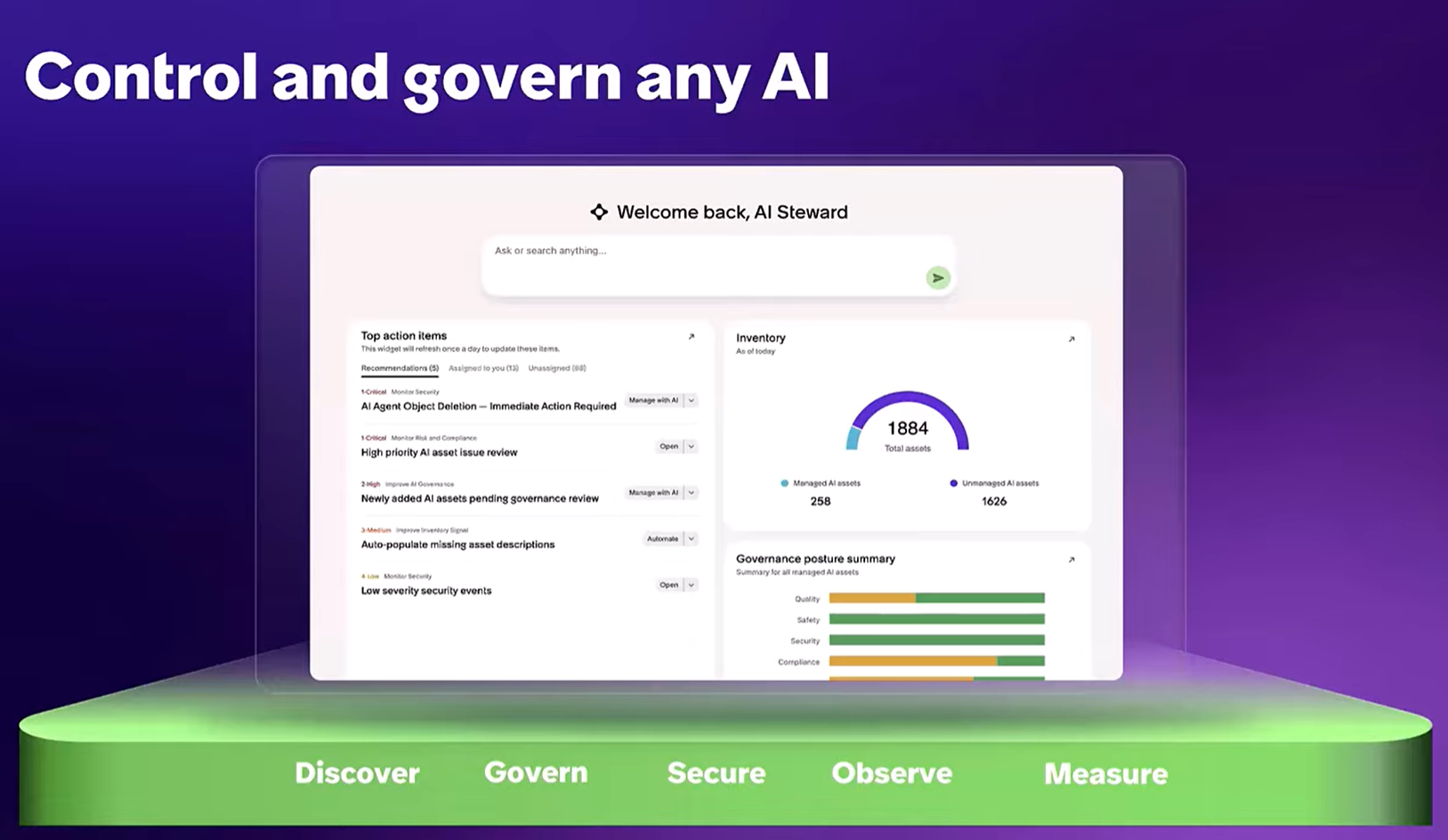
Once your core capabilities are defined and your data foundation is set, the next operational hurdle is governing these elements at scale. This is where the ServiceNow AI Control Tower functions as the central management console for your entire enterprise AI ecosystem. An effective AI Advisory framework relies on three pillars within the Control Tower to move organisations from chaotic, unmonitored pilots into a mature, structured operating model:
Step 1: Centralised Asset Discovery and Inventory
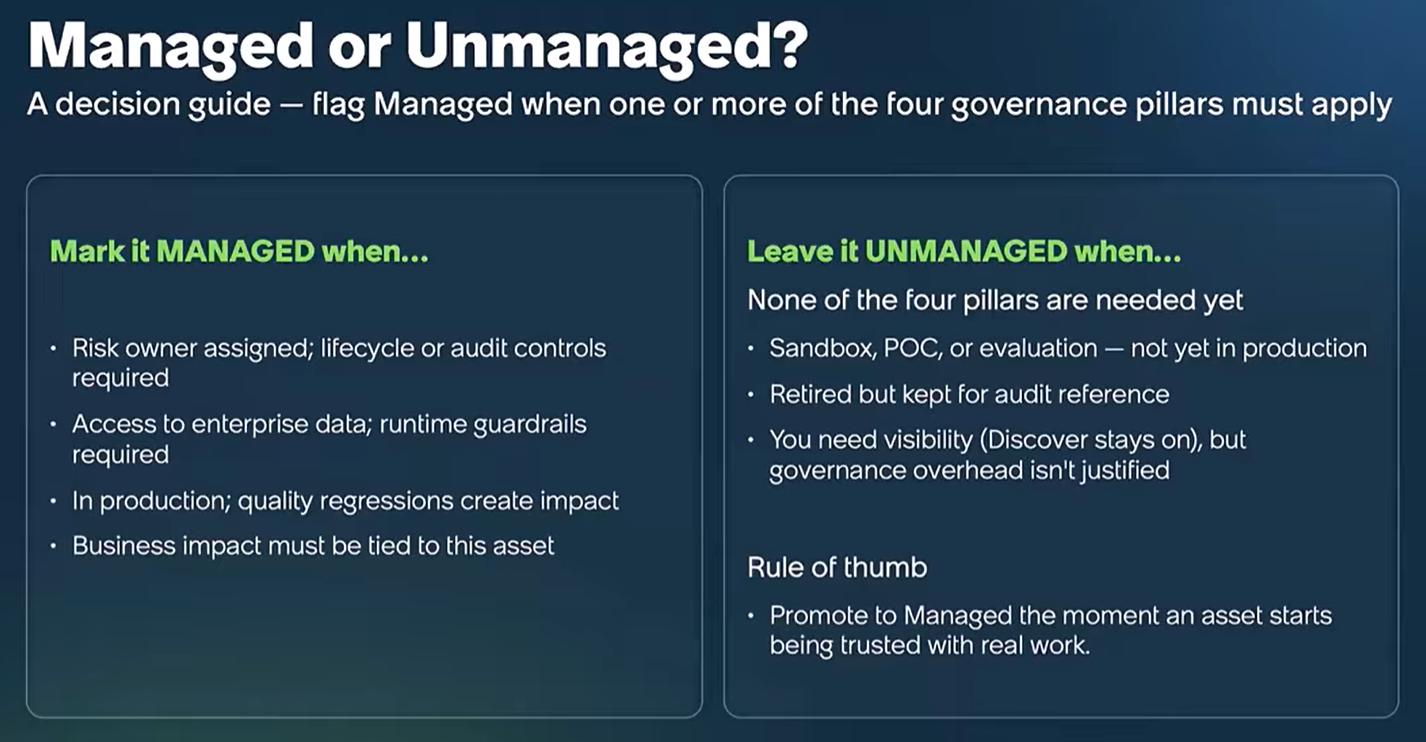
You cannot govern what you cannot see. The first step in the advisory journey is utilising the Control Tower to discover and catalogue every active AI model, token budget, and LLM connection across the enterprise. This process maps your AI tools directly into your system inventory, giving IT leadership full visibility into your actual footprint and eliminating rogue deployments.
Step 2: Implementing Real-Time Guardrails and Trust Frameworks
Autonomous AI agents require constant boundaries. The Control Tower enables administrators to configure real-time guardrails that monitor data inputs and outputs.
These security layers actively scan for prompt injections, prevent sensitive corporate data from leaking into public models, and evaluate outputs for hallucinations or unexpected model drift. If a model's accuracy drops below a specified threshold, the system can automatically flag an administrator or redirect the workflow to a human analyst.
Step 3: Performance, Cost, and Value Tracking
True operational transformation requires linking system usage directly to financial metrics. The platform tracks exactly how many tokens are being consumed, what those API calls cost, and matches that expense against concrete value metrics—such as hours saved, deflection rates, and workflow acceleration. Executive leadership gains access to transparent dashboards showing whether a specific model is delivering positive business outcomes or running at an unsustainable deficit.
Management Consulting Framework: Step-by-Step Implementation Guide
For organisations ready to modernise their operations, this four-phase framework details how to execute a successful ServiceNow optimisation strategy:
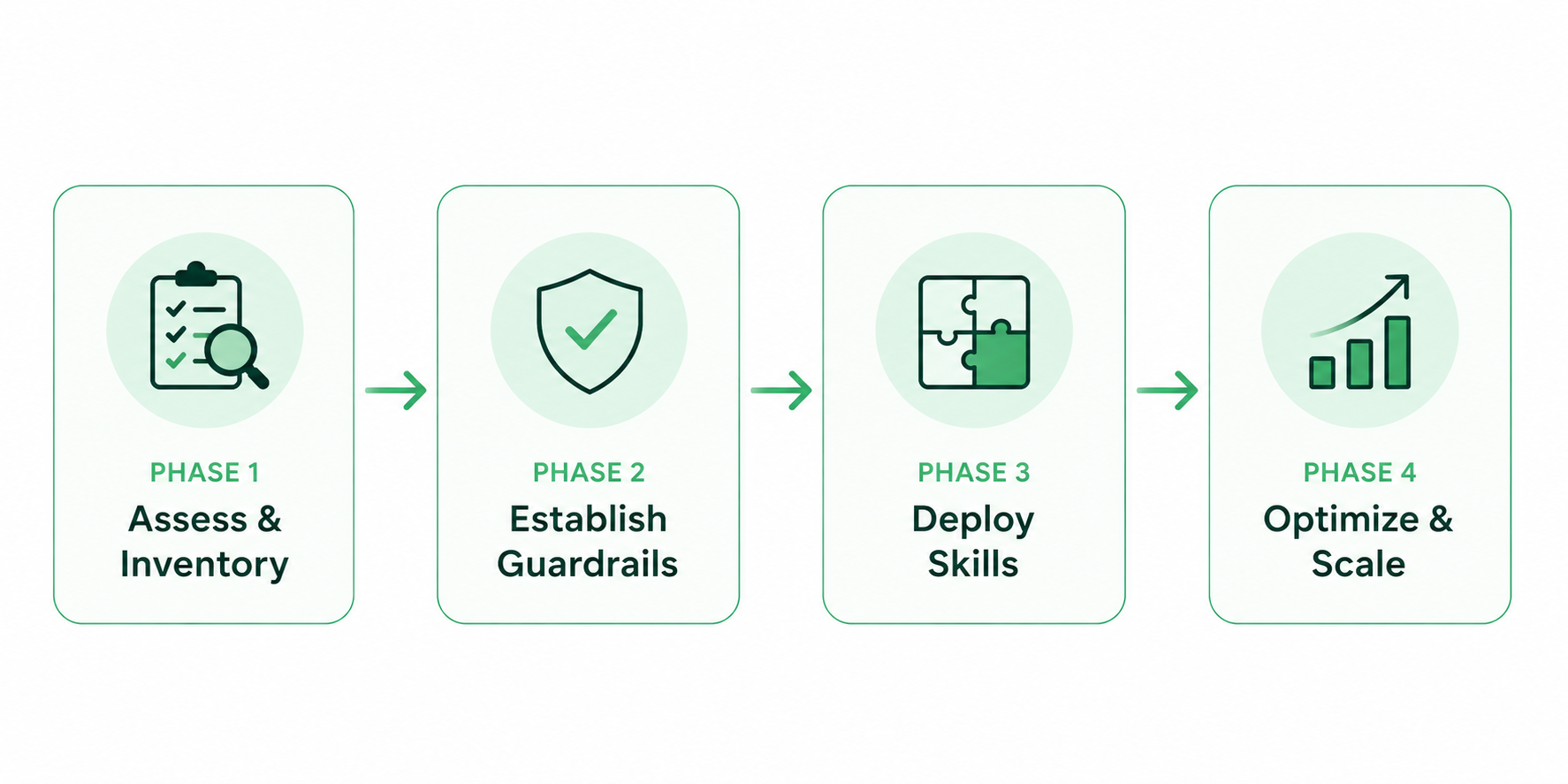
Phase 1: Assess & Inventory
- Objective: Map out the current state of AI usage and define clear business goals.
- Action Items: Conduct an enterprise-wide discovery audit to identify active AI pilots. Clean up your CMDB and align your service data models to ensure the underlying platform data is accurate.
Phase 2: Establish Guardrails
- Objective: Secure your environment before deploying automated workflows.
- Action Items: Configure your security rules and privacy policies within the AI Control Tower. Set up data masking to protect personally identifiable information (PII) and establish your baseline token budgets.
Phase 3: Deploy Targeted Skills
- Objective: Launch specific, high-impact AI use cases.
- Action Items: Activate standard Now Assist features (such as Case Summarisation or Knowledge Generation) in your production environments. For specialised industry workflows, use the Skill Kit to build and validate custom capabilities.
Phase 4: Optimise & Scale
- Objective: Continuously refine performance and maximise business returns.
- Action Items: Review your Control Tower dashboards weekly to track value realisation, monitor for model drift, and adjust your resource allocation based on actual usage and ROI data.
Conclusion: The Path Forward for the Intelligent Enterprise
Achieving operational transformation through generative AI does not happen by accident. It requires moving past isolated pilots and establishing an intentional approach to data, architecture, and governance.
By combining the workflow orchestration of Now Assist with the comprehensive oversight of AI Control Tower, organisations can scale their automated capabilities safely and efficiently. This unified strategy ensures that every AI investment is secure, compliant, and directly tied to measurable business value.