From AI Chaos to AI Governance: Why Enterprises Need Control Before Scale
The Enterprise AI Explosion Has Created a Governance Crisis. Artificial Intelligence adoption is accelerating faster than most enterprises can govern it.
Across IT operations, customer service, HR, finance, and supply chain teams, AI agents are rapidly being deployed to automate workflows, improve productivity, and reduce
operational friction. Yet behind this acceleration lies a growing challenge: disconnected AI initiatives.
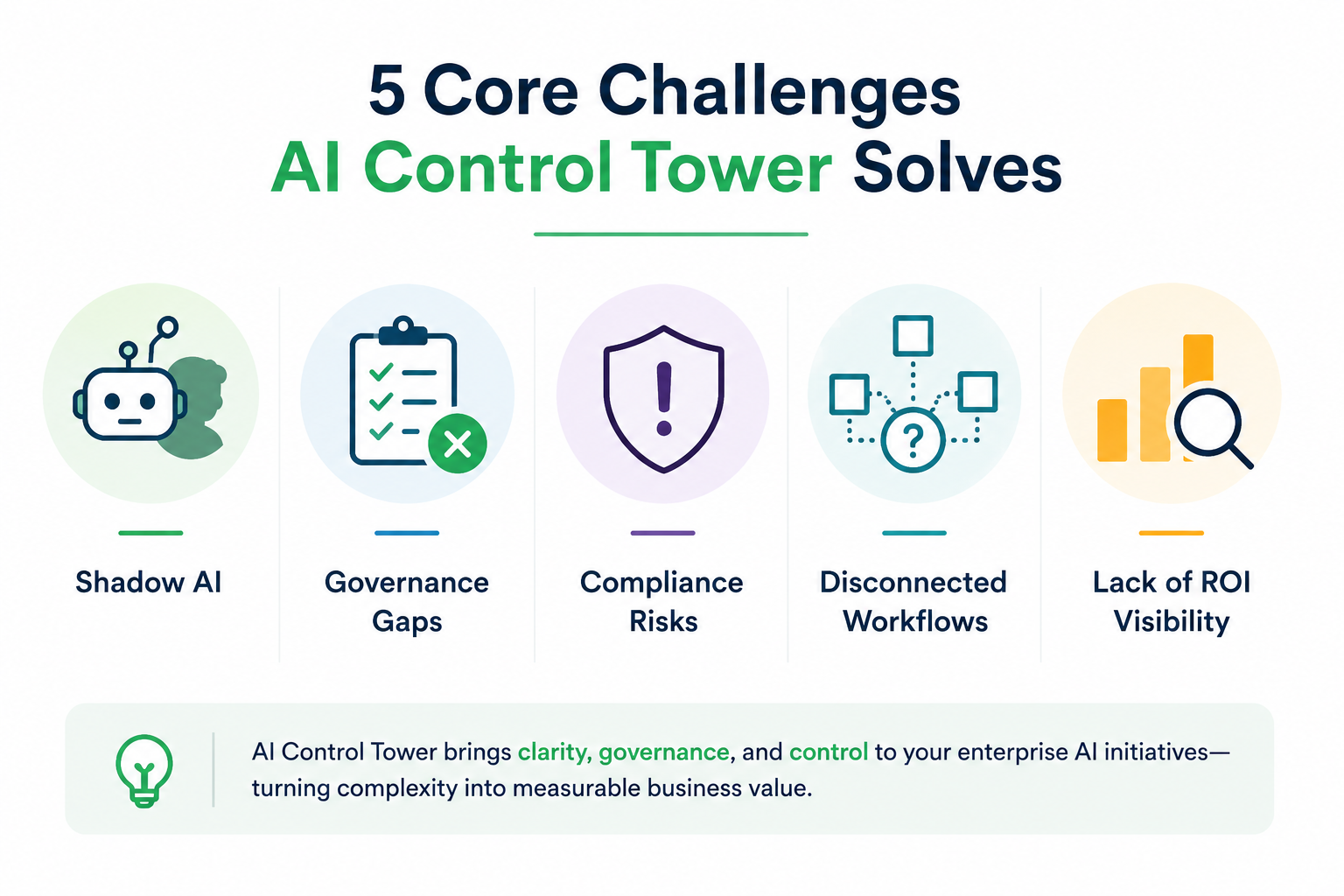
Many organisations now face an uncomfortable reality:
- AI pilots exist without centralised oversight
- Different departments deploy different models
- Governance policies remain inconsistent
- Compliance risks continue to increase
- ROI visibility is fragmented
- Strategic alignment is often missing
This is precisely the problem ServiceNow aims to solve with the introduction of AI Control Tower.
Rather than treating AI as isolated experiments, ServiceNow positions AI Control Tower as an enterprise-wide governance and orchestration layer that connects AI initiatives directly to business strategy. According to ServiceNow, the platform centralises visibility, governance, compliance, and lifecycle management for both native and third-party AI agents, models, and workflows.
Why Enterprises Are Struggling with AI Governance
Most enterprises did not build their technology ecosystems with agentic AI in mind.
Instead, organisations evolved through years of disconnected digital transformation initiatives:
- Legacy ERP systems
- Multiple cloud providers
- Separate ITSM platforms
- Fragmented CRM environments
- Isolated analytics tools
- Department-specific automation initiatives
The result is operational fragmentation.
Now add AI agents into this already complex environment.
Without centralised governance, organisations risk:
- Duplicate AI investments
- Security vulnerabilities
- Regulatory exposure
- Uncontrolled model drift
- Ethical AI concerns
- Inconsistent customer experiences
According to Gartner, enterprises using AI governance platforms could achieve significantly higher customer trust ratings and better regulatory compliance outcomes compared to competitors.
This is why enterprise AI governance is rapidly shifting from a technical concern into a boardroom priority.
The Strategic Role of ServiceNow AI Control Tower
ServiceNow describes AI Control Tower as a centralised command centre for governing, securing, managing, and realising value from AI agents, workflows, and models across the enterprise.
However, the bigger story is not simply governance.
The real innovation lies in how ServiceNow connects AI operations with business context.
The platform leverages:
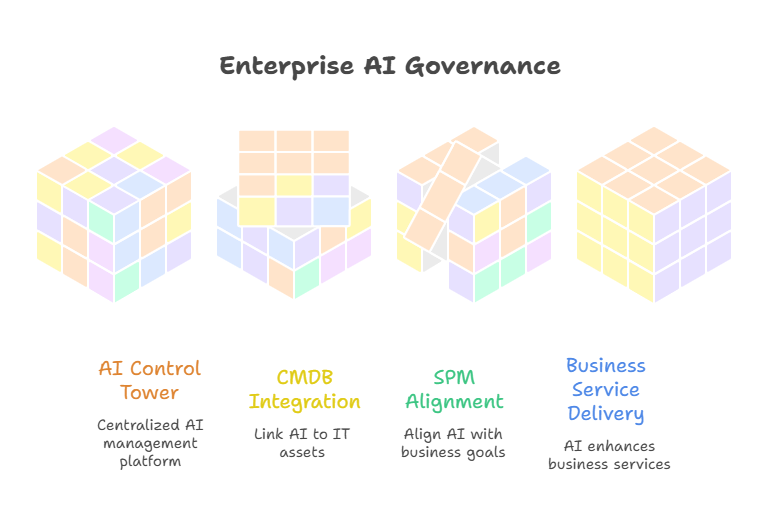
- CMDB (Configuration Management Database)
- CSDM (Common Service Data Model)
- SPM (Strategic Portfolio Management)
- Workflow orchestration
- AI lifecycle management
Together, these components allow enterprises to map AI systems directly to:
- Business services
- Operational processes
- Enterprise risks
- Strategic outcomes
- Business owners
- Compliance obligations
This changes AI from a technology experiment into an operational business capability.
AI Visibility Is Emerging as the Foundation of Enterprise AI Governance
One of the most pressing challenges enterprises face in the AI era is not deployment — it is visibility.
As organisations rapidly introduce AI agents, copilots, orchestration layers, and autonomous workflows across the business, many leaders are discovering a critical operational gap: they lack a clear, centralised view of how AI is actually functioning within the enterprise.
Most organisations still struggle to answer fundamental governance and operational questions:
- Which AI agents and models are currently active?
- What enterprise data and systems can they access?
- Which workflows, approvals, or decisions are being influenced?
- How are AI-driven actions impacting operational outcomes?
- Are these AI interactions aligned with internal governance, security, and compliance policies?
This is where ServiceNow is positioning itself differently.
Through its AI Control Tower, Workflow Data Fabric, integrated observability capabilities, and enterprise-wide governance architecture, ServiceNow enables organisations to establish comprehensive visibility across both native and third-party AI ecosystems.
The platform can monitor and govern AI activity across cloud environments, enterprise applications, and external AI providers through a broad integration framework spanning platforms such as Microsoft Azure, AWS, Google Cloud, Salesforce, and other enterprise systems.
The result is something many CIOs and enterprise architecture teams have been missing:
A unified operational control layer for enterprise AI.
Rather than managing disconnected AI initiatives in silos, organisations gain a centralised “single pane of glass” view into AI usage, orchestration, governance posture, operational impact, and policy compliance across the enterprise.
For organisations scaling AI adoption, visibility is no longer simply a reporting capability.
It becomes the foundational layer for trustworthy, secure, and governable enterprise AI operations.
Real-World Enterprise Scenario
Consider a global manufacturing enterprise operating a highly distributed technology ecosystem that includes:
- SAP for ERP and supply chain operations
- ServiceNow for ITSM, ITOM, and enterprise workflow orchestration
- Salesforce for customer engagement and CRM
- Microsoft Copilot is embedded across productivity and collaboration environments
- AI-driven supply chain forecasting models
- Autonomous finance and procurement automation bots
At scale, each of these platforms introduces its own AI models, automation logic, decision engines, data pipelines, and governance requirements.
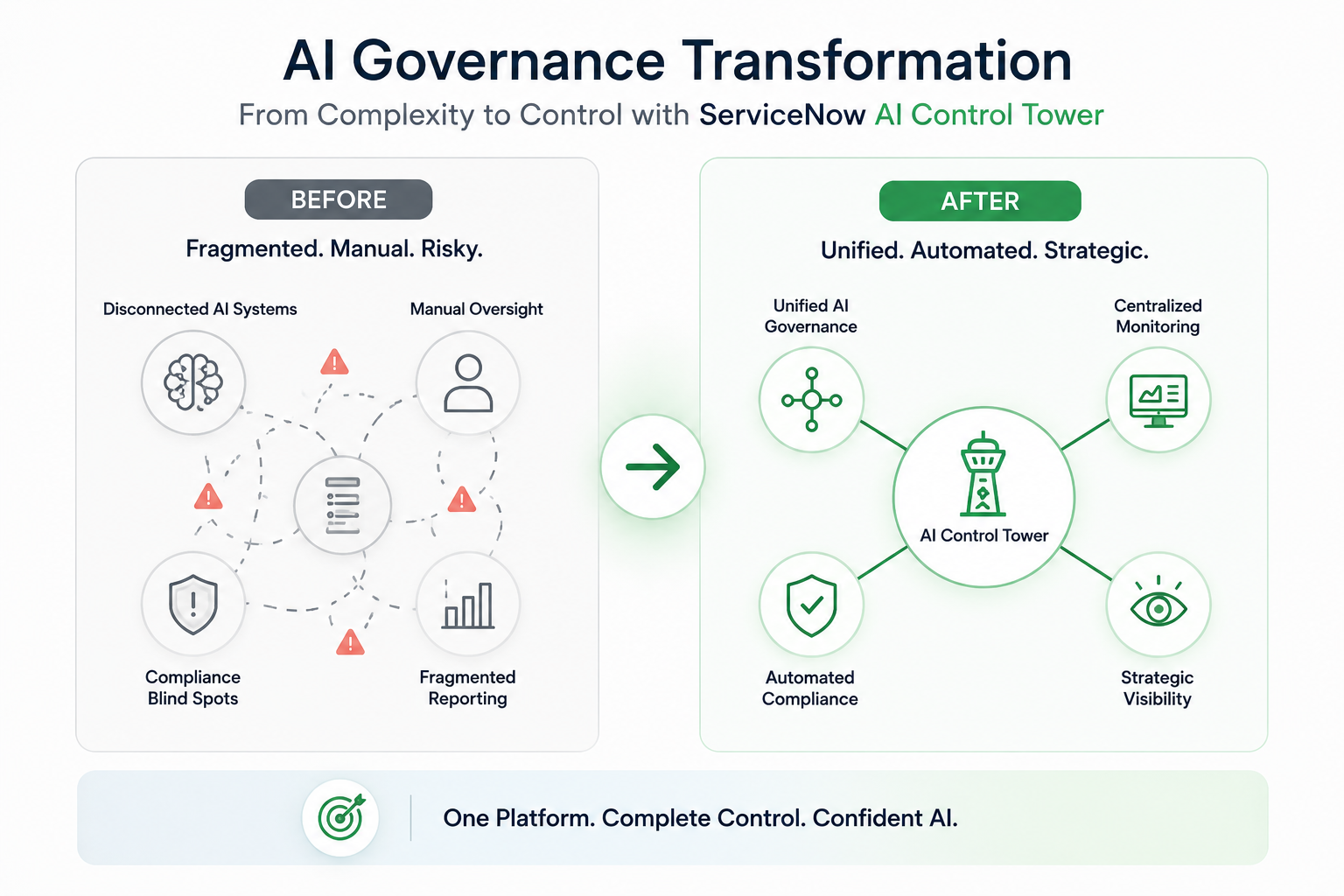
Without a centralised AI governance framework, the enterprise quickly encounters operational fragmentation.
AI systems begin operating as isolated control planes with limited interoperability and minimal cross-platform observability. Decision lineage becomes difficult to trace. Compliance and risk teams struggle to audit how AI-generated recommendations are produced, which datasets influenced outcomes, or whether automated decisions align with internal governance policies and regulatory obligations.
At the operational level, support and engineering teams lack unified telemetry across AI interactions, workflows, and dependencies. Business stakeholders may see AI activity occurring across the enterprise, but they cannot accurately measure utilisation, business value, operational risk exposure, or return on AI investments.
This is precisely where ServiceNow’s AI Control Tower introduces strategic value.
By establishing a centralised governance and orchestration layer across enterprise AI ecosystems, organisations gain the ability to standardise policy enforcement, monitor AI behaviour, track workflow execution paths, and maintain auditable visibility into AI-driven operations across both native and third-party platforms.
With AI Control Tower in place:
- AI workflows become observable and operationally measurable
- Governance controls become standardised across business units
- AI ownership, accountability, and decision lineage become traceable
- Enterprise-wide policy enforcement becomes scalable
- Strategic alignment between AI initiatives and business outcomes improves
- Operational, compliance, and security risks become quantifiable
At this stage, enterprise AI governance evolves beyond reactive oversight.
It becomes an active orchestration capability, enabling organisations to govern AI with the same operational discipline applied to critical enterprise services and infrastructure.
Why CMDB and CSDM Matter More Than Ever
Many organisations continue to view foundational architecture disciplines such as CMDB and CSDM as purely operational frameworks.
In reality, they are becoming increasingly critical to scalable enterprise AI governance.
One of ServiceNow’s strongest differentiators lies in its ability to combine AI governance with deep operational context through the Configuration Management Database (CMDB) and the Common Service Data Model (CSDM).
The CMDB provides a continuously updated system of record for enterprise infrastructure, applications, cloud resources, business services, data relationships, and operational dependencies. It establishes the underlying digital topology of the organisation.
Meanwhile, CSDM standardises how technical services, business capabilities, application services, and supporting infrastructure are modelled and related across the enterprise.
When AI governance capabilities are layered onto this architecture, organisations move beyond isolated AI monitoring into contextual AI intelligence.
Instead of simply identifying that an AI agent executed a workflow, enterprises can understand:
- Which business services were impacted
- Which upstream and downstream dependencies were involved
- Whether critical operational infrastructure was affected
- Which applications, APIs, or datasets influenced AI outcomes
- How AI-related incidents propagate across service relationships
- Where governance, security, or compliance risks are concentrated
This contextual awareness fundamentally changes how enterprises manage AI risk and operational resilience.
Using CMDB relationship mapping and CSDM service modelling, organisations can prioritise governance controls based on business criticality, operational impact, regulatory
exposure, and service dependencies rather than treating all AI activities equally.
The result is a significantly more mature governance posture.
Rather than managing AI as disconnected automation initiatives, enterprises govern AI within the full operational and business context of the organisation.
That distinction is not incremental; it is transformational.
AI Governance Is Rapidly Becoming a Cybersecurity Strategy
AI governance is no longer confined to operational oversight or compliance reporting. It is increasingly becoming a core pillar of enterprise cybersecurity strategy.
As organisations deploy autonomous agents, generative AI copilots, retrieval-augmented generation (RAG) architectures, and AI-driven workflow automation across the enterprise, the attack surface expands significantly beyond traditional applications and infrastructure.
Enterprises must now govern an entirely new category of operational and security risks, including:
- Sensitive data leakage across AI interactions and prompts
- Prompt injection and model manipulation attacks
- Unauthorised access to enterprise knowledge and systems
- AI-driven workflow tampering or privilege escalation
- Hallucinated outputs influencing business decisions
- AI-generated compliance or regulatory violations
- Unmonitored third-party AI integrations introduce shadow AI risk
The challenge is compounded by the fact that AI systems often operate across multiple platforms, APIs, data sources, and orchestration layers simultaneously.
Traditional security tooling was not designed to provide contextual visibility into how AI agents consume data, make decisions, invoke workflows, or interact with enterprise systems in real time.
This is where ServiceNow is extending the role of AI governance beyond policy administration and into operational resilience.
Through AI Control Tower, enterprises can centralise governance, observability, and policy enforcement across distributed AI environments — including integrations with external AI platforms, cloud-native AI services, and enterprise AI infrastructure deployments such as NVIDIA-powered AI ecosystems.
The platform enables organisations to establish governance guardrails around AI usage, monitor AI-driven workflow execution, track system interactions, and identify anomalous or non-compliant AI behaviour before it creates operational or security exposure.
This reflects a significant shift occurring across the enterprise technology landscape:
AI governance is evolving from a compliance discipline into a real-time security and resilience capability. For many organisations, governing AI is rapidly becoming inseparable from securing the enterprise itself.
The Rise of Responsible AI Operations
One of the most important, and often underestimated, aspects of enterprise AI adoption is accountability.
As AI becomes deeply embedded within enterprise workflows, decision chains, operational processes, and employee experiences, organisations must move beyond experimentation and establish clear operational ownership models for AI systems.
Enterprises are now being forced to answer increasingly complex governance questions:
- Who is accountable for AI-driven decisions and outcomes?
- Which workflows are partially or fully autonomous?
- How are AI-generated recommendations validated?
- What escalation paths exist when AI produces inaccurate or harmful outputs?
- How are governance policies enforced consistently across AI systems?
- How is operational, financial, or compliance impact measured?
- Which business services are dependent on AI availability and accuracy?
These challenges are driving the emergence of what many organisations are now calling Responsible AI Operations — the operationalisation of governance, accountability, transparency, and risk management across enterprise AI ecosystems.
ServiceNow’s AI Control Tower helps organisations establish this operational framework by introducing governance structures around AI deployment, monitoring, lifecycle management, and policy enforcement.
Rather than treating AI governance as a standalone compliance exercise, the platform integrates governance directly into enterprise workflows and operational processes.
This includes capabilities such as:
- Lifecycle visibility across AI models, agents, and workflows
- Centralised policy management and enforcement
- AI activity monitoring and operational telemetry
- Risk classification and governance oversight
- Auditability and decision traceability
- Workflow-level accountability and ownership mapping
- Continuous operational monitoring across AI ecosystems,
The broader shift here is significant.
Responsible AI is no longer limited to ethics discussions, innovation committees, or theoretical governance frameworks.
It is becoming a formal enterprise operating requirement — one that directly impacts operational resilience, cybersecurity posture, regulatory compliance, service reliability, and executive accountability.
The Bigger Industry Shift: AI Now Requires Operational Architecture
The launch of AI Control Tower signals something far bigger than the introduction of another enterprise AI product.
It reflects a fundamental shift in how organisations are beginning to think about AI at scale.
For several years, enterprise AI adoption largely focused on models, copilots, and isolated automation use cases. Organisations prioritised experimentation — deploying generative AI assistants, automating workflows, and integrating machine learning capabilities into individual business functions.
However, many enterprises are now discovering that scaling AI introduces a far more complex operational challenge. AI systems do not operate in isolation.
They interact with enterprise workflows, APIs, identity systems, cloud infrastructure, data pipelines, security controls, service dependencies, and business processes simultaneously. As AI adoption accelerates, the complexity of governing these interconnected systems increases exponentially.
This is driving a broader industry realisation:
Successful enterprise AI adoption requires operational architecture, not just AI capability.
Organisations now require foundational capabilities such as:
- Enterprise-wide AI governance and policy enforcement
- Workflow orchestration across distributed AI ecosystems
- Cross-platform observability and operational telemetry
- AI asset inventory and lifecycle management
- Identity, access, and privilege governance for AI agents
- Context-aware risk management and compliance monitoring
- Enterprise architecture alignment across business and technology services
- Strategic accountability and operational ownership models
This is where ServiceNow is attempting to position itself differently within the AI market.
Rather than competing purely on foundational model performance or generative AI capabilities, ServiceNow is positioning its platform as an enterprise orchestration and governance layer for AI operations.
The distinction is important.
The long-term enterprise AI winners may not simply be the organisations building the most advanced models. They may instead be the platforms capable of operationalising AI securely, governably, and consistently across complex enterprise environments.
In many ways, the industry is moving toward an “AI operations” model similar to the evolution of IT operations, cloud operations, and cybersecurity operations over the past decade.
That shift could ultimately define the next phase of enterprise AI adoption.
Final Thoughts: From AI Experimentation to Enterprise Transformation
Many organisations today remain trapped in fragmented AI experimentation.
Different business units deploy independent copilots, automation tools, AI agents, and machine learning services with limited governance consistency, minimal operational visibility, and little coordination across the broader enterprise architecture.
While these isolated initiatives may generate short-term productivity gains, they often create long-term operational complexity, governance gaps, and unmanaged risk exposure.
What enterprises increasingly require is not more disconnected AI experimentation.
They require coordinated enterprise AI execution.
This is where ServiceNow AI Control Tower represents a meaningful evolution in enterprise AI strategy.
By combining governance, observability, workflow orchestration, operational telemetry, and enterprise architecture context into a centralised platform, ServiceNow is helping organisations transition AI from isolated innovation initiatives into governed enterprise capabilities.
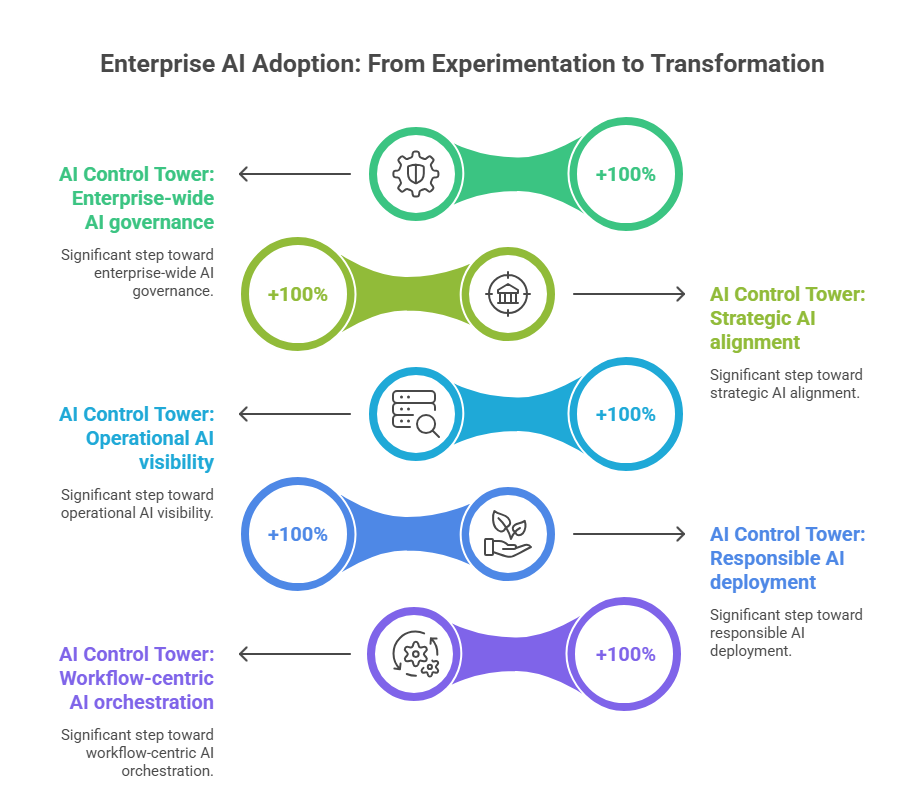
The platform represents a significant step toward:
- Enterprise-wide AI governance and policy standardisation
- Strategic alignment between AI investments and business outcomes
- Centralised operational visibility across AI ecosystems
- Responsible and auditable AI deployment models
- Workflow-centric AI orchestration across enterprise platforms
- AI lifecycle management and operational accountability
- Cross-functional governance between IT, security, risk, and business teams
As enterprise AI ecosystems continue expanding, organisations that establish centralised governance models early may gain substantial long-term advantages in:
- Operational agility and decision velocity
- Compliance readiness and auditability
- Cybersecurity resilience and risk reduction
- Workforce productivity and automation efficiency
- Enterprise-wide strategic execution
- Scalable AI adoption without uncontrolled operational sprawl
The broader implication is becoming increasingly clear.
The future of enterprise AI will not simply belong to organisations that use AI tools.
It will belong to organisations capable of governing, orchestrating, and operationalising AI at enterprise scale.
Key Takeaways
- Centralised AI governance transforms fragmented AI initiatives into scalable, operationally governed enterprise capabilities.
- ServiceNow AI Control Tower combines operational visibility, governance, CMDB intelligence, CSDM service modelling, and strategic portfolio alignment to help enterprises manage AI within a unified operational framework.
- Enterprises that establish AI governance early are likely to scale innovation faster while reducing operational complexity, compliance exposure, cybersecurity risk, and unmanaged AI sprawl.