
Why the C-Suite Needs to Rethink the Configuration Management Database
For years, the Configuration Management Database (CMDB) has been treated as a necessary evil—a technical inventory that IT teams grudgingly maintain while executives struggle to see its strategic value. But that mindset is rapidly becoming a competitive liability.
Consider what the CMDB is expected to answer during a critical business moment:
- What services are running on this infrastructure?
- What changes are safe to make?
- Which customers, employees, or revenue-generating processes will be affected by an outage?
- Can the organization prove that its operational data is controlled and trustworthy?
The difficulty is not merely collecting more data. It is making sure that the data represents the right configuration items (CIs), that duplicate records are not created, that authoritative sources are respected, and that relationships between technology components reflect reality. That is where ServiceNow’s CMDB CI Class Manager becomes strategically important. It gives organizations a governed way to define the structure, identity, ownership, relationships, and data-management behavior of CI classes. In practical terms, it turns the CMDB from a technology inventory into an operational model that leaders can use for resilience, risk, service continuity, and investment decisions.
The Business Problem: An Inventory Is Not an Operating Model
A list of servers, applications, databases, and services is useful, but it is not enough to run a modern enterprise. A list does not automatically explain :
- whether two records describe the same real-world CI
- which discovery source should be trusted for a particular attribute
- what an application depends on
- which services are hosted on a physical or virtual resource
- what should happen when an item is retired or changed
- whether the CMDB’s structure matches the organization’s governance model
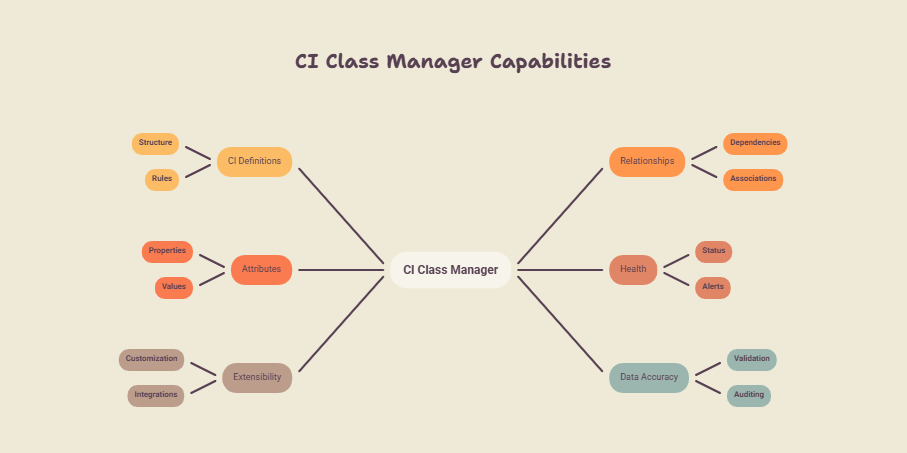
CI Class Manager addresses this gap by bringing several control points into one class-level experience . For a C-suite audience, these are not administrative checkboxes. They are controls on the quality of decisions made during change, incident response, audits, cloud transformation, and vendor negotiations.
What CI Class Manager Governs
Class Definition: A Common Language for Technology
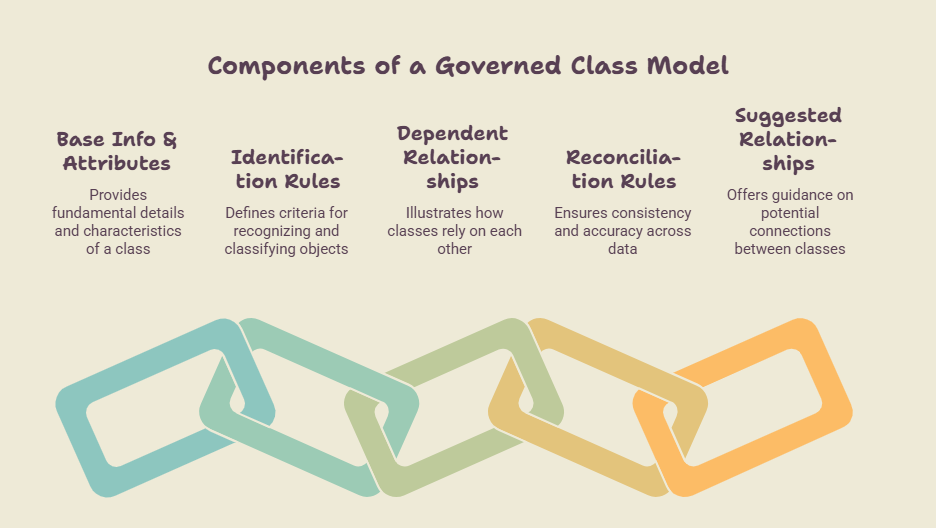
The Basic Info area establishes the identity of a CI class. It includes the display name, description, whether the class is extensible, whether it is a principal class, the table name, the managed-by group, the default product model, and an icon. These details establish more than naming consistency. They define how a technology object belongs in the CMDB and who is accountable for managing it. For example, a class such as Apache Web Server can be placed within the configuration-item hierarchy, associated with an engineering group, and connected to a default product model. That creates a bridge between technical structure and operating responsibility:
- Executives gain clearer ownership and accountability.
- Service owners gain a consistent vocabulary for reporting and impact analysis.
- Platform teams gain a governed place to extend the model without inventing disconnected structures.
- Risk teams gain more defensible evidence about what is in scope.
Attributes: The Detail Needed to Make a CI Useful
The Attributes tab defines the data fields that describe members of a class. The strategic question is not "How many fields can we store?" It is "Which fields are necessary to make an operational decision?" Excessive attributes create maintenance cost. Too few attributes weaken identification, risk analysis, and lifecycle control. A disciplined attribute model helps an organization prioritize the data that supports:
- service impact analysis
- vulnerability and lifecycle decisions
- change risk assessment
- ownership and accountability
- asset and configuration reconciliation
- reporting against internal standards
Identification Rules: Preventing Duplicate Reality
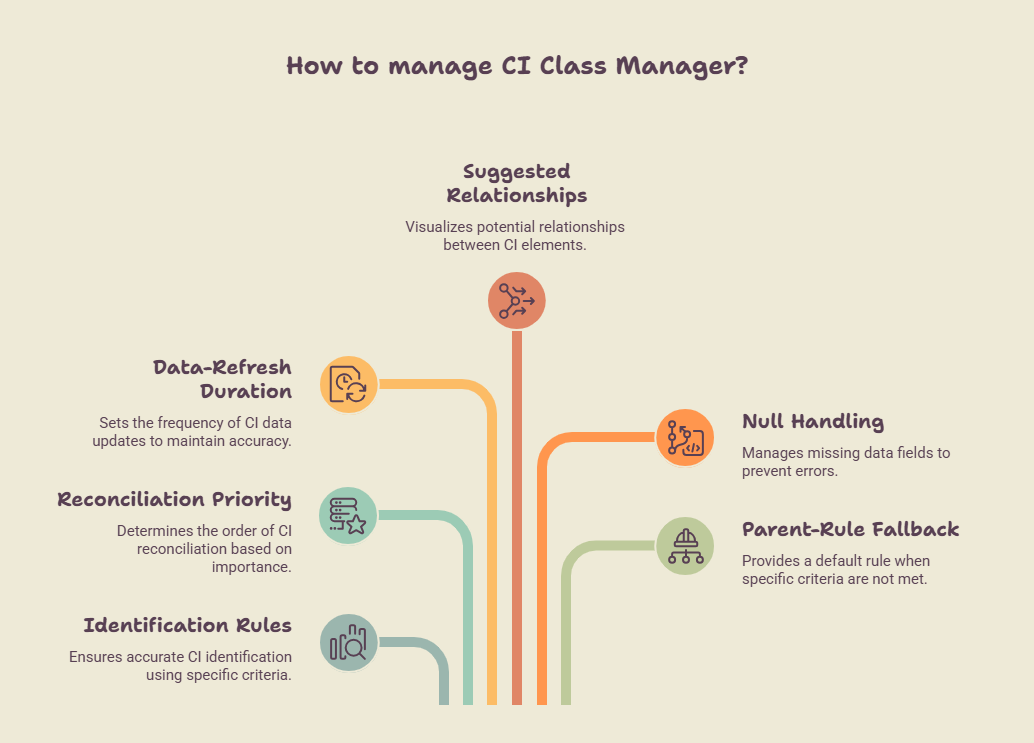
Identification rules define how ServiceNow recognizes that an incoming record belongs to an existing CI, or should create a new one. Examples of identifiers include attributes such as name, serial number, device ID, or object ID.
This is a foundational data-quality control. If identification is weak, a single server or application can appear as multiple CIs. That fragments history, splits relationships, inflates inventory, and distorts impact analysis. The walkthrough also illustrates two important rule behaviors:
- Allow null attributes: when enabled, a match may be attempted even if at least one selected criterion attribute is empty.
- Allow fallback to parent's rule: when a match is not found, the identification rule for the parent CI class can be used.
These options are powerful, but they should be governed deliberately. A permissive rule can improve matching when source data is incomplete; it can also create false matches if the chosen attributes are not sufficiently discriminating. This is precisely the kind of configuration decision that should be owned jointly by CMDB, service-management, and risk stakeholders—not left as an invisible technical default.
Dependent Relationships: Understanding What Relies on What
Dependent relationships describe how CIs rely on one another. The business value is immediate: when a server, application, or database changes state, the organization can reason about downstream consequences. Three executive outcomes follow:
- Dependency mapping: make technology dependencies visible.
- Impact analysis: estimate which applications or services may be affected by an outage or change.
- Lifecycle management: coordinate decommissioning, replacement, and maintenance across dependent CIs.
The configuration also distinguishes between hosting rules and containment rules. Hosting rules apply to lower-level physical or virtual resource relationships. Containment rules describe which objects a CI type can contain or which objects can exist within a service definition. This distinction helps prevent relationship models that look plausible but do not represent the actual technical topology.
Reconciliation Rules: Protecting the Truth
Identification asks, "Which CI is this?" Reconciliation asks, "Which source is allowed to update it?"
The Reconciliation Rules tab controls which discovery sources can populate particular attributes and in what order of priority. The examples show rules for an Apache Web Server in which a source such as ServiceNow Discovery is assigned a priority . The material also shows data refresh rules, including an effective duration of seven days, so that a lower-priority authorized source may update a CI when a higher-priority source has not refreshed it within the defined period. This is a governance mechanism for competing sources. It prevents unauthorized or lower-confidence systems from overwriting trusted values while still allowing the organization to manage stale data in a controlled way. For leadership, reconciliation supports a more meaningful CMDB metric than record volume: confidence in the provenance of operational data.
Real-World Impact: From Data Graveyard to Strategic Asset
A leading U.S. energy company faced exactly these challenges. Years of custom development had created unnecessary complexity in their ServiceNow CMDB, with extensive customizations limiting adoption of new capabilities. The result? Duplicate records, orphaned CIs, and fragmented lifecycle management that reduced data accuracy and operational visibility . Their transformation involved modernizing their CMDB by:
- Reducing customizations — analyzing more than 50 custom tables and migrating 35 of them to ServiceNow out-of-the-box structures
- Adopting the Common Service Data Model (CSDM) — restructuring configuration data while implementing organizational change management
- Implementing the Identification and Reconciliation Engine (IRE) — enabling accurate CI identification, automated duplicate detection, and reconciliation based on trusted data sources
- Modernizing discovery — replacing legacy probe-based discovery with Pattern-Based Discovery
The result? A trusted, high-quality CMDB that supports efficient IT operations and future platform innovation, enabling faster, more informed decisions with accurate configuration data.
The AI Imperative: Why Data Quality Matters More Than Ever
The emergence of AI-powered IT operations has raised the stakes dramatically. AI workflows can move beyond observation and initiate action—summarizing incident details, routing work to the appropriate resolver group, prioritizing vulnerability exposure, assessing change risk, and even launching remediation activities. Every AI recommendation depends on trusted, current, and governed data. Without strong controls, agents may rely on unreliable sources, expose sensitive content, or trigger unsafe actions. As one industry expert put it: "AI processes weak information rapidly. However, speed never creates accuracy". ServiceNow is actively evolving its CMDB to meet these demands, recently adding new CI types to support AI workloads, including:
- cmdb_ci_processing_unit — a base class for various types of processing units
- cmdb_ci_gpu — graphics processing units that handle AI/ML workloads
- cmdb_ci_function_ai — AI SaaS applications deployed on public cloud platforms
The organizations that get the most from AI-enabled operations will not be the ones with the most records or the loudest automation. They will be the ones that give automation a dependable model of reality.
CMDB Health: Turning Trust into Measurable KPIs
The Health area is where class design becomes measurable. The supplied material identifies three KPI groups :
- Completeness: whether required and recommended fields are populated
- Compliance: whether CMDB data follows predefined audits, certificates, or policies
- Correctness: whether integrity rules identify duplicate, orphan, stale, or otherwise incorrectly managed CIs
These indicators roll up from individual CI checks to class-level KPIs and then to overall CMDB health metrics. For a C-suite audience, the distinction is important: a high number of CIs does not prove a healthy CMDB. A more meaningful management conversation connects health measures to outcomes:
- Completeness supports better impact analysis and ownership decisions.
- Compliance supports audit readiness and policy enforcement.
- Correctness supports confidence that the CMDB reflects the environment rather than historical residue.
Why This Matters to the C-Suite
Faster Decisions Under Pressure
During an incident or major change, leaders need answers rather than a collection of disconnected records. Correct identification, trusted attributes, and meaningful dependencies shorten the path from "something changed" to "this is the business impact."
Lower Operational and Change Risk
A reliable class model makes it easier to evaluate what a change touches, which sources can alter critical attributes, and whether a component is approaching retirement. That reduces the chance of making a technically local change with enterprise-wide consequences.
Stronger Governance and Auditability
Managed groups, controlled class definitions, reconciliation priorities, and data-refresh behavior create visible governance decisions. The organization can explain not only what is in the CMDB, but why a value is there and which source was authorized to provide it.
A Scalable Foundation for Automation
Automation is only as effective as the context it receives. A CMDB with consistent classes and relationships is better prepared for service mapping, change-risk workflows, event correlation, operational resilience, and future AI-assisted experiences.
Better Return on the ServiceNow Investment
CI Class Manager helps move the CMDB conversation away from "Have we loaded enough records?" toward "Can the CMDB support the decisions our operating model requires?" That shift is critical for realizing value from ServiceNow beyond ticket management.
A Practical Executive Checklist
When evaluating a ServiceNow CMDB program, ask:
- Are the priority CI classes defined in business terms as well as technical terms?
- Is every important class assigned an accountable managed group?
- Which attributes are essential for impact, lifecycle, security, and compliance decisions?
- Can the organization explain how duplicate CIs are prevented?
- Are identification rules resilient to incomplete source data without encouraging false matches?
- Which discovery or integration source is authoritative for each critical attribute?
- What is the policy when trusted data becomes stale?
- Are dependencies modeled with correct direction and relationship semantics?
- Can service owners understand the model without becoming CMDB administrators?
- Are CMDB health measures tied to business outcomes such as change success, incident duration, or audit readiness?
The Strategic Conclusion
ServiceNow CI Class Manager is best understood as a control plane for the CMDB's meaning. It defines what a CI is, how it is recognized, which information describes it, how it connects to other CIs, and which sources are trusted to maintain it. That may sound like configuration work. At enterprise scale, it is decision infrastructure. The organizations that get the most from AI-enabled operations will not be the ones with the most records or the loudest automation. They will be the ones that give automation a dependable model of reality. By governing CI classes, identification, relationships, reconciliation, and suggested patterns, ServiceNow CI Class Manager helps create that model, and gives executives a stronger basis for resilience, accountability, and confident technology investment.
Ready to Transform Your CMDB from Inventory to Operating Model?
At TinyLoop, we help organizations move beyond treating the CMDB as a static repository and turn it into a strategic asset that drives business outcomes. Whether you're struggling with data quality, looking to implement CSDM, or preparing your CMDB for AI-powered operations, our experts can guide you through every step of the journey.
Start with the decisions the business needs the CMDB to support, then configure the class model to make those decisions reliable.
Three Key Takeaways
- A CMDB is not an inventory, it is an operating model; without governed classes, relationships, and reconciliation, automation only accelerates bad decisions.
- CI Class Manager transforms data quality from a technical burden into a strategic control plane, enabling faster incident response, lower change risk, and audit-ready governance.
- The true AI moment in IT operations isn't a chatbotz, it's having trusted, context-rich CIs that give automation a dependable model of reality, turning configuration into decision infrastructure.