
Why ServiceNow CI Class Manager deserves executive attention
For many organisations, the Configuration Management Database (CMDB) is expected to answer some of the most important questions during a critical business moment: What services are running on this infrastructure? What changes are safe to make? Which customers, employees, or revenue-generating processes could be affected by an outage? And can the organisation prove that its operational data is controlled and trustworthy?
The challenge, however, is not simply collecting more data. Modern organisations already have enormous amounts of information spread across discovery tools, applications, infrastructure, cloud platforms, and other sources. The real challenge is making sure that the information represents the right configuration items (CIs), that duplicate records are not created, that trusted sources are used, that ownership is clear and, most importantly, that relationships between technology components accurately reflect reality. This is where ServiceNow CI Class Manager becomes strategically important. Rather than treating the CMDB as simply a large technology inventory, CI Class Manager provides a governed way to define the structure, identity, ownership, attributes, relationships, and data-management behaviour of CI classes. In other words, it helps turn configuration data into an operational model that leaders can use when making decisions about resilience, risk, service continuity and technology investment. The important point is easy to miss: intelligence does not begin with an AI interface. It begins with good structure and reliable context. If the foundation is unclear, automation simply allows bad information to move faster.
The current-state problem: an inventory is not an operating model
Imagine an organisation that has thousands of servers, applications, databases, and other technology components recorded in its CMDB. On paper, it may appear to have excellent visibility. But when a major incident occurs, someone asks a much more difficult question:
“What does this actually affect?”
A simple inventory cannot necessarily tell you whether two records represent the same real-world CI, which discovery source should be trusted, what an application depends on, which services are running on a particular resource, who owns the technology, or what should happen when it is changed or retired. This is where CMDB maturity becomes important. A useful way to look at maturity is not by asking “How many CIs do we have?”, but by asking “How much can the organisation trust the information when it needs to make a decision?”
At a basic level, an organisation may simply have an inventory. A more mature CMDB introduces governed classes, ownership, and reliable attributes. A stronger CMDB adds accurate relationships, reconciliation, and measurable health. At the most useful level, the CMDB becomes a trusted decision foundation that connects technology, services, risk, and business outcomes. This is not an external industry benchmark; it is a practical maturity lens for assessing where an organisation is today and what it needs to improve.
A simple maturity benchmark: Inventory → Governed → Trusted → Decision-ready
The journey is therefore not about adding more records for the sake of having more records. It is about improving the quality, meaning, relationships, and confidence behind those records.
What CI Class Manager actually govern
At the centre of this journey is the CI class. A CMDB class provides a common language for describing a particular type of technology. CI Class Manager brings several important controls into one experience, including class definition, attributes, identification rules, relationships, reconciliation, and CMDB Health.
Class definition: creating a common language
The Basic Info area establishes the identity of a CI class, including its display name, description, extensibility, principal-class status, table name, managed-by group, default product model, and icon. These may sound like technical configuration details, but they have a direct operational meaning. When an organisation defines a class such as Apache Web Server, it is deciding what that technology represents, where it belongs within the CMDB hierarchy, and who is responsible for managing it. That creates a connection between technology and accountability. Executives can understand ownership more clearly, service owners gain a consistent vocabulary for reporting and impact analysis, platform teams gain a governed structure for extending the model, and risk teams have stronger evidence of what technology is actually in scope.
Attributes: capturing the information that matters
The next question is simple: What information actually makes this CI useful?
The answer is not “as many fields as possible.” Too many attributes increase maintenance effort, while too few make identification, risk analysis, and lifecycle management difficult. The better approach is to identify the information required to make an operational decision.
For example, the organisation may need attributes that support impact analysis, vulnerability and lifecycle decisions, change-risk assessment, ownership, reconciliation and reporting. The principle is straightforward:
If an attribute cannot support a meaningful operational or business decision, question whether it belongs in the model.
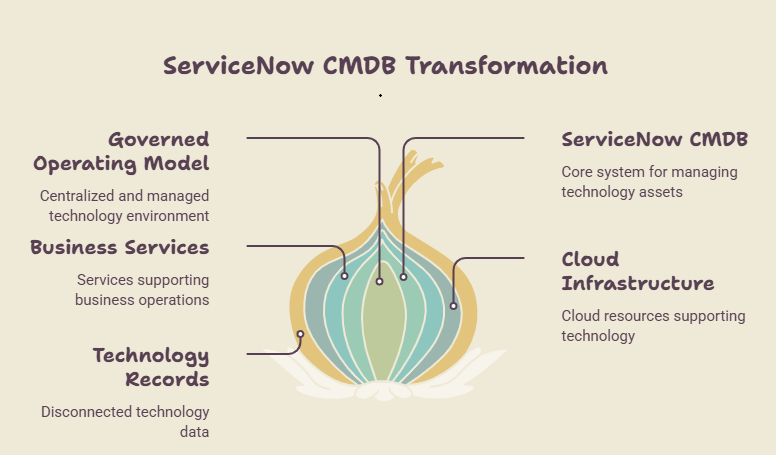
CI Class Manager helps turn configuration data from a technology inventory into a governed operating model.
Identification: preventing a duplicate version of reality
One of the most important controls in a CMDB is identification.
Identification rules determine whether incoming information belongs to an existing CI or whether ServiceNow should create a new one. Depending on the class, identifiers may use information such as class, configuration file, version, name, serial number, device ID, or object ID.
Why does this matter?
Because if identification is weak, the same server or application can appear as multiple CIs. Suddenly, history becomes fragmented, relationships are split, inventory becomes inflated, and impact analysis becomes unreliable. The technical configuration also includes important behaviours such as Allow null attributes and Allow fallback to parent’s rule. These can help deal with incomplete source information, but they must be governed carefully because overly permissive matching can create false matches. This is a good example of why CMDB management is not simply an administrator's task. Identification decisions can affect service management, risk, reporting, and business continuity.
Relationships: understanding what depends on what
A CI becomes much more valuable when its relationships are accurate.
Knowing that an organisation has a server is useful. Knowing that the server hosts a particular application, which supports an application service, which supports a critical business process, is much more powerful. Relationships allow organisations to move from “What do we have?” to “What depends on it?”
This enables dependency mapping, impact analysis, and lifecycle management. It also requires correct relationship semantics. A server may run on another resource, a database may run on a server, and a service may depend on an application; the direction and meaning of those relationships matter because analytics, automation, and impact analysis depend on them. This is where the AI conversation becomes practical. AI and automation can recommend patterns and surface information, but the recommendations are only meaningful when the underlying relationship vocabulary is governed and accurate.
Reconciliation: protecting the truth
Identification answers: “Which CI is this?”
Reconciliation answers: “Which source is allowed to update it?”
This distinction is fundamental. The Reconciliation Rules capability controls which discovery sources can populate particular attributes and establishes their priority. The supplied material also demonstrates data-refresh rules, including a seven-day example, allowing a lower-priority authorised source to update information when a higher-priority source has not refreshed the CI within the defined period. This gives the organisation a controlled way to manage competing sources. Instead of allowing whichever system updates last to become the “truth,” the organisation can define which sources are trusted for specific information and how stale data should be handled.
For leadership, this creates a much more valuable question than “How many records are in our CMDB?”
The better question is: “How confident are we in the source and accuracy of the information we are using to make decisions?”
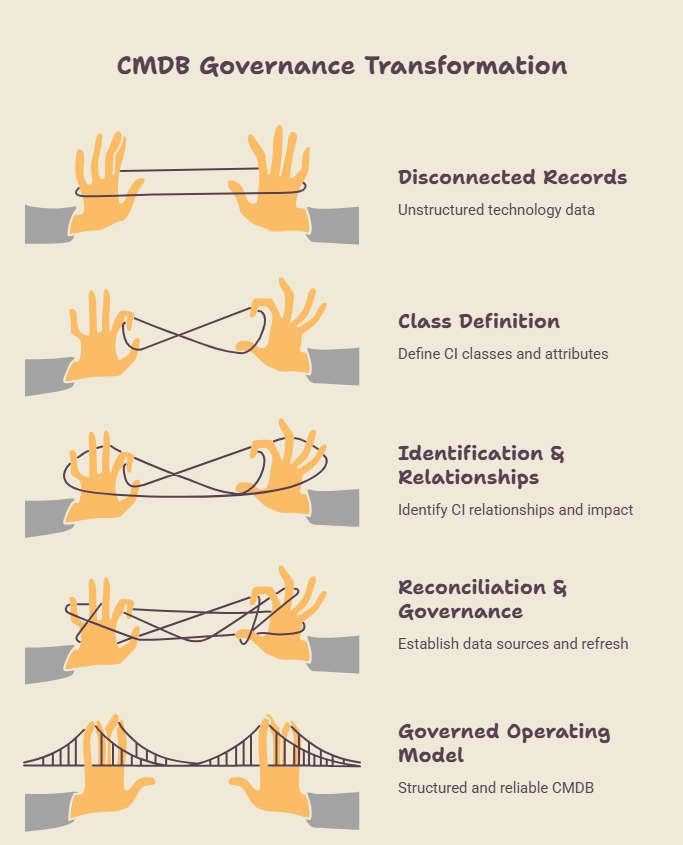
A governed CMDB connects classification, identity, relationships, and trusted data sources into one operating model.
Suggested relationships: turning expertise into repeatability
Not every ServiceNow administrator should need to memorise every valid relationship. That is where Suggested Relationships become useful. The supplied examples include relationships such as provides power for, runs on, distributed by a load balancer, uses a unique certificate, depends on storage or a database, and runs on Windows, UNIX, or Linux Server. The value is not simply convenience. Suggested relationships make the intended architecture visible and help make relationship design repeatable. They also provide a useful guardrail against incorrect relationship directions. For example, a rack may provide power for a server, but a server does not “run on” a rack. A database may run on a server, but the reverse relationship would not accurately represent the technical topology. These details matter because a relationship that looks reasonable to a person can still produce incorrect results when used by analytics, automation, or impact analysis. The relationship experience can also be filtered by direction and relationship type, making relationship design more structured and reviewable rather than dependent on individual administrator knowledge.
One view of the rules that shape reality
As CMDB environments become more complex, visibility of the rules themselves becomes important. The All Relationship Rules view brings together applicable relationship rules, including inherited rules and rules configured directly for a class, while allowing filtering by direction and type. This gives technical teams a clearer picture of how the model behaves, but it also creates value for leadership because hidden or inconsistent relationships can represent hidden operational risk. The same experience also includes the CI List for viewing CIs within a selected class and Pinned Classes for quickly returning to commonly used classes. These may seem like small usability features, but reducing friction helps teams stay within governed processes instead of returning to spreadsheets or disconnected documentation.
CMDB Health: turning trust into measurable performance
A mature CMDB cannot simply say that its data is “good.” It needs to measure it.
This is where CMDB Health becomes important. The supplied material highlights three core areas:
- Completeness — are the required and recommended fields populated?
- Compliance — does the data meet defined policies, audits, or certificates?
- Correctness — are there duplicate, orphaned, stale, or otherwise incorrectly managed CIs?
These measures can roll up from individual CI checks to class-level KPIs and ultimately to broader CMDB health. But there is an important executive lesson here:
A large CMDB is not necessarily a healthy CMDB.
A CMDB containing millions of records does not automatically mean an organisation has reliable information. The real value comes when health measures connect to business outcomes. Completeness can support better impact analysis and ownership decisions. Compliance can support audit readiness. Correctness can increase confidence that the CMDB represents the current environment rather than historical residue. This turns CMDB Health from a technical dashboard into a management conversation.
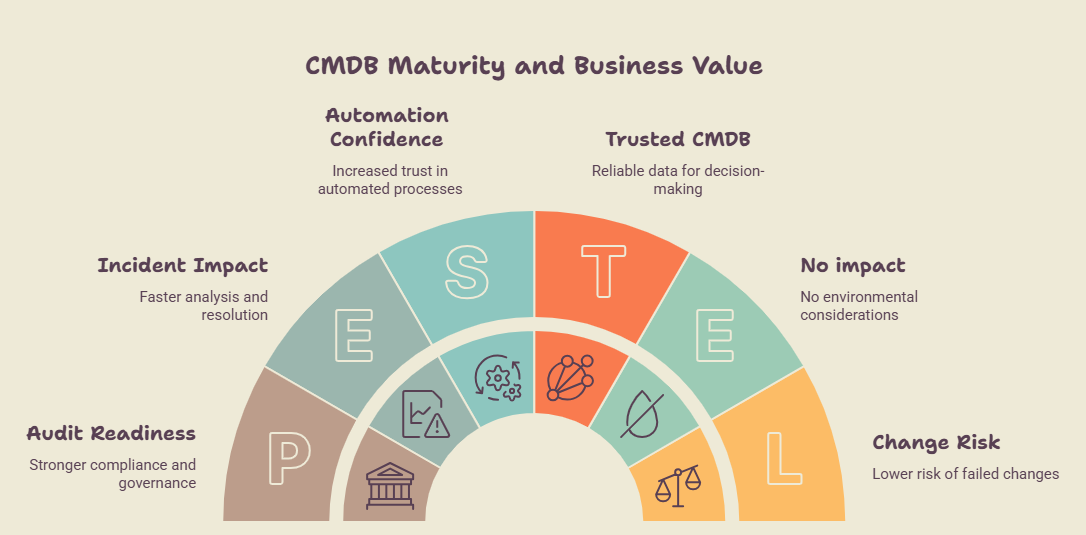
CMDB health becomes valuable when data-quality measures are connected to operational and business outcomes.
The CMDB can be governed centrally without hiding the platform
CI Class Manager provides a central experience for creating and updating CI classes, managing attributes, defining identifiers, setting reconciliation rules, modelling relationships and configuring CMDB Health. Its hierarchy makes the structure easier to understand, for example: Configuration Item → Application → Infrastructure Service → Web Server → Apache Web Server
At the same time, the underlying ServiceNow configuration remains accessible through areas such as System Definitions → Tables, Configuration → CI Identifiers, and Configuration → Suggested Relationships.
This is an important enterprise design principle: centralise the experience without hiding the underlying platform. It gives broader teams a simpler way to work while retaining the depth required by ServiceNow specialists.
The design decisions that determine whether a CMDB scales
A sophisticated CMDB interface cannot compensate for a poor underlying data model. The class structure needs to be intentional. CMDB classes group CIs that share attributes and are stored in their own tables, with parent-child relationships allowing more specialised classes to inherit from broader ones. For example, a Server can be a parent of Windows Server and Linux Server. The temptation is often to create a new class whenever something looks different. But every additional class creates more governance: more attributes, identification rules, reconciliation decisions, relationships, health conditions, and maintenance.
The better question is not: “Can we create a class for this?”
It is: “Will this distinction improve an important business or operational decision?”
That simple question can prevent significant technical debt. Understand the base table and foundational data. The CMDB is organised around the cmdb_ci base parent table, while configuration items connect with foundational information such as users, groups, companies, cost centres and locations, as well as assets, models and maintenance schedules. This distinction matters. A user, location, or company does not automatically become a CI simply because a CI references it. Foundational data provides the context needed to understand who owns, manages, supports, or is accountable for the technology. This is what moves the CMDB beyond a technology inventory. It begins to connect technology with people, accountability, cost, geography, support structures, and maintenance.
Do not confuse an application with an application service
One of the most important concepts when building a meaningful CMDB is understanding that Application, Application Service, and Business Application are not interchangeable terms. An application generally represents a technical software component or deployable technology. An application service represents a service instance delivered through technology and made available to consumers. A business application provides a more business-oriented product, capability, or portfolio perspective.
Why does this distinction matter?
Because collapsing these concepts into one record can make it difficult to understand: What software exists, what service is being delivered, and which business capability or portfolio investment the service supports. That is why CSDM alignment should be considered early in a CMDB programme rather than treated as a cleanup exercise after implementation.
Data quality starts with understanding how information is obtained
Not every attribute can be discovered automatically. The supplied material distinguishes between discoverable attributes, such as name, manufacturer, model ID, serial number, operating system, IP address, and location, and non-discoverable attributes, such as support group, approval group, managed-by group, and change group. This distinction should influence the operating model. Discovery, Service Mapping, or Agent Client Collector may provide information that can be observed automatically, while ownership, approvals, and governance assignments may require a trusted process or authoritative integration. This is why organisations should identify the authoritative source for important attributes before creating large numbers of custom fields. A field that cannot be populated reliably does not create intelligence. It creates maintenance work.
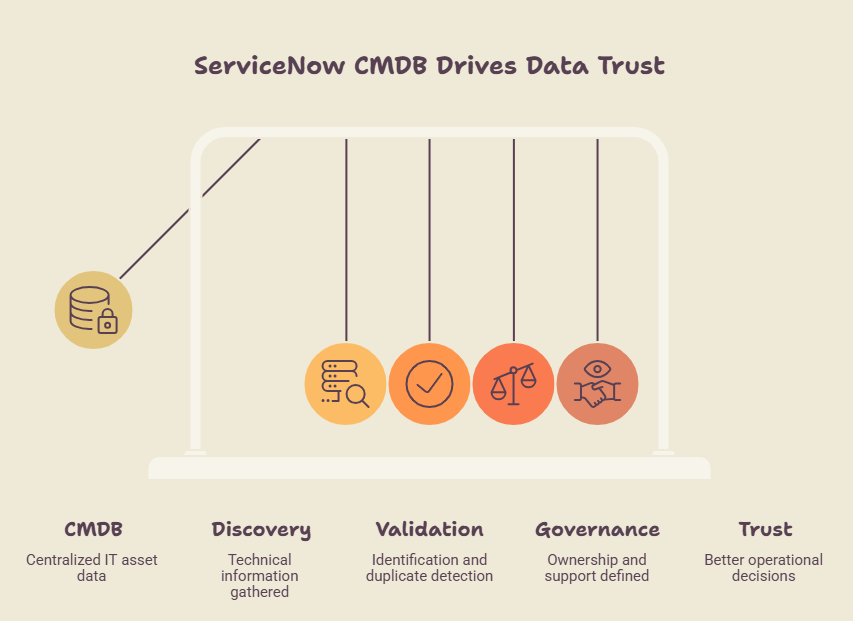
Trusted CMDB data begins with understanding where information comes from, how it is validated, and who governs it
From CMDB health to an AI-ready foundation
The relationship between CMDB quality and AI becomes clearer when we look at the entire lifecycle. The class structure, attributes, identifiers, relationships, and foundational references all influence CMDB Health. If attributes are poorly defined, completeness falls. If ownership is inconsistent, compliance and reporting weaken. If classes are too broad or too specialised, correctness and relationship analysis become harder. A practical governance cycle is therefore:
- Define the class and its business purpose.
- Select the attributes that matter.
- Identify what can be discovered and what requires ownership or integration.
- Establish identifiers and authoritative sources.
- Model valid relationships.
- Measure completeness, compliance, and correctness.
- Refine the model based on evidence.
The important point is that this is a continuous cycle rather than a one-time CMDB project. It creates structured and explainable data that automation can use with greater confidence.
What this means for the C-suite
For executives, the value of CI Class Manager is not the configuration screen itself. The value is what happens because the configuration is governed properly. During a major incident, leaders need to know what is affected and where the impact will spread. During a major change, they need confidence that the organisation understands the dependencies. During an audit, they need evidence that operational data is controlled. During transformation, they need visibility into what technology supports which services and business capabilities. A trusted CMDB can therefore contribute to:
- Faster decisions during incidents and major changes
- Lower operational and change risk
- Stronger governance and auditability
- Better foundations for automation and AI-enabled operations
- Greater value from the ServiceNow investment
The important shift is from asking: “Have we loaded enough CIs?”
to asking: “Can our CMDB support the decisions our operating model requires?” That is a much more valuable question.
Operational deliverables: what a mature CMDB programme should reveal
A strong CMDB assessment should not stop at technical configuration. It should help an organisation understand the operational problems hidden inside its data and processes.
The assessment can therefore lead to practical deliverables such as root-cause analysis, incident-trend analysis, SLA analysis, process-pain-point assessment, workflow assessment and platform-optimisation opportunities. The purpose is to connect CMDB findings with what teams experience every day: incidents that take too long to resolve, changes that create unexpected impact, ownership that is unclear, stale records that reduce confidence, and workflows that require unnecessary manual effort. This is where CMDB work becomes operational improvement rather than simply data management.
Strategic deliverables: moving from findings to action
Once the current state is understood, the next question is: What should the organisation do next?
The answer should be practical rather than theoretical. A useful strategic output is a quick-wins register that identifies improvements that can be delivered quickly, followed by prioritised recommendations based on business value, risk and effort. From there, the organisation can assess AI opportunities, define target operating model recommendations and establish an implementation roadmap. The roadmap should not attempt to transform everything at once. A mature approach is to start with the decisions that matter most, strengthen the relevant classes and relationships, measure the results, and then expand.
The strategic conclusion
ServiceNow CI Class Manager is best understood as a control plane for the meaning of the CMDB. It helps define what a CI is, how it is identified, what information describes it, how it connects to other CIs, which sources are trusted, and how the quality of that information is measured. That may initially sound like configuration work. At enterprise scale, it is much more than that. It is decision infrastructure. The organisations that gain the most from automation and AI-enabled operations will not necessarily be the ones with the most CMDB records or the most automation. They will be the organisations that can give their technology and automation platforms a dependable model of reality. That starts with getting the fundamentals right: clear classes, useful attributes, reliable identification, accurate relationships, trusted sources, measurable health and strong governance.
For TinyLoop, the opportunity is therefore not simply to help an organisation “build a CMDB.” It is to help the organisation answer a more important question: Can your CMDB be trusted when the business needs to make an important decision?
Three key takeaways
1. A CMDB is valuable because of the decisions it enables, not the number of records it contains.
Good classification, attributes, identification, relationships, reconciliation, and health create the confidence needed for incident management, change decisions, governance, and service visibility.
2. CMDB maturity is a journey from inventory to trust.
The progression is Inventory → Governed → Trusted → Decision-ready, with the focus moving from collecting data to understanding its meaning, quality, ownership, and business impact.
3. AI needs a dependable operational foundation.
Automation can move information faster, but it cannot compensate for poor classification, incorrect relationships, duplicate CIs, or unreliable data sources; a well-governed CMDB gives AI and automation the context required to produce more confident outcomes.