Artificial Intelligence is no longer just a productivity tool. It is rapidly becoming the operating system behind modern enterprises. While many organisations are still experimenting with Generative AI, ServiceNow is already focused on the next evolution: the Autonomous Enterprise.
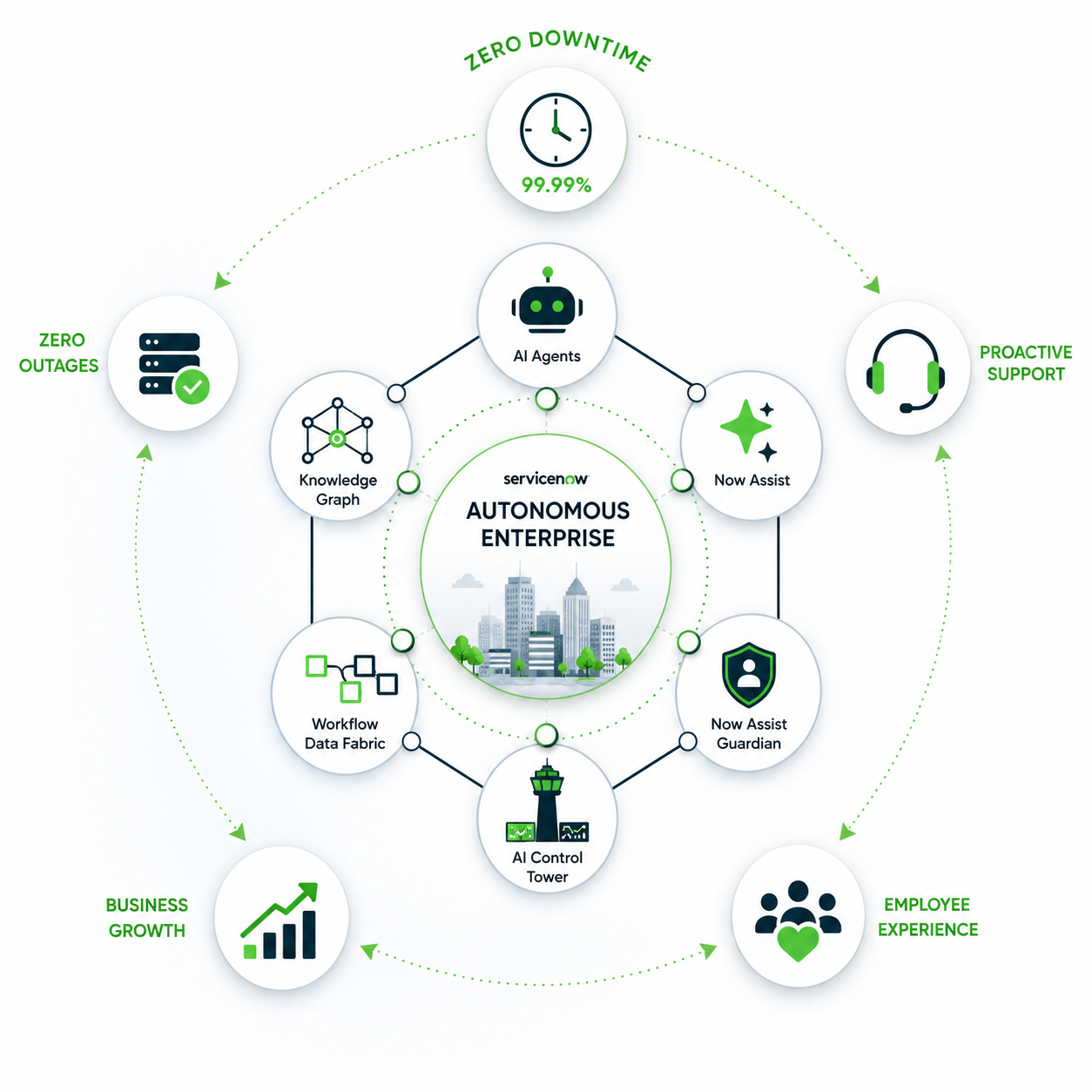
Imagine an organisation where IT issues are detected and resolved before users notice them, incidents are automatically triaged and closed, employees receive proactive support, and business workflows continuously optimise themselves without manual intervention. This is the future ServiceNow is building through its AI Platform, AI Agents, Now Assist, Knowledge Graph, AI Control Tower, and Now Assist Guardian.
In this guide, we'll explore ServiceNow's vision for autonomous operations, why AI ethics and trust matter, and how organisations can prepare for the next wave of enterprise AI innovation.
What Is an Autonomous Enterprise?
An Autonomous Enterprise is an organisation where AI continuously monitors, analyses, predicts, and acts across business operations with minimal human intervention.
Rather than waiting for employees to report problems, AI identifies issues early, recommends actions, and often resolves them automatically. The goal is not simply automation. The goal is to create an intelligent enterprise that learns, adapts, and improves continuously.
ServiceNow describes this future with three ambitious objectives:
While these goals may seem ambitious, many organisations are already taking steps toward them using ServiceNow AI capabilities.
Why ServiceNow Is Leading the Autonomous Enterprise Movement
Historically, IT teams have operated in a reactive mode. A problem occurs, a ticket is raised, and someone investigates the issue. ServiceNow is changing that model. Using AI Agents, predictive analytics, Knowledge Graph technology, workflow automation, and enterprise-wide orchestration, ServiceNow enables organisations to move from reactive support to proactive business transformation. ServiceNow CEO Bill McDermott often describes the platform as a control tower for business transformation. Rather than acting solely as an ITSM platform, ServiceNow is evolving into an enterprise-wide AI platform that coordinates people, processes, systems, and AI agents from a single control point.
This allows organisations to improve resilience, reduce operational costs, and create better employee experiences.
How AI Agents Are Driving Autonomous Operations
An AI Agent is an intelligent digital worker capable of understanding context, making decisions, and performing actions without constant human involvement.
Unlike traditional automation, AI Agents can reason through situations and adapt their responses based on changing conditions.
Within ServiceNow, AI Agents are being embedded across multiple workflows.
In IT Service Management (ITSM), AI Agents can automatically classify incidents, provide updates during major outages, recommend solutions, and even close tickets once issues are resolved. Within IT Operations Management (ITOM), AI Agents can perform automated triage, analyse root causes, detect anomalies, and identify potential failures before they impact users.
In IT Asset Management (ITAM), AI Agents can assist with software and hardware procurement, ensure compliance, and optimise asset utilisation.
For Strategic Portfolio Management (SPM), AI can monitor project health, identify risks, and alert managers when projects begin to drift from planned outcomes.
The result is a shift from manual administration to intelligent decision-making.
The Technology Foundation Behind Autonomous AI
Autonomous AI requires more than powerful language models. It requires a connected platform capable of understanding business context.
ServiceNow provides this foundation through several key capabilities.
Workflow Data Fabric integrates information across multiple systems, creating a unified data layer for AI.
Knowledge Graph connects relationships between people, departments, assets, services, applications, and business processes. This contextual understanding allows AI to deliver more accurate and relevant responses.
Now Assist acts as the generative AI layer that helps users create content, summarise information, generate recommendations, and improve productivity.
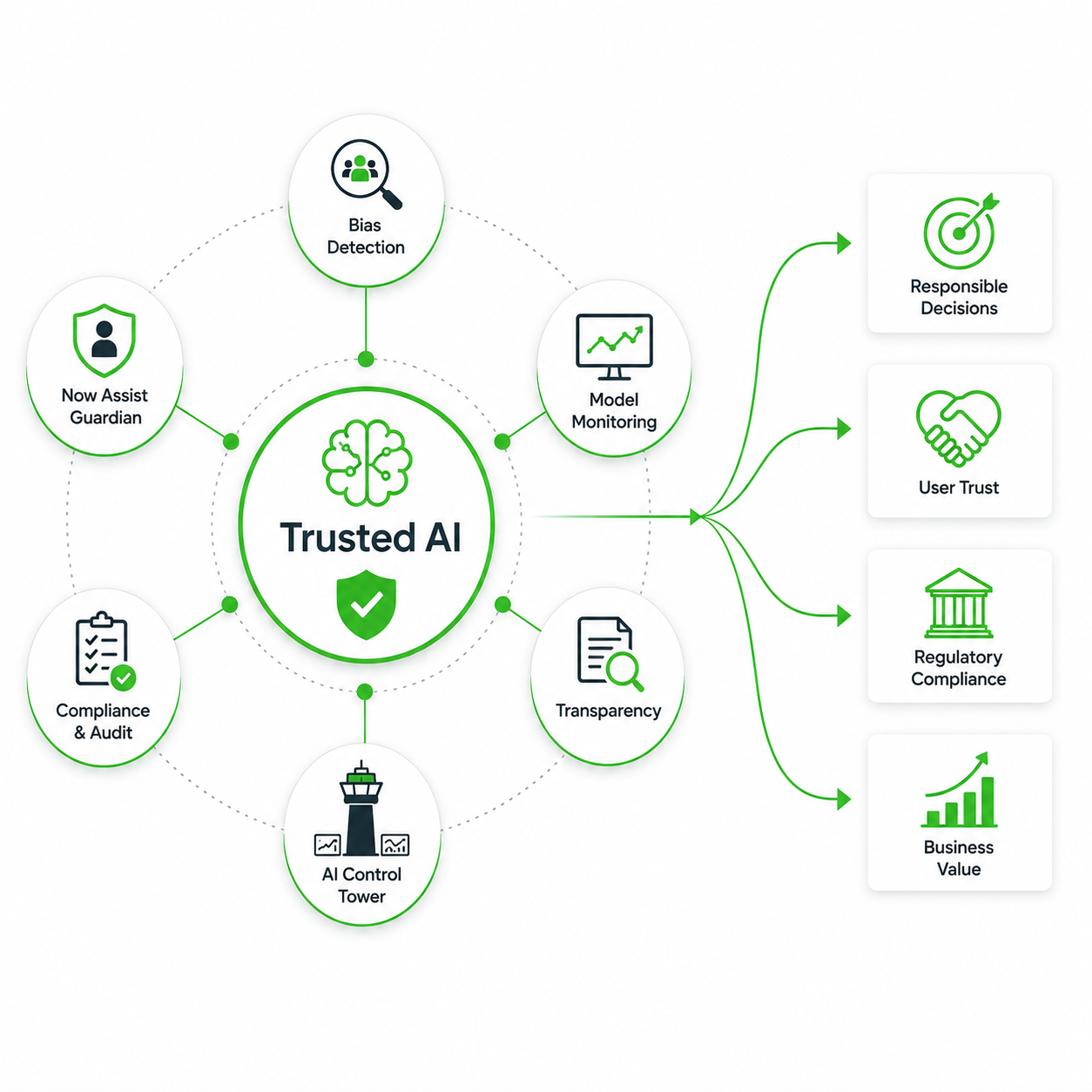
AI Control Tower provides governance, visibility, and lifecycle management across enterprise AI initiatives.
Now Assist Guardian helps organisations maintain security, compliance, and responsible AI practices.
Together, these capabilities eliminate silos and create a highly connected AI ecosystem.
Step-by-Step Guide: Preparing Your ServiceNow Environment for Autonomous AI
Although autonomous operations continue to evolve, organisations can start preparing their ServiceNow environments today.
Step 1: Enable Now Assist
Navigate to the Application Manager and install the relevant Now Assist applications for your workflows, such as ITSM, ITOM, FSM, SPM, or Security Operations.
Step 2: Configure AI Skills
Open the Now Assist Administration Console and activate the AI skills required for your business processes.
Examples include:
- Incident Summarisation
- Resolution Recommendations
- Knowledge Generation
- Chat Summarisation
- Project Summarisation
Step 3: Implement Knowledge Graph
Configure Knowledge Graph schemas and relationships so AI can understand organisational context.
This allows AI to provide personalised and context-aware recommendations.
Step 4: Establish AI Governance
Deploy AI Control Tower to monitor AI assets, models, prompts, usage, and risk controls.
Create governance workflows and approval processes for AI initiatives.
Step 5: Configure Now Assist Guardian
Implement Guardian policies to monitor AI interactions, detect risks, enforce compliance requirements, and improve trust in AI outputs.
Step 6: Monitor Adoption and Value
Use AI Control Tower dashboards to measure:
- AI usage
- Business value
- Adoption rates
- Risk posture
- Productivity gains
Why AI Ethics and Trust Matter
As AI becomes more autonomous, organisations must ensure that systems remain trustworthy, transparent, and accountable. Three major challenges must be addressed.
Bias
Bias occurs when AI produces unfair or unbalanced outcomes. Bias can originate from training data, business processes, or implementation decisions. If left unchecked, it can result in poor decisions, regulatory concerns, and reduced user confidence. ServiceNow addresses this through AI governance controls, human oversight, and Guardian-based monitoring.
Model Drift
Model Drift occurs when AI performance declines because business conditions, data, or user behaviours have changed over time. An incident routing model that performed well a year ago may become inaccurate as services evolve. ServiceNow combats drift through monitoring, retraining processes, and AI Control Tower oversight.
Transparency
Transparency ensures users understand why AI made a recommendation or decision. Trust increases when users can see the reasoning behind AI actions.
ServiceNow supports transparency through explainable outputs, audit trails, governance dashboards, and monitoring capabilities.
Preparing for the Next Wave of Enterprise AI
The future of AI is not only about technology. It is equally about people, skills, and organisational readiness. As AI adoption accelerates, new capabilities become increasingly important.
Prompt Engineering helps employees communicate effectively with AI systems.
AI Literacy enables teams to understand both the strengths and limitations of AI.
Data Fluency ensures organisations can interpret AI insights and maintain data quality.
Human-AI Collaboration teaches teams how to work alongside AI rather than viewing it as a replacement.
Organisations that invest in these capabilities today will be better positioned for long-term success.
Building an AI-Ready Strategy
Future-ready organisations are adopting a flexible approach to AI. Rather than relying on a single model, they are leveraging multiple AI providers, including OpenAI, Anthropic Claude, Google Gemini, Microsoft Azure OpenAI, and others, depending on business requirements. Successful organisations also embed governance from the beginning, create environments for experimentation, and design solutions that can scale across multiple business functions. Most importantly, they view AI as a long-term organisational capability rather than a short-term technology project.
The Future Belongs to Autonomous Enterprises
The autonomous enterprise is no longer a future concept. It is rapidly becoming reality. With AI Agents, Now Assist, Knowledge Graph, Workflow Data Fabric, AI Control Tower, and Now Assist Guardian, ServiceNow is creating an intelligent platform capable of predicting problems, automating actions, and continuously improving business outcomes. The organisations that embrace this shift today will be better positioned to reduce costs, improve resilience, enhance employee experiences, and accelerate innovation tomorrow.
The future is not simply faster work. It is smarter, more predictive, and increasingly autonomous work.
Three Key Takeaways
1. Autonomous AI Is Transforming Enterprise Operations
ServiceNow's vision of zero downtime, zero outages, and zero service desk incidents is becoming achievable through AI Agents and predictive automation.
2. Governance and Trust Are Critical
AI success depends on managing bias, model drift, transparency, compliance, and accountability through solutions such as AI Control Tower and Now Assist Guardian.
3. Future Success Requires Both Technology and Skills
Organisations must invest in AI literacy, prompt engineering, data fluency, governance, and scalable AI strategies to prepare for the next wave of enterprise transformation.