
Enterprise IT operations are entering a new operational era
For years, organisations invested heavily in automation, monitoring platforms, ITSM modernisation, and digital workflows. Yet many enterprise IT environments still struggle with fragmented operations, escalating service costs, alert fatigue, siloed knowledge, and inconsistent employee experiences.
In 2026, the challenge is no longer whether enterprises should adopt AI. The challenge is how organisations operationalise AI at scale without introducing additional complexity, governance risk, or operational fragmentation.
This is where ServiceNow Now Assist is rapidly emerging as a strategic enterprise AI layer for IT operations. Rather than functioning as a standalone chatbot or productivity tool, ServiceNow Now Assist is becoming deeply integrated into enterprise workflows, operational processes, knowledge systems, incident management, and AI-driven service orchestration.
For CIOs, CTOs, and operations leaders, this signals a much larger transformation: AI is moving from isolated experimentation into enterprise operational infrastructure.
Executive Summary
Many enterprises today operate across highly distributed technology environments involving:
- Hybrid cloud infrastructure
- Multiple monitoring platforms
- Legacy ITSM workflows
- Disconnected enterprise knowledge bases
- Manual service desk processes
- Rising operational and compliance pressures
Despite major investments in digital transformation, operational maturity across IT environments often remains inconsistent.
Common enterprise challenges include:
- High Mean Time to Resolution (MTTR)
- Escalating incident volumes
- Workflow bottlenecks
- Poor cross-team visibility
- Manual knowledge retrieval
- SLA breaches
- Alert fatigue across IT operations teams
- Increasing operational costs per ticket
Now Assist introduces a fundamentally different operational model.
Using generative AI, workflow intelligence, contextual summarisation, and enterprise-wide data orchestration, ServiceNow enables organisations to embed AI directly into operational workflows rather than layering AI on top of disconnected systems. The result is faster decision-making, improved operational resilience, enhanced employee experience, and measurable service cost optimisation.
The Current State of Enterprise IT Operations
Many enterprises are still operating within fragmented IT operational models. Monitoring tools operate independently from ITSM platforms. Knowledge repositories remain disconnected from operational workflows. Incident resolution often depends on tribal knowledge rather than structured intelligence. This creates major operational maturity gaps. In many organisations:
- Incident triage remains heavily manual
- Service desk teams spend excessive time summarising tickets
- Root cause investigations lack contextual visibility
- Workflow automation exists in isolated silos
- AI adoption occurs without governance consistency
- Knowledge management remains underutilised
The result is operational inefficiency at scale.
Even mature enterprises frequently struggle to establish unified operational intelligence across infrastructure, applications, cloud environments, security operations, and employee support services. This is precisely where Now Assist is reshaping operational execution.
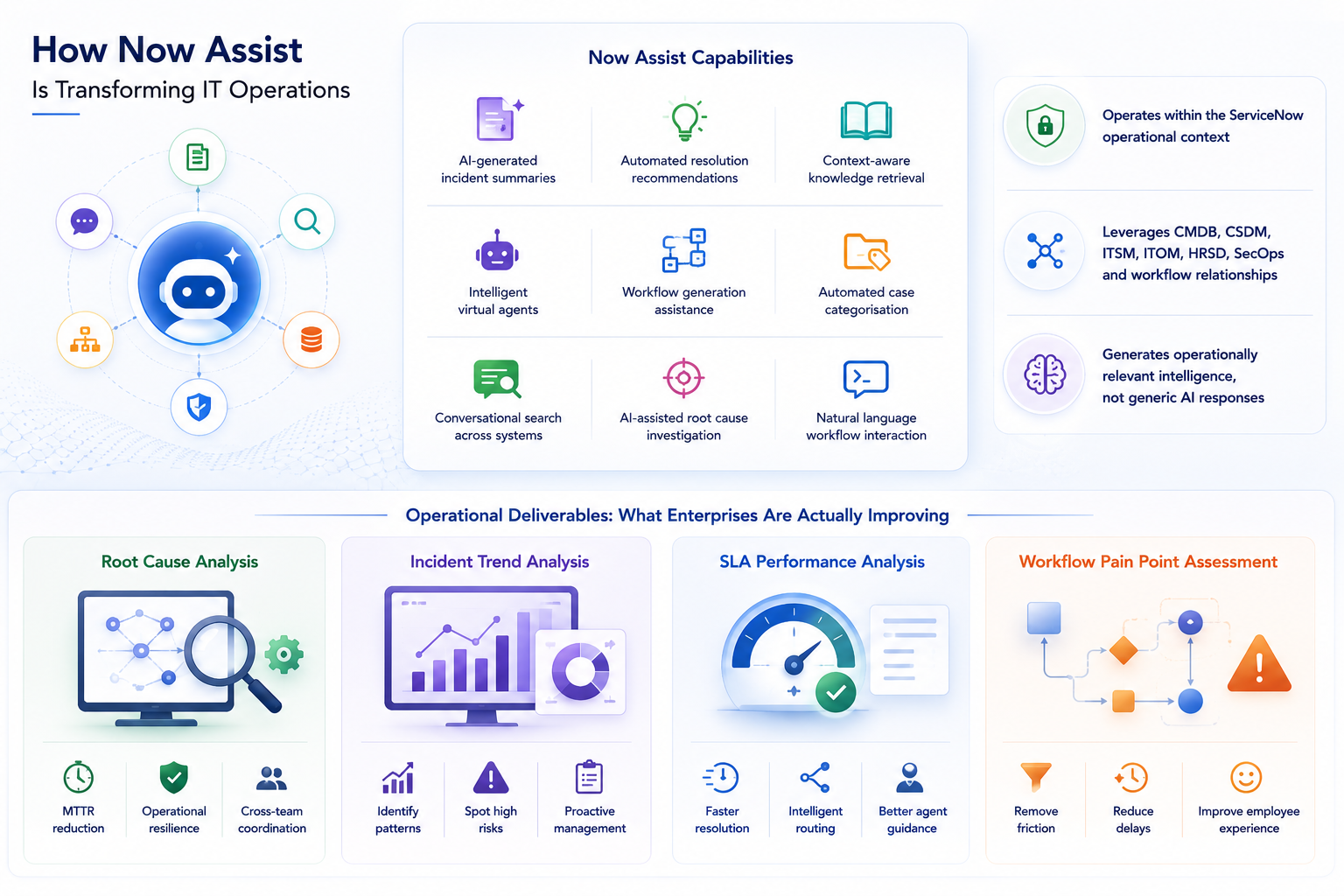
How Now Assist Is Transforming IT Operations
Unlike traditional automation platforms, Now Assist introduces contextual AI directly into enterprise workflows. The platform leverages large language models (LLMs),
workflow data orchestration, enterprise knowledge retrieval, and operational context from the ServiceNow platform to assist employees, agents, and operations teams in real time.
This includes capabilities such as:
- AI-generated incident summaries
- Automated resolution recommendations
- Context-aware knowledge retrieval
- Intelligent virtual agents
- Workflow generation assistance
- Automated case categorisation
- Conversational search across enterprise systems
- AI-assisted root cause investigation
- Natural language workflow interaction
Critically, Now Assist operates within the ServiceNow operational context. This is where its enterprise value becomes significantly more strategic than standalone generative AI tools. Because ServiceNow already maintains deep operational context through CMDB, CSDM, ITSM, ITOM, HRSD, SecOps, and workflow relationships, Now Assist can generate operationally relevant intelligence rather than generic AI responses. That distinction matters enormously in enterprise environments.
Operational Deliverables: What Enterprises Are Actually Improving
Root Cause Analysis
Traditional root cause investigations often involve multiple teams manually correlating logs, alerts, infrastructure dependencies, and incident records.
Now Assist accelerates this process by leveraging operational context across incidents, CI relationships, change records, and historical patterns.
AI-assisted summarisation enables operations teams to identify probable root causes faster while reducing investigation overhead.
This directly improves:
- MTTR reduction
- Operational resilience
- Cross-team coordination
- Incident response efficiency
Incident Trend Analysis
One of the most overlooked operational problems in enterprise IT is trend visibility.
Most organisations collect enormous amounts of operational data but struggle to extract actionable intelligence.
Now Assist helps operations teams identify:
- Recurring incident patterns
- High-risk services
- Repeat failure trends
- Knowledge gaps
- Escalation bottlenecks
- Service degradation indicators
This enables more proactive operational management instead of reactive firefighting.
SLA Performance Analysis
SLA breaches remain a major operational and financial challenge for enterprises.
Now Assist improves SLA performance through:
- Faster ticket summarisation
- Automated response recommendations
- Intelligent routing
- AI-generated agent guidance
- Reduced handling times
By reducing manual effort across service operations, organisations improve both service quality and operational scalability.
Workflow Pain Point Assessment
Many enterprises automate workflows without optimising them first.
This creates automation inefficiencies that scale operational problems rather than solving them.
Now Assist introduces workflow-level intelligence by identifying:
- Redundant approval chains
- Manual intervention points
- Delayed escalations
- Workflow abandonment patterns
- Employee experience friction
This allows organisations to optimise workflows before scaling AI automation initiatives.
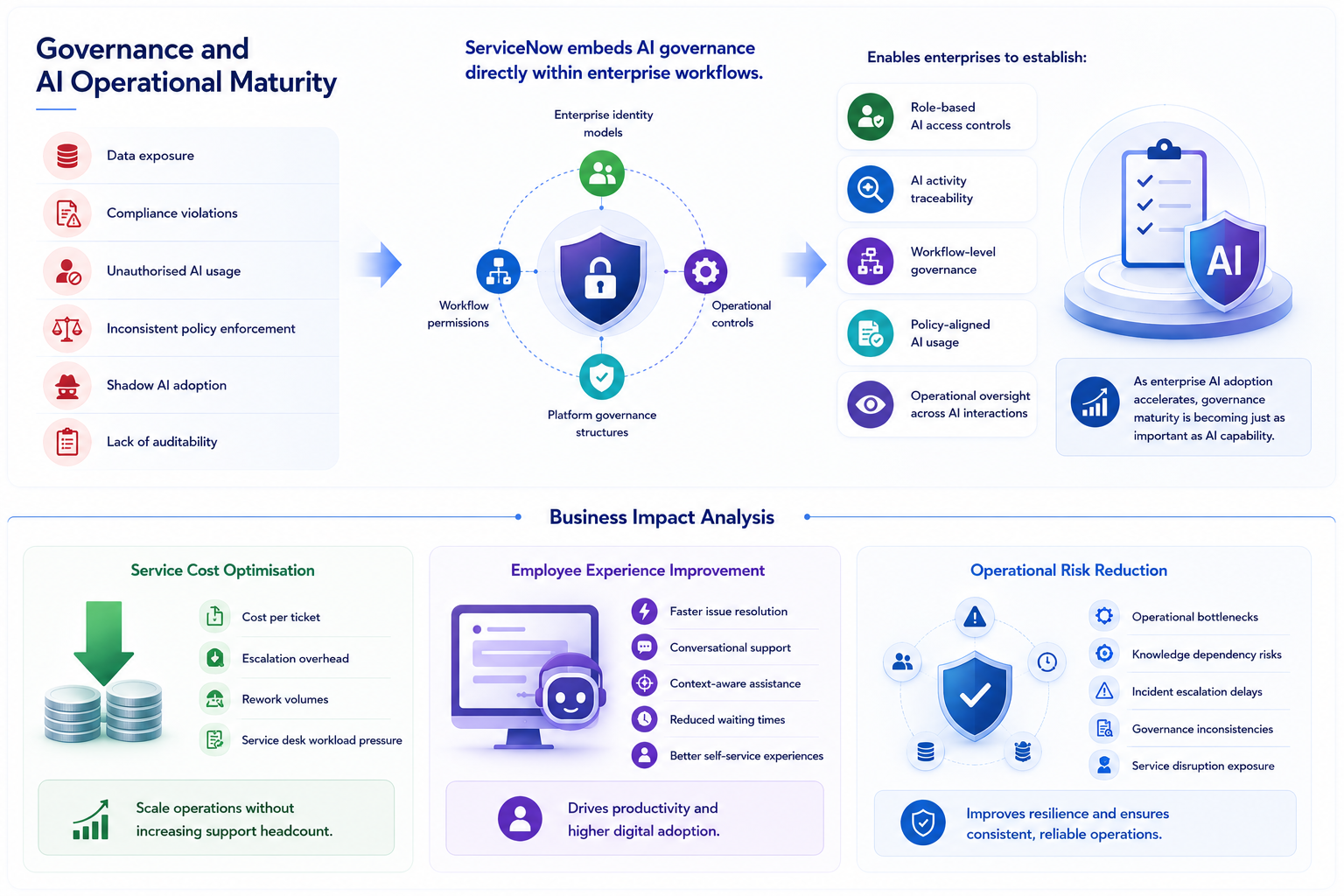
Governance and AI Operational Maturity
One of the biggest enterprise concerns surrounding generative AI is governance.
Many organisations are deploying AI tools faster than they can operationally govern them.
This creates major risks involving:
- Data exposure
- Compliance violations
- Unauthorised AI usage
- Inconsistent policy enforcement
- Shadow AI adoption
- Lack of auditability
ServiceNow addresses this challenge by embedding AI governance directly within enterprise workflows.
Unlike consumer AI platforms, Now Assist operates within enterprise identity models, workflow permissions, operational controls, and platform governance structures.
This enables enterprises to establish:
- Role-based AI access controls
- AI activity traceability
- Workflow-level governance
- Policy-aligned AI usage
- Operational oversight across AI interactions
As enterprise AI adoption accelerates, governance maturity is becoming just as important as AI capability itself.
Business Impact Analysis
The operational benefits of Now Assist extend far beyond productivity improvements.
For enterprise leadership teams, the business impact becomes measurable across multiple dimensions.
Service Cost Optimisation
AI-assisted workflows reduce manual handling effort across service operations.
This lowers:
- Cost per ticket
- Escalation overhead
- Rework volumes
- Service desk workload pressure
Organisations can scale operations without proportionally increasing support headcount.
Employee Experience Improvement
Employees increasingly expect consumer-grade digital experiences within enterprise environments.
Now Assist improves employee experience by enabling:
- Faster issue resolution
- Conversational support interactions
- Context-aware assistance
- Reduced waiting times
- Improved self-service experiences
This directly impacts workforce productivity and digital adoption rates.
Operational Risk Reduction
By improving visibility, standardisation, and workflow intelligence, organisations reduce:
- Operational bottlenecks
- Knowledge dependency risks
- Incident escalation delays
- Governance inconsistencies
- Service disruption exposure
Operational resilience becomes significantly more scalable.
Three Key Takeaways:
- ServiceNow Now Assist is transforming IT operations from reactive service management into AI-driven operational intelligence and workflow orchestration.
- Enterprises that combine AI automation with governance, CMDB context, and operational visibility will scale AI faster while reducing risk and service complexity.
- In 2026, operational success will depend less on deploying AI tools and more on operationalising AI securely across enterprise workflows, services, and employee experiences.