
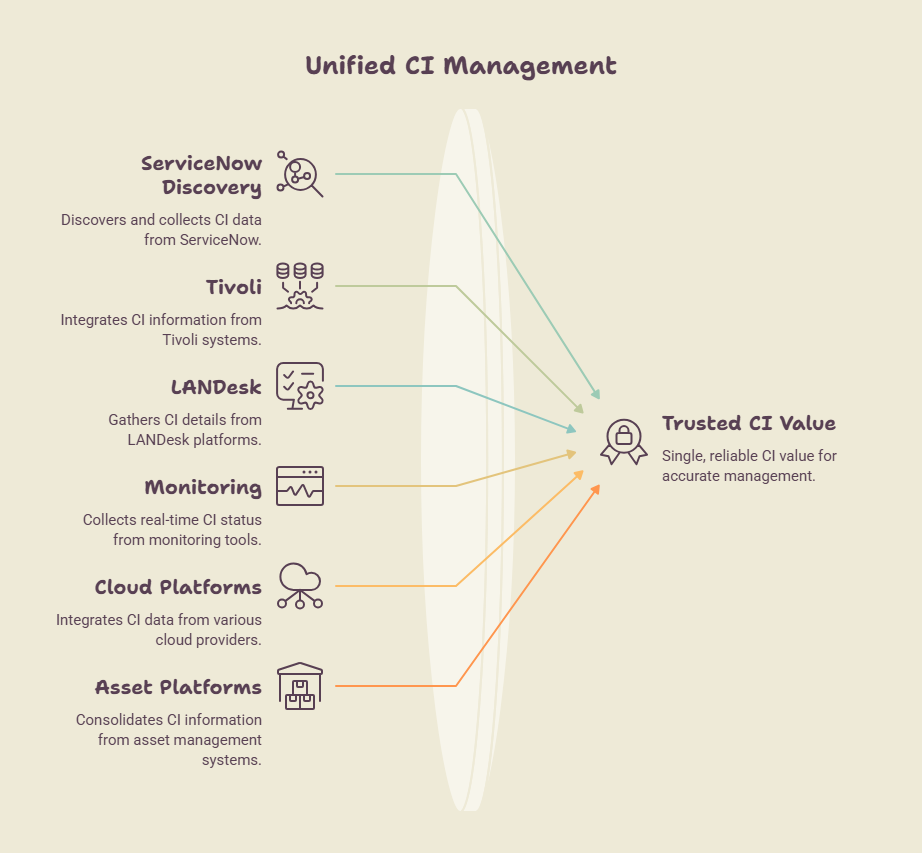
A ServiceNow CMDB is only as valuable as the data it contains. When several discovery tools, monitoring platforms, endpoint systems, cloud services, and enterprise applications update the same Configuration Item (CI), the CMDB must decide which value to trust. This is the purpose of ServiceNow CMDB Reconciliation Rules. Reconciliation Rules help control how CI attributes are updated when multiple data sources report different information. They reduce data conflicts, prevent unreliable sources from overwriting trusted values, and improve the accuracy of the CMDB for ITSM, ITOM, IT Asset Management, security, reporting, and AI-assisted operations. Dynamic Reconciliation Rules extend this capability further. Instead of depending only on a fixed source priority, they can select a value based on criteria such as the most frequently reported value, the latest reported value, or the largest or smallest numeric value. These rules are especially useful when organisations operate a Multisource CMDB with data arriving from many discovery and management platforms. For ServiceNow customers, the message is important: CMDB reconciliation is not simply a technical configuration task. It is a data governance capability that affects operational risk, service cost, employee experience, automation, and the organisation’s readiness for artificial intelligence.
Executive Summary: Why CMDB Reconciliation Matters
Most enterprises do not have one single source of infrastructure data. A Windows Server, Linux Server, database, application, or cloud resource may be identified by ServiceNow Discovery, an endpoint management platform, a monitoring tool, a vulnerability scanner, an asset system, or a third-party integration. These systems may report different values for the same CI attribute. One source may show that a server has 3,000 MB of RAM, while another reports 4,000 MB. A monitoring system may have the freshest information, but an asset system may have stronger ownership data. Without reconciliation, the last update can overwrite the existing value, even when that update is incomplete or incorrect. A reconciliation rule establishes a controlled decision process. It answers questions such as:
- Which sources are allowed to update a particular CI attribute?
- Should ServiceNow use the newest value or the most frequently reported value?
- Should the largest or smallest numeric value be retained?
- What happens when a rule exists at both a parent and child CI class?
- Which rule takes precedence when static and dynamic rules apply to the same attribute?
A mature CMDB does not attempt to make every data source equally authoritative. It applies a clear governance model so that the most useful value is retained for the correct business purpose.
The Current-State Problem: A CMDB with Conflicting Data
A simple maturity assessment usually begins with the current state. Before implementing Dynamic Reconciliation Rules, a ServiceNow team should understand how data currently enters the CMDB and how conflicts are resolved. A low-maturity environment often has manually created CIs, duplicate records, unclear ownership, and integrations that update attributes without a documented source policy. The CMDB may appear populated, but its data cannot be trusted consistently. A developing environment may have Discovery and Identification and Reconciliation Engine controls in place, but reconciliation is still based mainly on default or broad source priorities. The organisation can identify some duplicates, but it cannot always explain why a particular attribute value was selected. A managed environment has documented CI ownership, defined data sources, class-specific rules, and regular CMDB Health reviews. Teams know which source should update server hardware, application ownership, location, lifecycle, and operational status.
An optimised environment uses Multisource CMDB data, dynamic rules, data quality dashboards, automated exception handling, and service-level reporting. It also uses the CMDB as a trusted foundation for service impact analysis, automation, risk management, and AI-supported decision-making. A useful assessment should examine:
- Data completeness: Are required CI attributes populated?
- Data correctness: Are the values accurate and validated?
- Data freshness: How recently were the values updated?
- Data ownership: Is there a responsible team for each CI class?
- Data lineage: Can the organisation identify which source reported each value?
This assessment prevents a common mistake: implementing reconciliation rules without first understanding the data problem they are intended to solve.
Static and Dynamic Reconciliation Rules
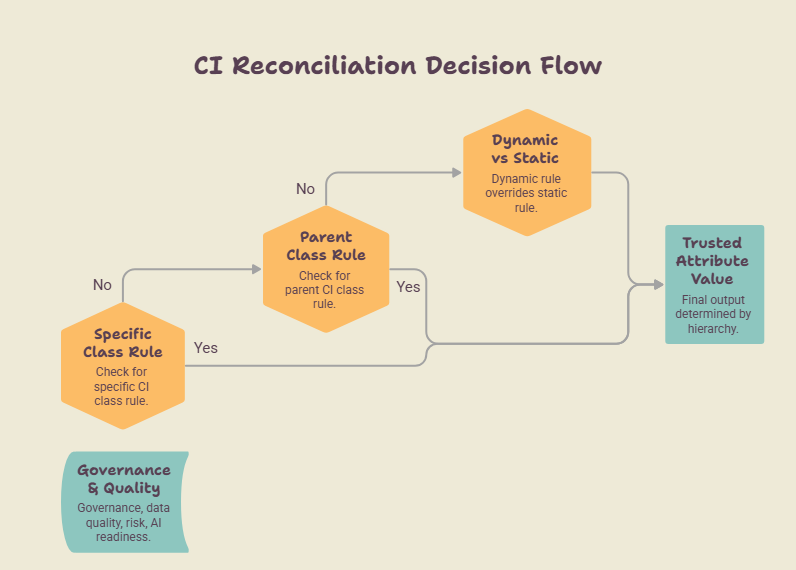
A static reconciliation rule defines which discovery source is authorised to update an attribute and establishes the priority among multiple sources. For example, a company may decide that ServiceNow Discovery is the preferred source for a server’s operating system, while an asset platform is preferred for purchase information or lifecycle status. Static rules are predictable and easy to audit. They work well when the organisation has clearly defined authoritative sources. However, they may not work well when sources provide different but potentially valid values, or when the most useful value depends on the data itself. A Dynamic Reconciliation Rule uses Multisource CMDB data to select an attribute value according to a defined rule type. It can evaluate the values reported by multiple sources and determine which value should be applied to the CMDB. Dynamic rules are optional and become available when Multisource CMDB is enabled. They can exist alongside static reconciliation rules. When both rule types apply to the same CI attribute, the dynamic rule takes precedence, allowing the data-driven decision to control the final value. This distinction is important. Static rules answer, “Which source should we trust?” Dynamic rules can answer, “Which reported value best satisfies the business or data-quality requirement?”
The Main Dynamic Reconciliation Rule Types
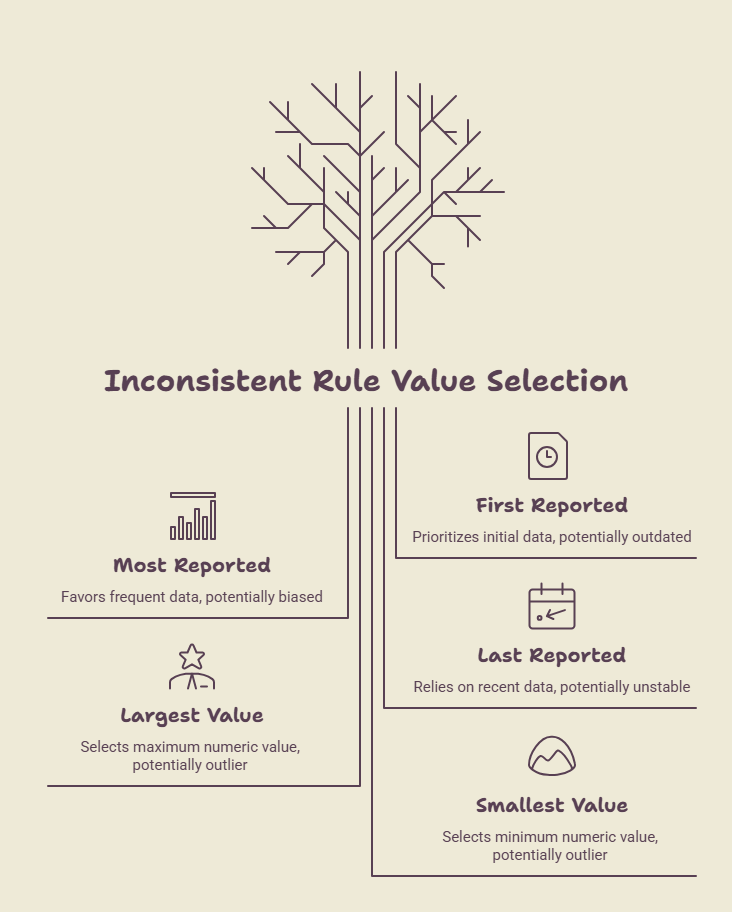
ServiceNow provides several Dynamic Reconciliation Rule types. The correct choice depends on the CI attribute and the operational purpose of the data. First Reported retains the value that was reported first within the available Multisource CMDB data. This may be useful where the initial observation is important or where the first system to identify a value has a specific operational meaning. Most Reported selects the value that appears most frequently across the available sources. This is useful when several independent systems report the same value and one outlier should not immediately replace the consensus. Last Reported uses the latest reported value. This can be appropriate for rapidly changing attributes where freshness is more important than historical agreement. Largest Value selects the largest reported value. It is useful for numeric attributes where the highest capacity or measurement is the required business choice. Smallest Value selects the smallest reported value. This may be useful when the organisation wants to retain the most conservative or limiting value, such as the lowest reported disk space. The Largest Value and Smallest Value options apply only to numeric fields. They are not intended for text values, ownership fields, application names, or other non-numeric attributes.
How to Configure a Dynamic Reconciliation Rule
The configuration process begins in the CI Class Manager. An administrator can navigate to the relevant CI class hierarchy, search for a class such as Linux Server or Windows Server, and open the Reconciliation Rule tab. The administrator then selects Add and chooses Dynamic Reconciliation Rule. The rule type and target attribute are selected in the configuration wizard. A filter condition can also be added to limit the rule to particular CIs. If no filter is added, the rule applies broadly to the selected CI class.
For example, a team might create a Smallest Value rule for the Disk Space attribute of Linux Server CIs. The rule will compare the values stored in the Multisource CMDB and retain the lowest reported value. The team might create a separate Most Reported rule for the RAM attribute, allowing the value that appears most often across the available sources to be selected. After saving the rule, the result should be validated. A practical validation approach is to perform test updates through System Definition → Scripts Background, inspect the CI record, and review the CMDB 360 Data Preview. Testing should confirm not only the final value but also the source values that were considered during processing.
Configuration should always be performed in a controlled environment first. A rule that works well for one CI class may create unexpected results for another class, particularly when the same attribute has different operational meanings.
Practical Example One: Selecting the Largest RAM Value
Consider a Windows Server CI with three reported RAM values. ServiceNow reports one value, Tivoli reports another, and LANDesk reports a third. Static reconciliation rules are also defined for the discovery sources. In this scenario, a Dynamic Reconciliation Rule is created for the RAM attribute using the Largest Value rule type. The CMDB compares the available values and retains the largest value, which in the lesson example is reported by LANDesk. The important result is that the static reconciliation rule is not used for this attribute because the dynamic rule has precedence. The three values remain available in Multisource CMDB for the Identification and Reconciliation Engine to evaluate during processing. This approach is useful when the business wants to avoid under-reporting capacity. For example, a service owner may want the highest detected memory value when planning infrastructure capacity or checking whether a server meets a technical standard.
However, the largest value is not automatically the correct value in every situation. If the goal is to report the currently active configuration, the Most Reported or Last Reported rule may be more appropriate. Reconciliation must always reflect the business question. Practical Example Two: Using the Most Reported RAM Value. A second example uses a Dynamic Reconciliation Rule for the RAM attribute, but with different rule types applied to different classes. The Server class uses Largest Value, while the Windows Server class uses Most Reported. The more specific Windows Server rule takes precedence for Windows Server CIs. In the example, Tivoli and ServiceNow report the same RAM value more frequently than the other source. The CMDB therefore retains the value that is most commonly reported.
This demonstrates two important principles:
- A rule defined for a specific CI class takes precedence over a rule inherited from a parent class.
- The most specific applicable rule controls the outcome.
It also shows why CMDB design must consider the class hierarchy. A broad rule at the Server level can provide a useful default, while a more specific rule at the Windows Server level can handle the needs of that class.
Practical Example Three: Selecting the Smallest Disk Space Value
The same logic can be applied to Disk Space. In the configuration example, the Smallest Value rule is used for Disk Space. The lowest reported value is retained from the available Multisource CMDB records.
In the example, the disk-space value remains 29.44 from Alt-RIS. This can be valuable when the objective is to identify the most constrained reported capacity. A service desk or operations team may prefer to see the lowest available disk-space value because it could represent the most urgent operational risk. A conservative rule can help identify potential storage issues before they become incidents. However, it can also create false alarms if one source reports stale or incorrectly formatted data. This is why monitoring, data-quality checks, source ownership, and exception management should be supported by reconciliation rules.
Governance, Precedence, and Operational Risk
Dynamic reconciliation is not a replacement for governance. It is one part of a wider CMDB operating model. Rules defined within a specific CI class take precedence over rules defined at a parent class. If no rule exists for the specific class, the parent-class rule can apply. If both a static and dynamic rule exist for the same CI attribute, the dynamic rule takes precedence. Documented so administrators, service owners, and auditors understand how the final value was selected. Governance should define who can create, approve, modify, and retire reconciliation rules. It should also define which attributes are business-critical. Server capacity, operating system, application ownership, service status, location, and lifecycle state may require different reconciliation strategies. Operational risk increases when a rule is created without considering the consequences. A wrong value may affect incident diagnosis, change risk assessment, vulnerability prioritisation, service mapping, compliance reporting, or capacity planning. It can also cause teams to lose confidence in the CMDB.
A strong governance process should include:
- A documented owner for each important CI class.
- A source-of-truth policy for critical attributes.
- A review process for new reconciliation rules.
- Monitoring for stale, missing, or conflicting source data.
- A record of why a particular dynamic rule type was selected.
Business Impact and Employee Experience
The business value of reconciliation appears in everyday operations. When a major application fails, support teams need to understand the infrastructure behind it. If the CMDB contains conflicting or outdated data, the incident response team may spend valuable time verifying basic information instead of restoring service. Accurate reconciliation supports incident trend analysis by improving the relationship between incidents, CIs, applications, and services. It also improves SLA analysis because teams can identify which services, infrastructure components, or suppliers are associated with repeated breaches. For ERP environments, this is especially relevant. ERP platforms often depend on multiple servers, databases, integrations, interfaces, and scheduled jobs. When infrastructure information is unreliable, teams may struggle to identify the source of performance problems, integration failures, or service interruptions.
A trusted CMDB can improve employee experience in several ways. Service desk agents receive better context when handling tickets. Engineers spend less time searching across disconnected tools. Change managers can assess impact more confidently. Employees experience faster resolution because support teams have clearer information at the beginning of an incident. Reconciliation can also reduce service cost. It helps minimise duplicate investigation, manual verification, unnecessary escalations, and avoidable changes caused by incorrect configuration data. The greatest savings do not come from the rule itself; they come from the improved decisions that reliable data enables.
Key Findings for a CMDB Assessment
A review of Dynamic Reconciliation Rules should produce a findings report that connects technical configuration to business outcomes.
The most common findings may include:
- Multiple systems update the same CI attribute without a documented reconciliation policy.
- Static rules exist, but they do not address conflicting values across the Multisource CMDB.
- Dynamic rules are missing for high-risk numeric attributes such as capacity or disk space.
- CI class inheritance causes a broad parent rule to apply where a class-specific rule is required.
- Teams cannot explain why the current value was selected.
- Test validation is limited, so rule outcomes are not confirmed through CI records and CMDB 360 Data Preview.
These findings should be ranked by operational impact, not simply by the number of technical issues. A conflict affecting a non-critical lab server may be less urgent than a conflict affecting an ERP database or customer-facing service.
Operational Deliverables
A practical CMDB reconciliation review should produce several operational deliverables. Root cause analysis should identify why values conflict. Possible causes include different discovery schedules, incomplete integrations, inconsistent field mapping, stale records, or unclear ownership. Incident trend analysis should examine whether poor CI data is associated with recurring incidents, long resolution times, or repeated escalations. SLA analysis should assess whether inaccurate CI relationships or attributes contribute to missed response or resolution targets. Process pain point assessment should capture where service desk agents, infrastructure teams, asset managers, and change coordinators manually verify data. Workflow assessment should review how reconciliation decisions affect incident, change, problem, request, and vulnerability workflows. Platform optimisation opportunities should identify where Multisource CMDB, Dynamic Reconciliation Rules, CMDB Health, Service Mapping, or automation can improve reliability.
Strategic Recommendations and AI Opportunities
The first strategic recommendation is to establish a prioritised rule register. Start with CI classes and attributes that have the greatest effect on incidents, changes, security, service availability, and cost. Quick wins may include applying Most Reported to selected attributes with reliable source agreement, using Smallest Value for capacity-risk indicators, and adding class-specific rules where broad parent rules are producing poor results. The target operating model should include a CMDB product owner, CI class owners, source-system owners, data stewards, platform administrators, and an approval forum for major rule changes. Each role should understand both the technical and business consequences of reconciliation. AI readiness should be assessed realistically. Dynamic Reconciliation Rules are not artificial intelligence, but they help create the consistent and traceable data that AI requires. An AI assistant cannot reliably explain incident impact, recommend a change, or identify the likely cause of an outage if the underlying CI data is incomplete or contradictory.
Potential AI opportunities include:
- Detecting unusual conflicts between discovery sources.
- Identifying attributes that frequently change or disagree.
- Recommending a suitable reconciliation strategy based on historical outcomes.
- Summarising the data lineage behind a CI value.
- Predicting which data-quality issues may affect incidents or SLA performance.
- Supporting service desk agents with trusted infrastructure context.
The AI maturity assessment should therefore consider data quality, lineage, ownership, freshness, integration coverage, and explainability. A CMDB with a large volume of ungoverned data is not automatically AI-ready.
Implementation Roadmap
A practical implementation roadmap can be delivered in four stages:
Stage one: Assess. Inventory data sources, CI classes, critical attributes, current conflicts, and operational pain points. Establish a baseline for CMDB completeness, correctness, freshness, and compliance.
Stage two: Design. Define the source policy and select the appropriate reconciliation rule type for each priority attribute. Document class inheritance, filters, ownership, approval requirements, and expected outcomes.
Stage three: Validate. Test rules using representative CIs and controlled updates. Review CI records and CMDB 360 Data Preview. Confirm that the selected value matches the intended business outcome and that no critical workflow is negatively affected.
Stage four: Operate and optimise. Monitor data quality, review exceptions, analyse incidents and SLA trends, and update rules as systems or business requirements change. Treat reconciliation as a living governance practice rather than a one-time implementation task.
A useful benchmark is not simply the number of reconciliation rules created. A stronger benchmark asks whether the organisation can explain the value of each rule, identify its owner, measure its effect, and demonstrate improved operational outcomes.
Conclusion
ServiceNow CMDB Reconciliation Rules provide the control required when multiple systems contribute data to the same configuration record. Static rules establish source authority, while Dynamic Reconciliation Rules use Multisource CMDB data to select values according to defined criteria. The most important lesson is that no rule type is universally correct. Most Reported, Largest Value, Smallest Value, First Reported, and Last Reported each serve a different purpose. Their value depends on the CI class, the attribute, the quality of the data sources, and the operational decision the organisation needs to make. When designed with governance, tested carefully, and monitored continuously, reconciliation improves CMDB reliability, incident response, SLA performance, employee experience, service cost optimisation, and AI maturity. For organisations preparing to improve their ServiceNow platform, the next step is not simply to add more data. It is to make existing data more trustworthy, explainable, and useful. A well-governed CMDB gives every operational team — and every future AI capability — a stronger foundation for better decisions.
Three Key Takeaways
- Dynamic Reconciliation Rules help ServiceNow select the most suitable CI attribute value when multiple data sources report conflicting information.
- Rule precedence matters: specific CI class rules override parent-class rules, and dynamic rules take precedence over static rules when they apply to the same attribute.
- A trusted CMDB is an operational and AI-readiness capability, not merely an inventory database. Better reconciliation supports faster incident resolution, improved governance, lower service costs, and more reliable automation.