
Artificial intelligence can summarise incidents, recommend changes, identify operational patterns and support automation—but only when the configuration data behind those decisions is reliable. For organisations investing in ServiceNow, that creates a deceptively simple question:
When new configuration data arrives, does it represent an existing Configuration Item (CI), or should ServiceNow create a new CI?
The answer sits at the heart of the ServiceNow Identification and Reconciliation Engine (IRE). Identification rules determine which CI an incoming record represents. Reconciliation rules determine which data source is authorised to update that CI and which source takes precedence when multiple systems provide information. Together, these controls create an important data-governance foundation for the ServiceNow CMDB. And this matters well beyond CMDB administration. Weak CI identification can create duplicate or overloaded CIs, fragmented histories, inaccurate relationships, and misleading service-impact information. Those weaknesses can then affect incident management, change risk, service mapping, compliance reporting, automation, and AI use cases that depend on trustworthy configuration context.
ServiceNow's current Australia documentation describes IRE as a central framework for identifying and reconciling data from different sources, helping maintain CMDB integrity when multiple systems create and update CIs. The strategic message is therefore straightforward:
Before an organisation makes its CMDB AI-ready, it must first make its CI identity and data authority trustworthy.
Current-State CMDB Maturity: Is Your CMDB Ready for AI?
A useful CMDB maturity assessment should not begin with the question, “How many CIs do we have?”
It should begin with:
- Can we reliably identify the same technology object across multiple discovery sources?
- Can we explain why a CI contains a particular attribute value?
- Do we know which source is authoritative for critical attributes?
- Can we distinguish genuine new CIs from duplicate observations?
- Can we detect when identification rules are too weak or too permissive?
- Can we measure the operational impact of poor CI quality?
- Can AI and automation safely rely on the resulting configuration data?
A mature CMDB is therefore not simply a large repository of configuration records. It is a controlled system of identity, relationships, data authority, and provenance.
ServiceNow's IRE framework exists specifically to support this control model. Identification rules uniquely identify CIs, while reconciliation rules control which discovery sources can update CI attributes.
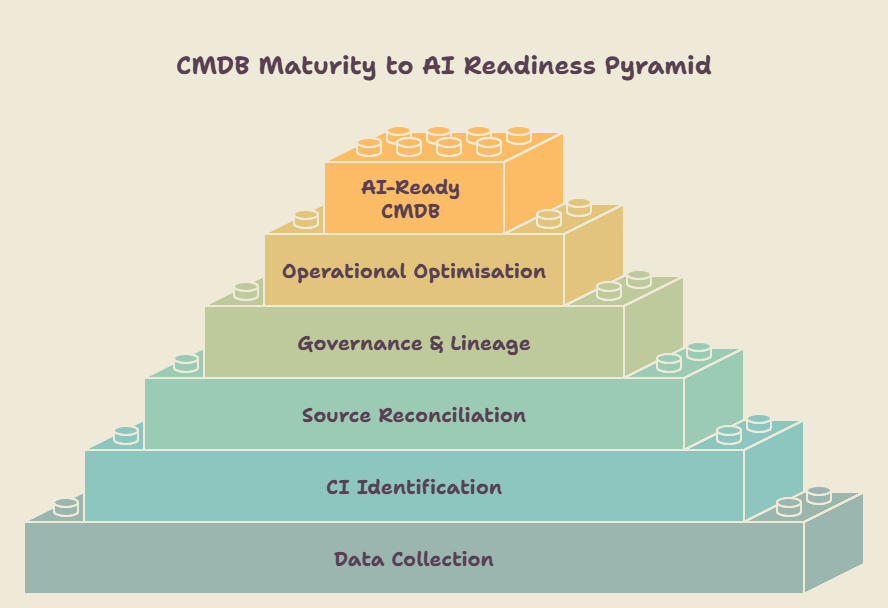
A practical maturity model
Foundational: The organisation collects CI data but has inconsistent identification logic, unclear source ownership, and limited visibility into duplicate records.
Managed: Identification rules exist for important CI classes, and reconciliation policies begin to establish source authority.
Controlled: Identifier priorities, source precedence, exception handling, and CI quality are actively governed and monitored.
AI-ready: The CMDB can provide consistent CI identity, trustworthy attributes, traceable data lineage, and reliable relationships to the automation and AI capabilities that depend on it.
This is an assessment framework rather than an industry benchmark: the supplied material does not provide external benchmark scores. The important point is that CMDB maturity should be evaluated by decision quality and data reliability, not simply record volume.
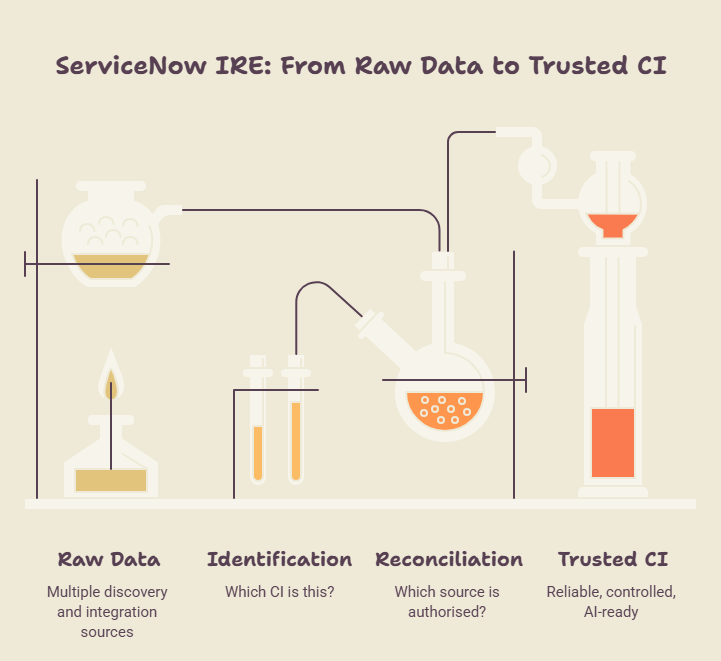
What Is a ServiceNow CMDB Identification Rule?
A ServiceNow CMDB identification rule defines the attributes used to uniquely recognise a CI. When configuration information arrives from ServiceNow Discovery, Service Mapping, cloud platforms, endpoint tools, third-party discovery products, or other integrations, the IRE evaluates the incoming information against the identification rules for the relevant CI class.
The outcome is fundamentally a match-or-create decision:
Match found → update the existing CI
No valid match → create a new CI, subject to applicable controls
The objective is not simply to reduce the number of records. The objective is to preserve the identity and history of the real-world technology object represented by the CI.
ServiceNow's current documentation states that identification rules apply to CI classes and use prioritised identifier entries to establish strong identification logic. This priority is important. For example, a hardware identification strategy might evaluate:
- Serial number plus serial-number type
- Serial number
- Name
- MAC address plus name
The actual strategy should depend on the CI class and the quality and uniqueness of the available source data. The broader principle is:
The order and composition of identifier entries are part of the organisation's CMDB identity policy.
What Is a ServiceNow CMDB Reconciliation Rule?
Identification answers:
“Which CI is this?”
Reconciliation answers:
“Which source is allowed to update it?”
This distinction is critical.
A CMDB can receive information about the same CI from ServiceNow Discovery, Service Mapping, cloud platforms, endpoint-management tools, monitoring platforms, asset-management systems, application discovery tools, and controlled manual processes. Without reconciliation, different sources can potentially compete to update the same attributes. Reconciliation rules establish data authority and precedence, helping prevent an unauthorised or lower-priority source from overwriting information supplied by a trusted source. ServiceNow's current documentation describes reconciliation rules as the mechanism that determines which discovery sources can update CI attributes. It also documents static and dynamic reconciliation approaches, with dynamic reconciliation leveraging CMDB 360 when enabled. This turns reconciliation from a technical configuration detail into a governance mechanism.
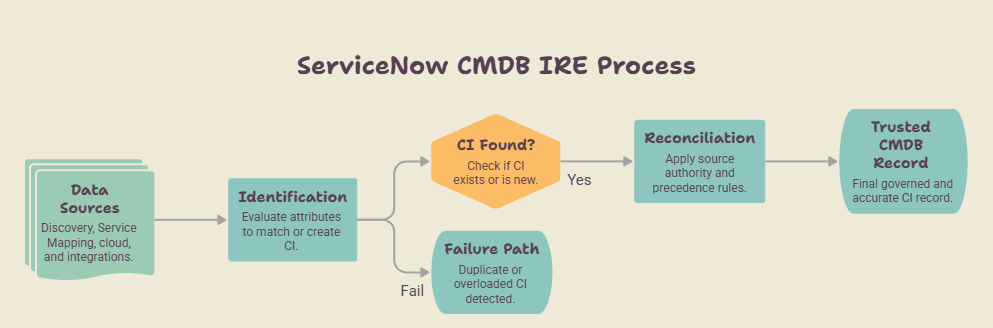
How the IRE Process Works
A simplified IRE flow can be understood as: Data ingestion → Identification evaluation → Attribute matching → Reconciliation evaluation → Update or insert
Incoming data may contain identity attributes, technical properties, ownership information, and relationships. The IRE evaluates the incoming values against the configured identification rules for the CI class. If a valid match is found, the existing CI becomes the target. If there is no valid match, the process may create a new CI, subject to the applicable controls. Once the CI has been identified, reconciliation determines which source is authorised to update the CI or particular attributes. ServiceNow also provides IRE data-source controls that can prevent a particular source from creating new CIs for a class while still allowing that source to update existing CIs. This can be useful when a discovery source is trusted for enrichment but not for CI creation. That creates a much more controlled ingestion model:
Not every source should necessarily have the authority to create. Not every source should necessarily have the authority to overwrite.
The CMDB Failure Modes: Duplicate vs Overloaded CIs
Two opposing identification failures deserve particular attention.
Duplicate CIs
A duplicate CI exists when multiple records represent the same real-world object.
Potential consequences include:
- Split incident history
- Fragmented change history
- Inaccurate service dependencies
- Inflated CI counts
- Ambiguous ownership
- Unreliable compliance and lifecycle reporting
ServiceNow identifies weak identification rules as one potential cause of duplicate CIs and provides mechanisms for detecting and remediating duplicates.
Overloaded CIs
An overloaded CI represents the opposite problem. Here, different real-world objects are incorrectly treated as a single CI. This can be particularly dangerous because the CMDB may appear cleaner while information from one object overwrites information belonging to another. Therefore, the goal is not: “Match as much as possible.”
The goal is: “Match with sufficient confidence to preserve real-world identity.”
Identification Rules Must Be Class-Specific
One of the most important design principles is that identification logic should not simply be copied across the CMDB. Hardware and application CIs often have fundamentally different identity characteristics. For hardware, serial number, serial-number type, name, and related network attributes may contribute to identification. For applications, identity might involve:
- System class
- Application name
- CI port
- Running process command
- Running process parameters
- Class
A name by itself may not distinguish two application instances. Conversely, adding an unstable attribute can make matching less reliable.
The rule must therefore reflect what actually makes that CI class unique.
“Allow Null Attributes”: A Small Setting With a Big Governance Question
The Allow null attribute setting deserves careful consideration. When null attributes are not allowed, the required criterion attributes generally need to be populated before the identification entry can be used confidently. When null attributes are allowed, ServiceNow can attempt to match even when some selected attributes are empty. This creates a fundamental trade-off: More matching availability ↔ potentially lower matching confidence
A permissive configuration may help an organisation process incomplete discovery data. But if the remaining attributes are weak, it can increase the risk of incorrect matching.
The correct question is therefore not:
“Should Allow null attributes be enabled?”
It is:
“What level of identification confidence is acceptable for this CI class given the quality of our source data?”
That is a governance decision—not merely a configuration decision.
Business Impact: Why CMDB IRE Matters Beyond the Platform Team
The quality of identification and reconciliation decisions is directly related to operational outcomes.
Incident management: Accurate CI identity helps preserve incident history and service relationships, supporting better service-impact analysis.
Change risk: Change decisions depend on understanding what a component supports and what supports it. Duplicate or overloaded CIs weaken this context.
Governance and auditability: Organisations should be able to explain why a CI contains a particular value, which source supplied it, and which source had authority.
Employee experience: Service teams spend less time manually investigating contradictory configuration information when CI identity and source ownership are clearer.
Service cost optimisation: Poor CMDB data creates operational friction: investigation takes longer, manual reconciliation increases, and automation becomes less reliable.
AI maturity: AI can correlate incidents, changes, alerts, and services only when those records consistently refer to the same underlying technology. This is the critical connection between CMDB maturity and AI maturity.
AI does not remove the need for data discipline.
AI increases the value of getting that discipline right.
Operational Deliverables for a CMDB Assessment
For organisations assessing their ServiceNow CMDB, IRE should be incorporated into a broader operational assessment. Root-cause analysis: Identify whether duplicate or overloaded CIs originate from:
- Weak identifier selection
- Conflicting source data
- Missing attributes
- Inconsistent discovery
- Poor source authority
- Inappropriate fallback logic
- Inadequate exception management
Incident trend analysis: Examine whether poor CI identity correlates with repeated incidents, inaccurate service impact, or longer investigation effort.
SLA analysis: Assess whether configuration data quality contributes to delays in incident investigation, fulfilment, or change decisions.
Process pain-point assessment: Identify where engineers manually validate CI identity, reconcile conflicting attributes, or correct configuration information.
Workflow assessment: Review where CMDB data is consumed by incident, change, discovery, service mapping, asset, and automation workflows.
Platform optimisation: Evaluate identification rules, reconciliation rules, data-source rules, class-specific logic, priorities, null handling and parent-rule fallback.
ServiceNow's current guidance explicitly positions identification, reconciliation, data-source, and dependent relationship rules as complementary parts of CMDB configuration.
Strategic Deliverables: From CMDB Cleanup to Continuous Improvement
A mature CMDB assessment should finish with actionable recommendations rather than a list of technical observations.
Quick wins register
Prioritise obvious opportunities such as:
- Reviewing weak identification entries
- Validating high-priority CI classes
- Clarifying source ownership
- Reviewing null-attribute settings
- Identifying high-impact duplicate populations
- Reviewing parent-rule fallback
Prioritised recommendations
Prioritisation should consider: Business impact × operational risk × implementation effort × AI dependency
AI opportunities assessment
Identify where trusted CMDB information could support:
- Incident summarisation
- Service-impact analysis
- Change-risk assessment
- Operational recommendations
- Automated investigation
- Agentic workflows
But AI use cases should be prioritised only after validating the underlying configuration data.
Target operating model
Establish clear accountability across: CMDB Owner → CI Class Owner → Data Source Owner → Service Owner → Platform Governance → AI Governance
Implementation roadmap
A practical roadmap can move from: Assess → Remediate → Govern → Measure → Optimise → Enable AI
The important point is that CMDB optimisation should not be treated as a one-off cleanup exercise. It should become an ongoing operating capability.
The CMDB Researcher's Practical Checklist
When evaluating a ServiceNow CMDB, ask:
- What attributes uniquely identify each priority CI class?
- Are the strongest identifiers evaluated first?
- What happens when a preferred identifier is missing?
- Could the rule create duplicate CIs?
- Could it overload one CI with multiple real-world objects?
- Are hardware and application identity strategies appropriately different?
- Is Allow null attributes enabled, and why?
- Can specialised CI classes safely fall back to parent rules?
- Which sources are authorised to update critical attributes?
- What precedence exists between those sources?
- What happens when the preferred source becomes stale?
- How are IRE exceptions measured?
- Are CMDB Health outcomes connected to remediation?
- Can the organisation explain the lineage of important CI attributes?
These questions are closely aligned with the supplied technical material and provide a useful assessment framework for CMDB researchers.
Conclusion: The AI-Ready CMDB Starts With Identity
The future of the CMDB is not simply about collecting more configuration records. It is about creating trusted configuration intelligence. Identification rules establish whether incoming information belongs to an existing CI. Reconciliation rules establish which source has authority over the resulting data. Together, they help create a controlled path from discovery and integration data to reliable CMDB information. That foundation affects incident management, change risk, service mapping, governance, employee experience, operational cost, and AI maturity. The strategic question for CMDB leaders is therefore not simply:
“Is our CMDB populated?”
It is:
“Can we trust the identity, relationships and source authority represented by our CMDB?”
If the answer is yes, the CMDB becomes much more than a configuration repository. It becomes a reliable operational data foundation for automation, analytics, and AI. For TinyLoop, this creates a powerful CMDB optimisation proposition: help organisations design identity and data-authority controls around the decisions they need to make—not simply around the records they happen to collect.
Three Key Takeaways
1. Identification is the foundation of CMDB trust
If ServiceNow cannot reliably determine which CI an incoming record represents, duplicate, overloaded, and fragmented configuration data can undermine downstream ITSM, service mapping, governance, and AI.
2. Reconciliation turns CMDB data into governed data
Knowing which CI a record represents is only half the problem. Organisations also need to know which source is authorised to update it and how competing sources are governed.
3. AI readiness starts with configuration-data discipline
A CMDB does not become AI-ready simply by adding AI capabilities. It becomes AI-ready when CI identity, relationships, data authority, provenance, and quality are trustworthy enough for automation and AI to rely on them.