AI Adoption Is Accelerating, But Governance Is Falling Behind
Enterprise AI adoption has moved far beyond experimentation. Across the modern corporate landscape, organizations are aggressively deploying artificial intelligence to optimize daily operations. IT departments leverage AI for automated incident response, while customer service teams rely on conversational agents to handle complex inquiries. In human resources and finance, models streamline everything from talent acquisition to invoice processing. Meanwhile, security operations depend on AI to detect threats in real time, and enterprise search platforms leverage deep knowledge management systems to instantly surface internal information for employees.
However, this rapid expansion has exposed a critical vulnerability that CIOs can no longer ignore: AI adoption is vastly outstripping corporate governance. Departments frequently purchase and deploy specialized AI software independently, creating fragmented ecosystems across the organization. This lack of centralized oversight makes data flows increasingly difficult to trace, leaving leadership blind to significant compliance, security, and financial risks. Without clear ownership or structured framework, companies are exposing themselves to operational liability before fully understanding the true business impact of the technologies they have deployed. This is exactly why enterprise leaders are turning their attention toward ServiceNow AI Control Tower.
The conversation is no longer:
“Should we adopt AI?”
The real question is now:
“How do we govern AI at enterprise scale without slowing innovation?”
The Rise of “Shadow AI”
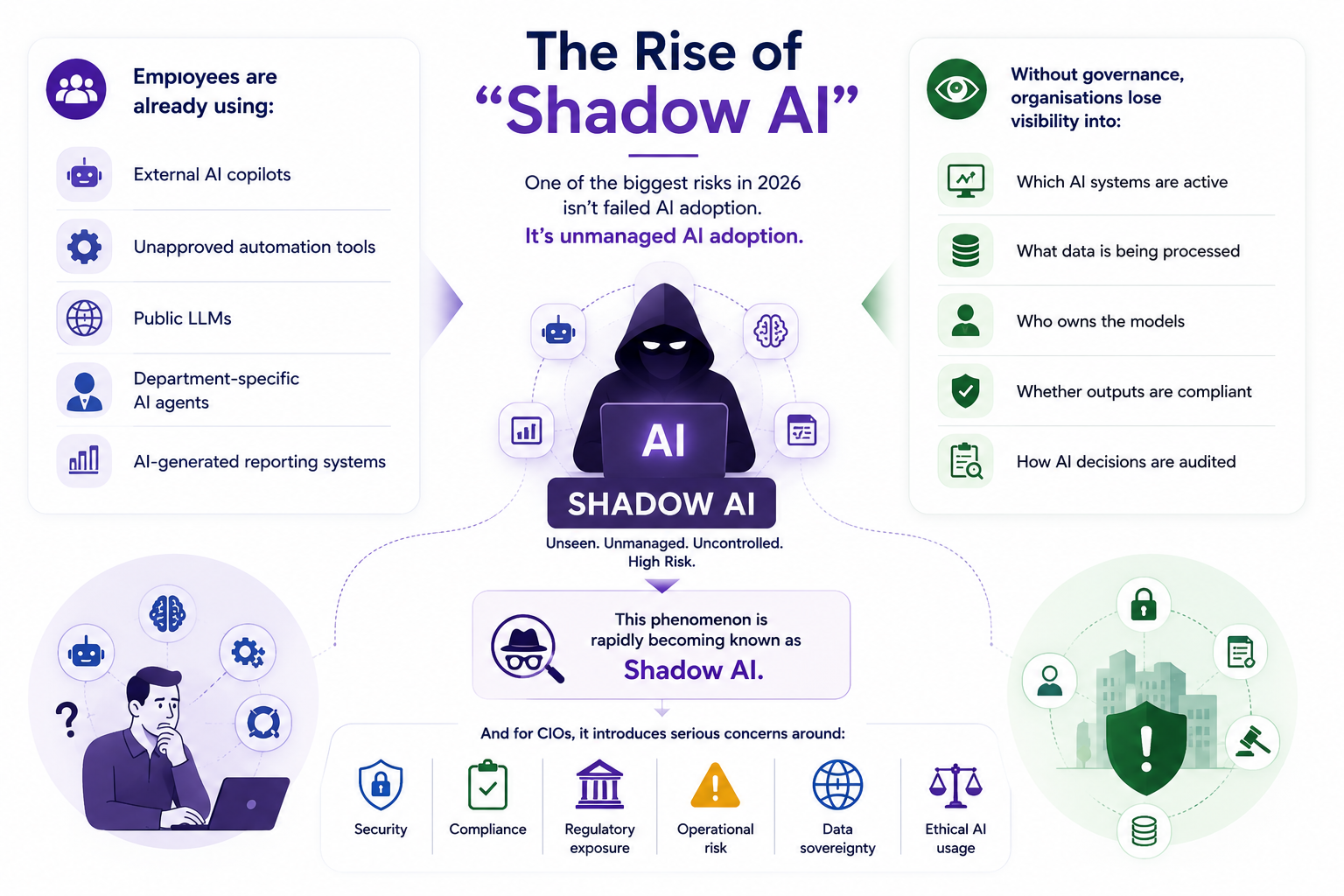
One of the biggest risks in 2026 isn’t failed AI adoption. It’s unmanaged AI adoption. Across many enterprises, employees are rapidly integrating artificial intelligence into their daily workflows, often without official oversight. Staff members across various departments regularly rely on external AI copilots, unapproved automation scripts, public large language models, localized AI agents, and automated reporting systems to speed up their work. While this drives individual efficiency, this decentralized adoption creates severe operational Blindspots.
Without centralized governance, organizations quickly lose control and visibility over their technology ecosystem. Leadership is left in the dark regarding which AI systems are actively running, what sensitive corporate data is being processed, and who holds ultimate responsibility for specific models. Furthermore, this lack of structure makes it nearly impossible to verify regulatory compliance or audit how automated decisions are being made.
This phenomenon is rapidly becoming known as Shadow AI.
And for CIOs, it introduces serious concerns around:
- Security
- Compliance
- Regulatory exposure
- Operational risk
- Data sovereignty
- Ethical AI usage
Why AI Governance Is Becoming a Board-Level Discussion
AI governance has evolved beyond a technical routine managed strictly by IT teams; it now stands as a core priority for organizational resilience and business continuity. Rapid global shifts in regulatory frameworks demand strict oversight across model transparency, output explainability, ethical application, automated decision-making, and complete data lineage. Because failure to adhere to these evolving standards poses severe financial and reputational threats, oversight responsibilities have shifted directly into executive boardrooms.
This regulatory transition forces Chief Information Officers to demonstrate granular, real-time control over their enterprise technology ecosystems. Executives must now continuously answer critical operational questions regarding which models are active, the specific business processes they influence, the auditability of generated outputs, connected underlying data sources, third-party vendor involvement, and active risk monitoring systems.
Today, most organizations struggle to answer these questions with confidence, operating with fragmented data and siloed tools. This widespread visibility gap is driving urgent demand for centralized AI governance platforms capable of unifying risk management, compliance, and enterprise-wide oversight.
What Is ServiceNow AI Control Tower?
ServiceNow AI Control Tower provides organizations with a unified operational framework to centralize, govern, and scale their enterprise AI ecosystem. Rather than relying on disconnected spreadsheets, disparate departmental tools, or fragmented monitoring systems, it establishes a single pane of glass to track model inventories, enforce continuous compliance, oversee third-party integrations, and align deployment strategies with core enterprise risks.
For a visual demonstration of how these governance features operate within an enterprise ecosystem, watch the ServiceNow AI Control Tower Demo.
This short walkthrough provides a direct look at the dashboard interface, model tracking capabilities, and governance workflows within the system., organisations gain a centralised framework for:
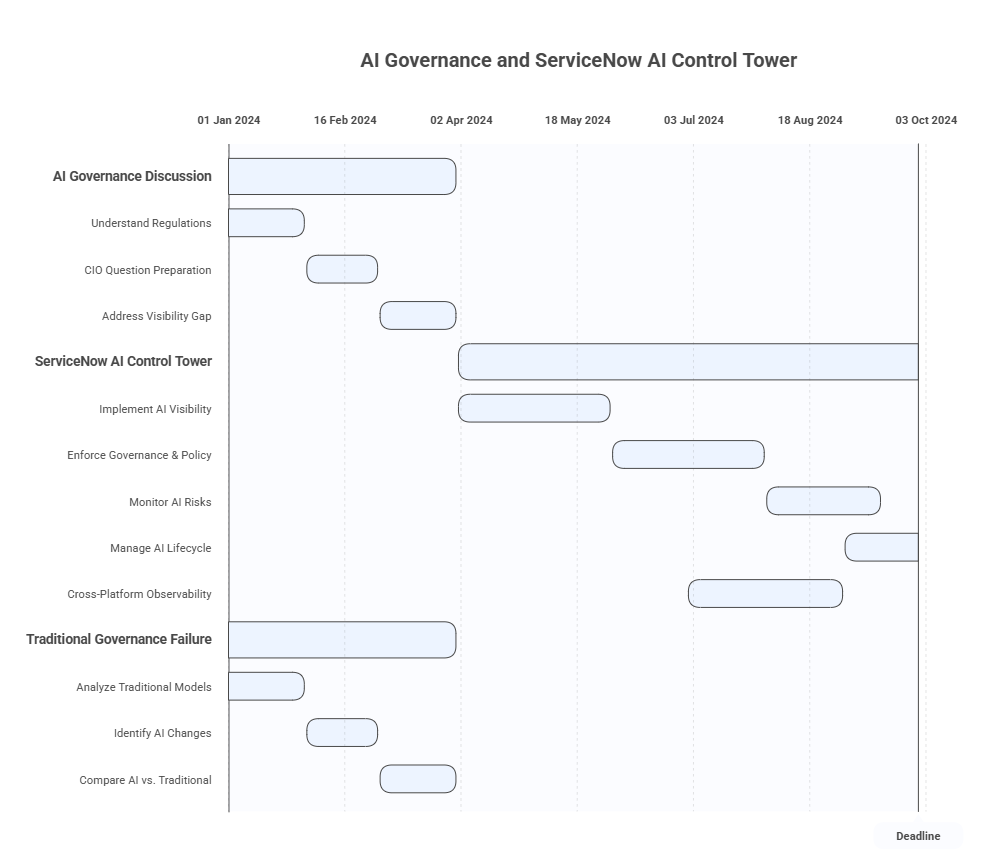
AI Visibility: Track AI models, assistants, agents, workflows, and integrations across the enterprise.
Governance & Policy Enforcement: Apply governance controls consistently across AI deployments.
Risk Monitoring: Identify operational, compliance, and security risks associated with AI systems.
Lifecycle Management: Manage AI initiatives from deployment through optimisation and retirement.
Cross-Platform Observability: Monitor AI activity across enterprise environments instead of isolated systems.
In simple terms:
AI Control Tower aims to become the operational command centre for enterprise AI.
Why Traditional Governance Models Are Failing
Historically, enterprise governance frameworks were constructed to manage environments anchored by traditional applications, static workflows, and human-driven operational processes. These legacy models operated under the assumption that software behavior was inherently predictable. System controls depended on fixed business logic, rigid integration paths, and manual human approvals serving as the primary safeguard against operational risk. Because systems changed infrequently and followed strict, pre-programmed rules, traditional IT service management (ITSM) and compliance protocols could easily maintain control through periodic audits and static approval gates.
Enterprise AI completely dismantles this classic operational foundation. Unlike conventional software systems that deliver deterministic, repeatable results, AI platforms operate probabilistically and evolve dynamically through continuous model updates, adaptive learning, and shifting contextual inputs. Because AI agents interact across APIs, execute autonomous decisions, and adapt based on prompt data and real-time inputs, they introduce a fluid, highly unpredictable operational environment. This dynamic reality exposes the limitations of legacy frameworks, creating an entirely new tier of governance complexity that traditional, manual controls were simply never designed to oversee.
This fundamental mismatch becomes obvious when comparing classic enterprise software with AI-driven operations. Traditional applications function within well-defined boundaries, featuring static integrations, deterministic outputs, and known workflow paths that allow organizations to rely on explicit manual approvals. In contrast, autonomous AI systems process fluid inputs to generate variable outputs on the fly, rendering static checks and manual oversight ineffective. Attempting to force AI operations into rigid legacy governance structures creates severe operational bottlenecks and unmonitored risk blind spots across the enterprise.
AI systems, by contrast, introduce:
- Adaptive model behaviour
- Context-aware and probabilistic responses
- Dynamic AI interactions across platforms
- Autonomous recommendations and decision support
- Self-optimising or continuously learning workflows
As AI adoption scales across the enterprise, organisations increasingly require governance models capable of supporting AI observability, operational telemetry, lifecycle monitoring, policy orchestration, and contextual risk management — not just traditional application oversight.
This shift is why governance platforms must now evolve from:
“System management”
to:
“AI operational oversight.”
The Technical Challenge Most Enterprises Underestimate
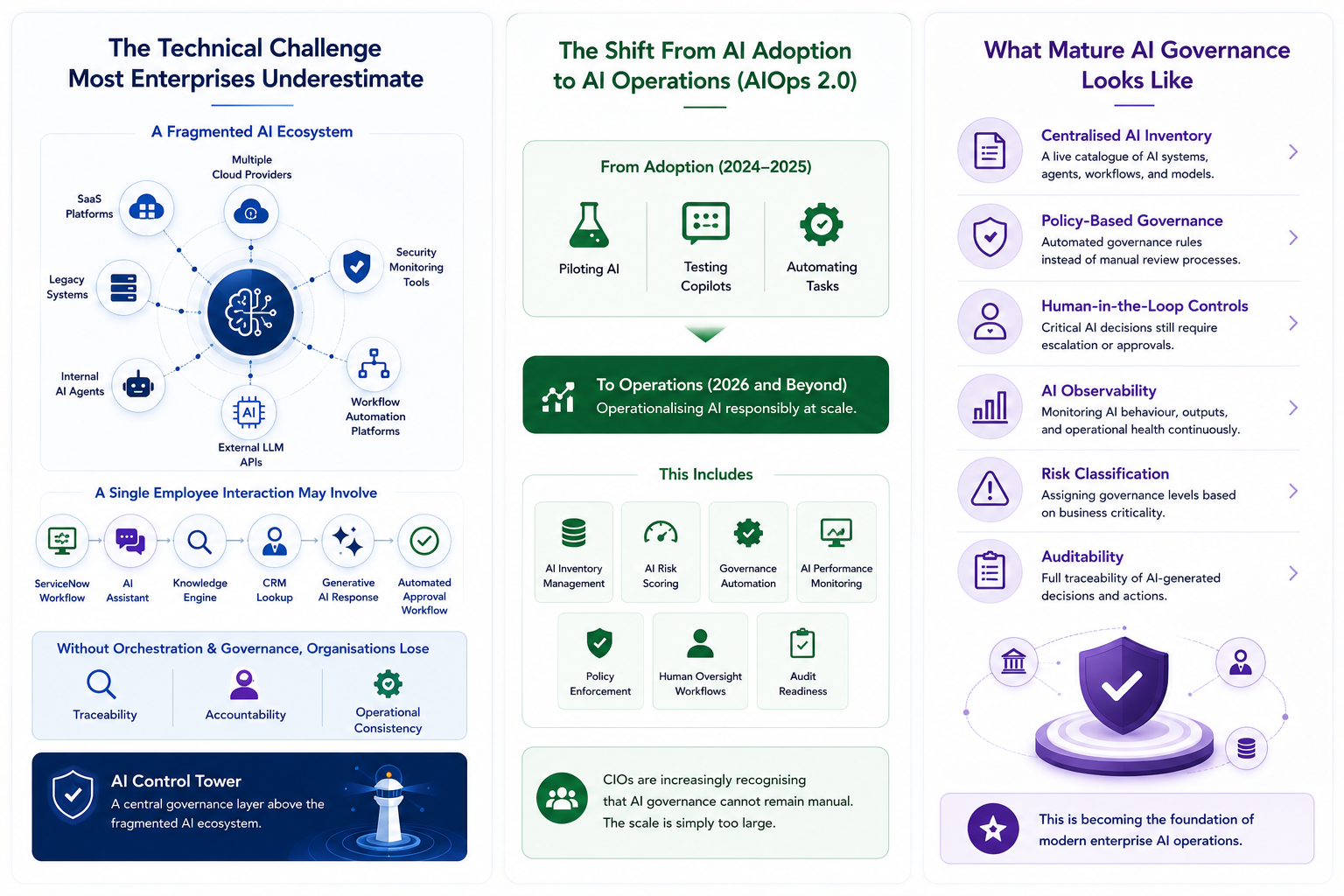
The hardest part of enterprise AI governance is not the performance of the AI model itself, but managing the complex ecosystem surrounding it. Most modern enterprises operate across a fragmented landscape that includes multiple cloud providers, SaaS platforms, legacy systems, internal AI agents, external LLM APIs, workflow automation platforms, and security monitoring tools. This sprawling architecture makes it exceptionally difficult to maintain complete visibility over how and where artificial intelligence is being utilized across the organization.
Consider a routine employee interaction, which can easily trigger a complex chain of events. A single request might initiate a ServiceNow workflow, engage an AI assistant, query a knowledge retrieval engine, pull data from a CRM, generate a response, and finalize an automated approval. Without a dedicated layer for orchestration and governance, organizations quickly lose traceability, accountability, and operational consistency. This is where an AI Control Tower becomes strategically important, serving as a centralized governance layer that connects and oversees the entire fragmented AI ecosystem.
The Shift From AI Adoption to AI Operations (AIOps 2.0)
In 2024 and 2025, enterprises focused heavily on:
- Piloting AI
- Testing copilots
- Automating tasks
In 2026, the focus is changing.
The priority is now: Operationalising AI responsibly at scale.
This includes:
- AI inventory management
- AI risk scoring
- Governance automation
- AI performance monitoring
- Policy enforcement
- Human oversight workflows
- Audit readiness
CIOs are increasingly recognising that AI governance cannot remain manual. The scale is simply too large.
What Mature AI Governance Looks Like
High-performing enterprises are moving toward governance frameworks that include:
Centralised AI Inventory: A live catalogue of AI systems, agents, workflows, and models.
Policy-Based Governance: Automated governance rules instead of manual review processes.
Human-in-the-Loop Controls: Critical AI decisions still require escalation or approvals.
AI Observability: Monitoring AI behaviour, outputs, and operational health continuously.
Risk Classification: Assigning governance levels based on business criticality.
Auditability: Full traceability of AI-generated decisions and actions.
This is becoming the foundation of modern enterprise AI operations.
Why This Matters for ServiceNow Customers
ServiceNow occupies a uniquely advantageous position within modern enterprise architecture because it already serves as the central orchestration engine for critical organizational workflows. Rather than treating artificial intelligence as an isolated layer requiring its own bespoke administrative framework, organizations can embed governance controls directly into the operational environments where work actually happens. This native integration spans every core business domain, including Information Technology Service Management (ITSM), Human Resources Service Delivery (HRSD), Security Operations (SecOps), customer workflows, enterprise automation, knowledge systems, and overall employee experiences. By applying policy enforcement, auditability, and oversight at the exact point of workflow execution, companies establish a unified operational standard that naturally scales alongside their existing digital processes.
This native alignment provides a significant architectural edge for large enterprises striving to maintain control in an increasingly complex digital landscape. As businesses rapidly deploy new machine learning tools and automated agents, they frequently suffer from fragmented AI ecosystems, a condition where siloed governance policies create compliance blind spots, redundant overhead, and inconsistent user experiences. Embedding governance into ServiceNow’s established platform eliminates this fragmentation by consolidating visibility and control under a single pane of glass. Ultimately, this approach allows enterprises to accelerate their AI adoption with confidence, ensuring that innovation remains fully compliant, traceable, and strategically aligned with business objectives without interrupting daily operations.
Where TinyLoop Fits In
TinyLoop helps organisations modernise enterprise operations through intelligent workflow transformation, automation strategy, and ServiceNow optimisation.
As AI governance becomes a CIO priority, organisations increasingly need support with:
- AI readiness assessments
- Governance framework design
- Workflow orchestration
- Platform integration strategy
- AI operational visibility
- Responsible AI implementation
The challenge is no longer deploying AI.
The challenge is deploying AI responsibly, securely, and operationally at scale.
That requires:
- Architecture
- Governance
- Automation
- Operational discipline
Not just technology.
Final Thought: The Enterprises Winning in 2026 Will Not Be the Ones Using the Most AI
The next phase of enterprise AI maturity has officially moved past the phase of quick experimentation and pilot programs. As organizations deploy intelligent agents and autonomous models across critical business functions, success is no longer measured by how many AI tools a company buys or how fast it launches prototypes. Instead, long-term competitive advantage belongs to the organizations that can seamlessly integrate these technologies into their core workflows while maintaining total operational control.
True enterprise maturity now centers on establishing comprehensive visibility across all active models, enforcing strict governance frameworks to manage risk, and embedding clear human accountability for AI-driven outcomes. Without operational trust, even the most sophisticated AI systems create unpredictable liabilities rather than strategic value. CIOs are recognizing that scaling AI safely requires a centralized command center to monitor performance, compliance, and cost in real time—which is precisely why platforms like ServiceNow AI Control Tower are becoming essential strategic priorities as leaders shape their roadmap for 2026.
Because enterprise AI without governance does not create transformation. It creates risk.
Key Takeaways
- Enterprise AI is scaling faster than governance, making visibility, compliance, and operational control critical priorities for CIOs in 2026.
- ServiceNow AI Control Tower provides a centralised governance layer to monitor, manage, and operationalise AI across complex enterprise environments.
- The future of successful AI adoption is not just automation; it’s responsible, observable, and governed AI at scale.