Artificial Intelligence is rapidly becoming a core part of modern organisations. From AI-powered assistants and AI Agents to workflow automation and content generation, businesses are deploying AI across multiple departments and use cases. While this creates exciting opportunities, it also introduces new challenges around governance, compliance, risk management, ownership, and business value.
This is where ServiceNow AI Control Tower comes in.
AI Control Tower acts as the central command centre for managing, governing, monitoring, and scaling AI across the enterprise. It helps organisations understand what AI assets exist, who owns them, how they are performing, what risks they introduce, and whether they are delivering measurable business value.
In this guide, we'll explore the key capabilities of AI Control Tower, explain how it helps organisations govern AI at scale, and walk through the major dashboards and governance functions available within the platform.
What is an AI Control Tower?
AI Control Tower is ServiceNow's enterprise AI governance solution. It provides a centralised framework for managing AI systems, AI models, prompts, agents, and AI-powered applications throughout their lifecycle. Rather than allowing AI initiatives to grow independently across departments, AI Control Tower gives organisations a single source of truth for AI governance. It helps technology leaders, risk teams, compliance officers, and AI stewards understand exactly what AI assets exist within the business and how those assets are performing. The platform combines governance, inventory management, risk oversight, adoption monitoring, business value tracking, and compliance management into a unified experience.
Step-by-Step Configuration Guide for AI Control Tower
How to Configure ServiceNow AI Control Tower
Before organisations can govern AI assets, monitor adoption, and manage compliance activities, AI Control Tower must first be installed and configured within the ServiceNow environment. The following steps provide a practical configuration guide that administrators can follow.
Step 1: Verify Licensing and Prerequisites
Before installation, confirm that your ServiceNow instance has access to:
- AI Control Tower
- Now Assist
- AI Governance capabilities
- CMDB
- AI Asset Management components
You should also verify that your instance is running a supported ServiceNow release. Required roles typically include:
- admin
- AI Steward
- AI Product Owner
- Risk and Compliance User
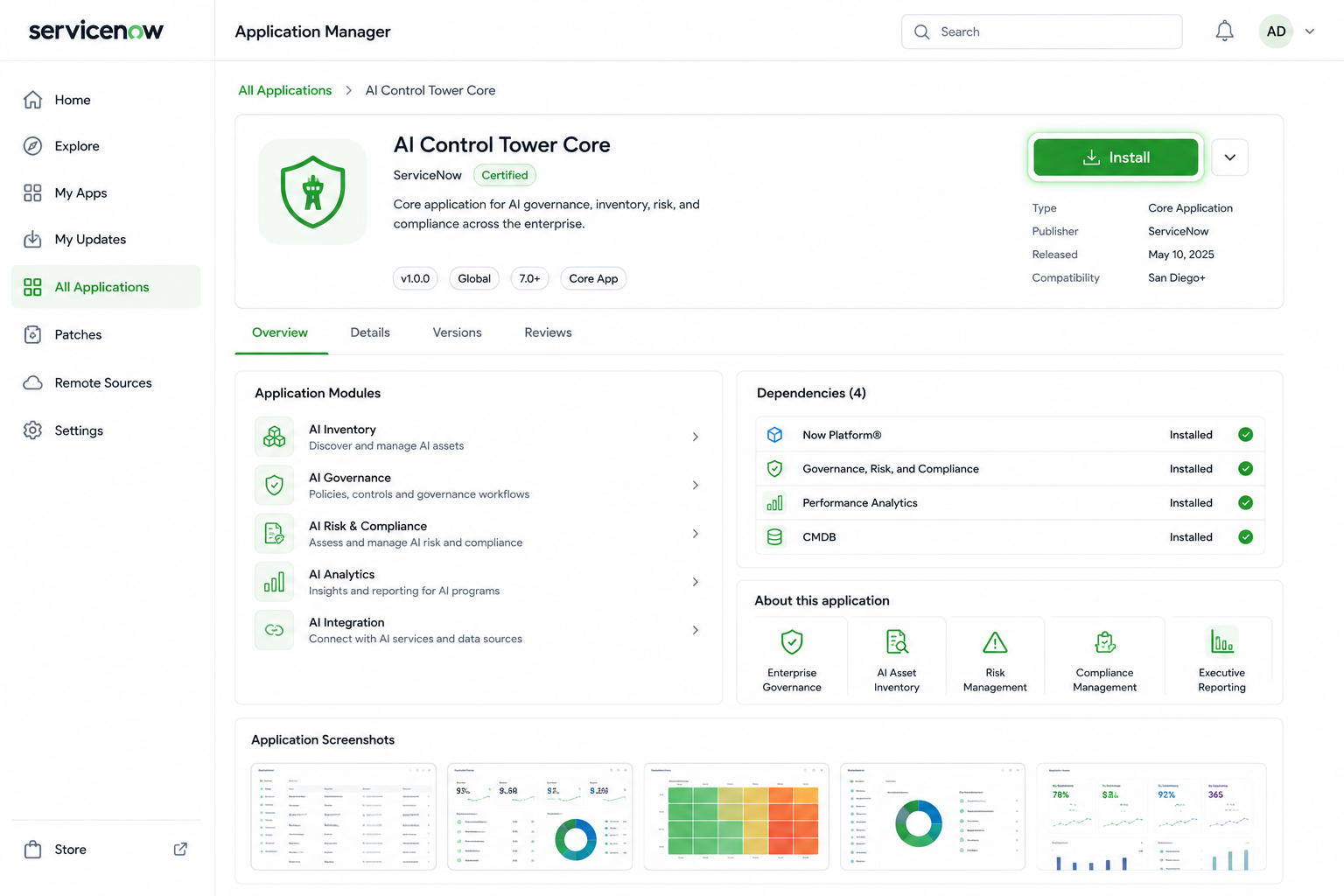
Step 2: Install AI Control Tower
Navigate to: Application Manager
Search for: AI Control Tower
Select: AI Control Tower Core
Click: Install
Wait for all dependencies to complete installation. Depending on your environment, ServiceNow may automatically install supporting applications and governance components.
Step 3: Assign AI Governance Roles
Navigate to: User Administration → Users
Assign appropriate roles to governance stakeholders.
Recommended assignments:
RoleResponsibilityAI StewardManages AI inventory and governance reviewsAI Product OwnerOversees AI business outcomesRisk & Compliance UserReviews AI risks and controlsAdminPlatform configuration.
This ensures governance responsibilities are clearly separated
Step 4: Open AI Control Tower
Navigate to: AI Control Tower → Overview
Review the available dashboards:
- AI Inventory
- AI Strategy
- Value
- Adoption
- Risk & Compliance
- AI Cases
These dashboards form the foundation of the governance framework.
Step 5: Configure AI Asset Inventory
Navigate to: AI Inventory
Create records for:
- AI Systems
- AI Models
- AI Agents
- Prompts
- AI Applications
For each asset, capture:
- Business Owner
- Technical Owner
- Department
- Risk Classification
- Deployment Status
- Save the records.
Step 6: Configure AI Lifecycle Reviews
Open an AI Asset record. Configure lifecycle stages:
- Draft
- Assessment
- Review
- Approval
- Production
- Retirement
Enable approval workflows for governance reviews. This ensures AI assets move through formal approval gates before deployment.
Step 7: Configure Strategy Mapping
Navigate to: Strategy Tab
Link AI initiatives to:
- Business Objectives
- Strategic Priorities
- Programs
- Investment Portfolios
This allows leadership teams to see how AI investments support organisational goals.
Step 8: Configure Value Tracking
Navigate to: Value Tab
Define measurements such as:
- Productivity Gains
- Time Savings
- Cost Reduction
- Business Benefits
- ROI Metrics
Connect these measurements to individual AI assets. This helps quantify the impact of AI initiatives.
Step 9: Configure Adoption Monitoring
Navigate to: Adoption Dashboard
Enable monitoring for:
- Active Users
- Department Usage
- AI Requests
- Adoption Trends
- Engagement Metrics
Review adoption regularly to identify training opportunities.
Step 10: Configure Risk and Compliance Reviews
Navigate to: Risk & Compliance
Configure:
- Risk Assessments
- Compliance Reviews
- Control Frameworks
- NIST AI RMF Mapping
Assign review owners and approval workflows.
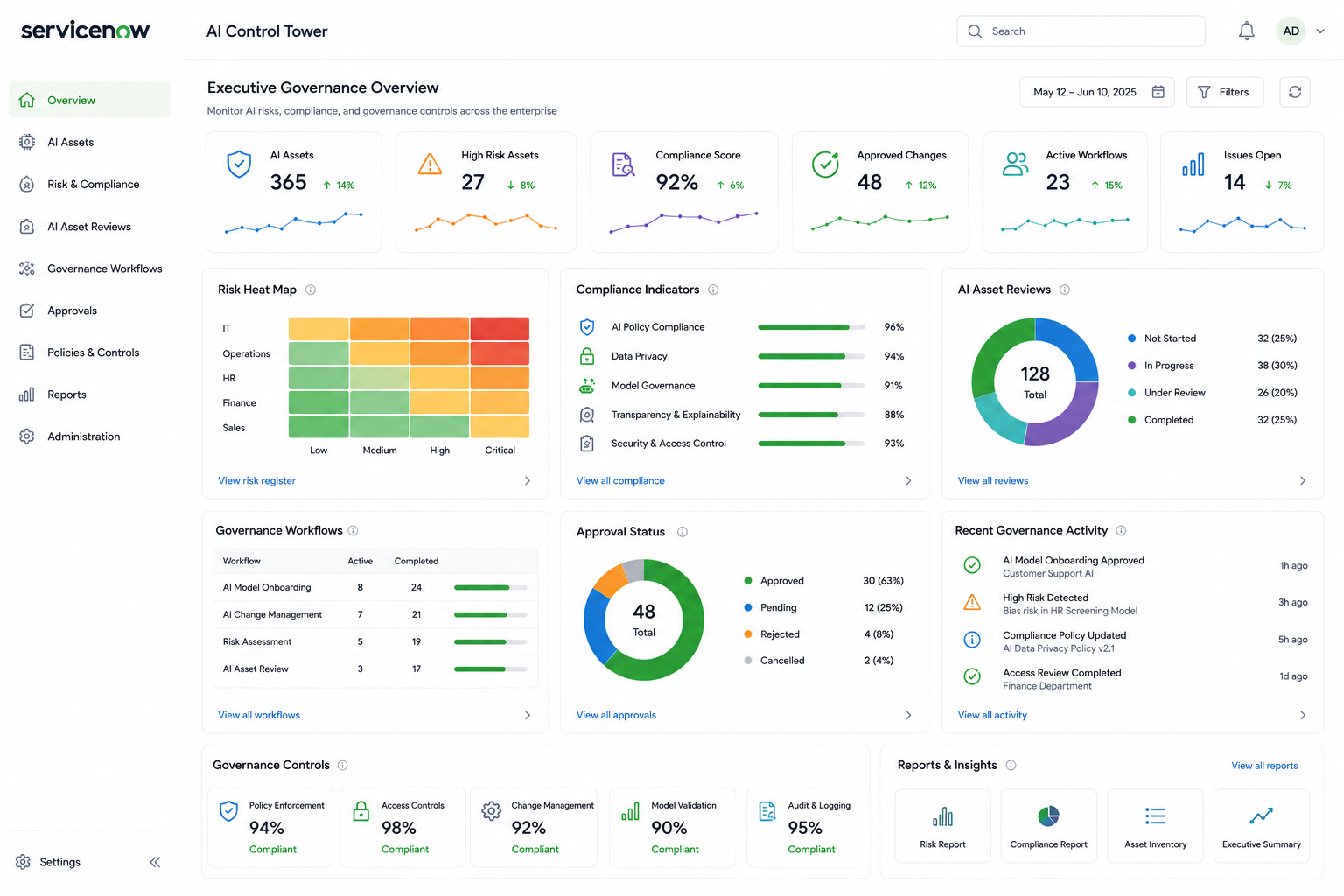
Step 11: Configure AI Governance Cases
Navigate to: AI Cases
Create workflows for:
- Risk Reviews
- Approval Requests
- Compliance Investigations
- Governance Assessments
This provides a structured governance process for AI assets.
Step 12: Validate the End-to-End Governance Process
After configuration:
- Create a sample AI Asset.
- Assign an AI Steward.
- Submit for review.
- Complete approval workflow.
- Track value metrics.
- Monitor adoption.
- Review risk assessments.
This confirms the governance framework is functioning correctly.
Why AI Governance Matters
Many organisations begin their AI journey by focusing on technology selection. They choose models, deploy assistants, and launch AI projects. However, as AI adoption grows, visibility often decreases. Teams may create AI solutions without formal approval processes. Different departments may use different models. Risks become harder to track. Measuring business value becomes difficult. Compliance obligations become increasingly complex. AI governance provides the structure required to manage these challenges. It establishes ownership, accountability, review processes, approval workflows, risk assessments, and ongoing monitoring. AI Control Tower was designed specifically to address these enterprise-scale governance requirements.
Understanding the Roles Within AI Control Tower
One of the most important aspects of AI governance is ensuring that the right people have access to the right information and responsibilities.
AI Steward
An AI Steward is responsible for managing and maintaining AI assets throughout their lifecycle. They oversee governance processes, review AI systems, coordinate approvals, and ensure AI assets remain aligned with organisational policies. AI Stewards act as the operational owners of AI governance activities.
AI Product Owner
An AI Product Owner focuses on business outcomes and value delivery. They define objectives, prioritise AI initiatives, monitor adoption, and ensure AI investments contribute to organisational goals. The Product Owner helps connect AI initiatives to measurable business value.
Risk and Compliance User
A Risk and Compliance User focuses on governance frameworks, regulatory requirements, risk assessments, and compliance obligations. They help ensure AI solutions operate within organisational policies and external regulatory expectations. This separation of responsibilities creates stronger governance and reduces the risk of uncontrolled AI deployments.
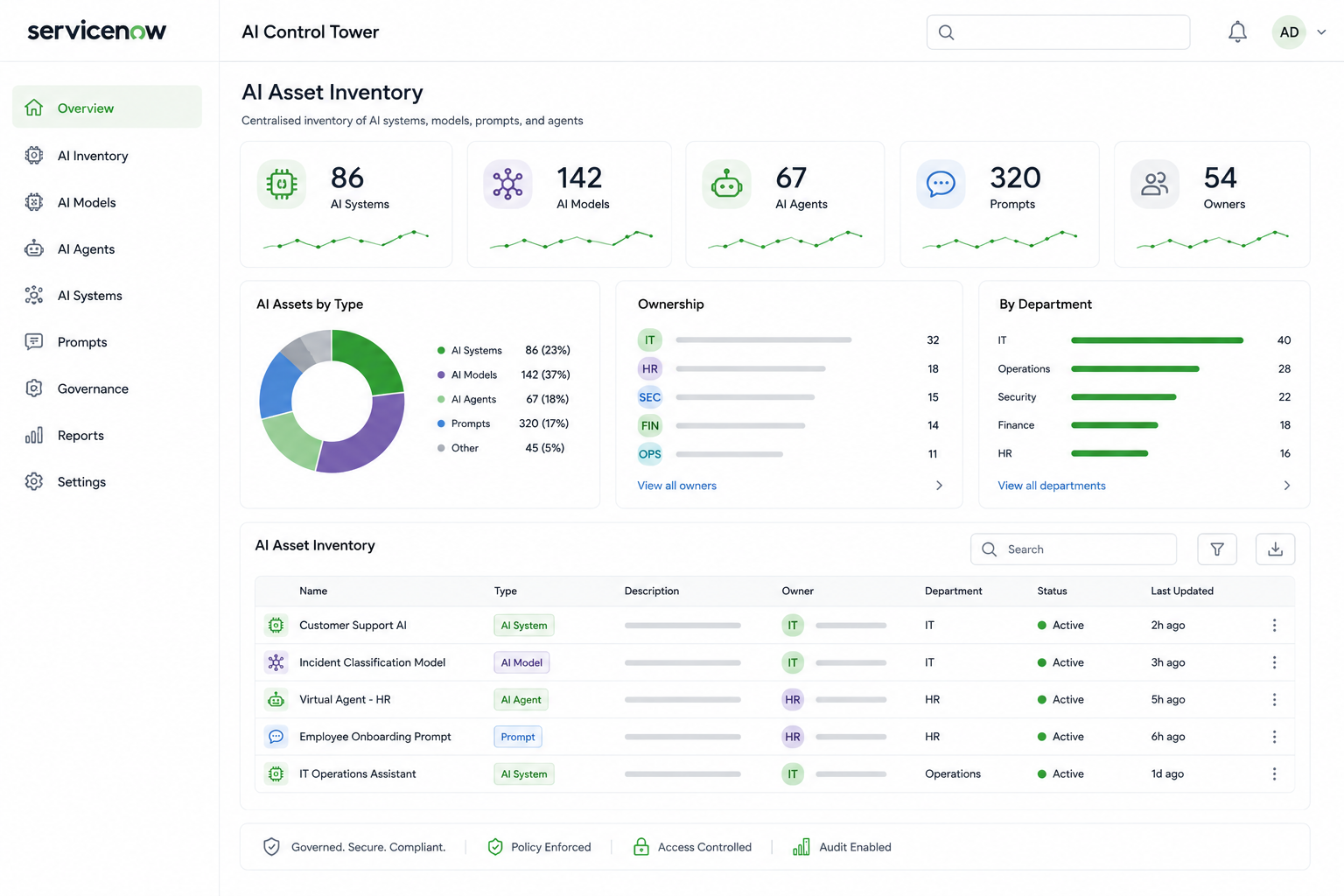
Step 1: Establish Your AI Inventory
The first step in governing AI is understanding what exists. AI Control Tower allows organisations to build a comprehensive inventory of AI assets, including:
- AI Systems
- AI Models
- AI Agents
- Prompts
- AI Applications
- Third-Party AI Services
- Generative AI Solutions
Every AI asset becomes a managed record within the platform. This creates visibility across the entire AI landscape and helps organisations avoid shadow AI initiatives.
Step 2: Manage the AI Asset Lifecycle
Once assets are registered, organisations can manage them through a formal governance lifecycle. Each AI asset can progress through stages such as: Identification, Review, Assessment, Approval, Deployment, Monitoring, and Retirement. This structured approach ensures that AI systems are evaluated before deployment and continuously monitored after release. Governance reviews become part of the standard operating process rather than an afterthought.
Step 3: Align AI Strategy with Business Goals
Successful AI programs are connected to business outcomes. AI Control Tower enables organisations to link AI initiatives directly to strategic objectives, business priorities, operational goals, and investment programs. This allows executives to understand why AI projects exist, what business problems they are solving, and how success will be measured. Instead of managing isolated AI experiments, organisations can build a coordinated enterprise AI strategy.
Step 4: Measure Business Value
One of the most common executive questions is simple: "What value is our AI investment delivering?"
AI Control Tower addresses this challenge through dedicated value tracking capabilities. Organisations can monitor productivity improvements, efficiency gains, automation outcomes, cost reductions, and business performance metrics associated with AI initiatives. This visibility helps justify AI investments and supports future expansion decisions.
Step 5: Monitor Adoption Across the Enterprise
Even the best AI solution delivers little value if nobody uses it. AI Control Tower includes adoption monitoring capabilities that help organisations understand how AI tools are being used across departments and teams. Administrators can identify adoption trends, usage patterns, engagement levels, and areas where additional training may be required. This allows organisations to proactively improve adoption rather than discovering problems after implementation.
Step 6: Manage Risk and Compliance
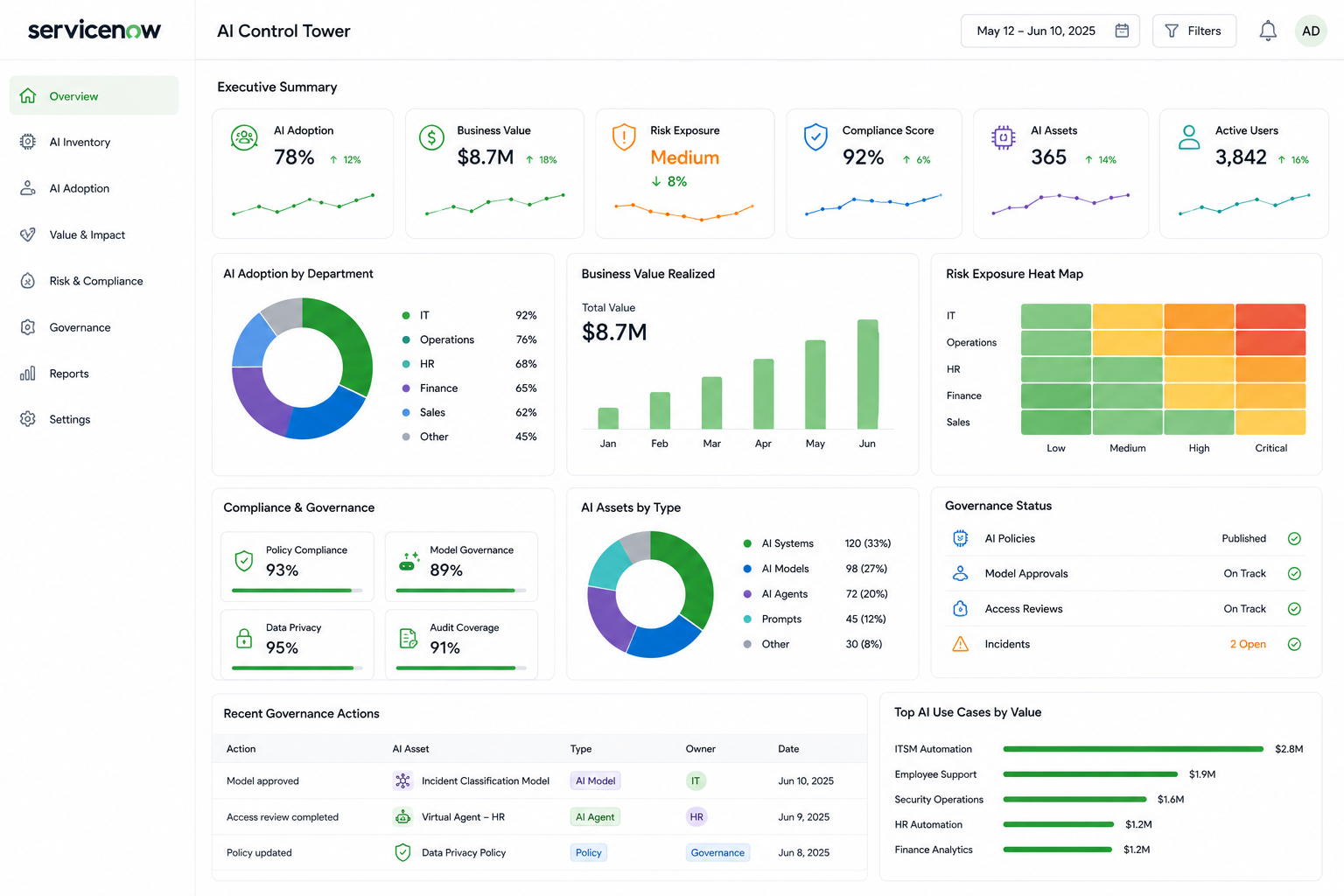
As AI adoption grows, governance becomes increasingly important. AI Control Tower helps organisations assess AI risks, track compliance activities, document reviews, and align governance practices with recognised frameworks such as the NIST AI Risk Management Framework. Risk and compliance teams can monitor AI assets throughout their lifecycle and ensure that governance controls remain effective. This creates a repeatable and auditable governance process.
Step 7: Create and Resolve AI Governance Cases
Governance activities often require collaboration between multiple stakeholders.
AI Control Tower supports governance workflows through AI governance cases.
These cases can be used to:
- Review AI assets
- Investigate risks
- Perform compliance assessments
- Coordinate approvals
- Document governance decisions
This creates a transparent governance process and maintains an auditable record of decisions.
Bringing It All Together
AI governance is quickly becoming one of the most important capabilities for organisations adopting Generative AI and Agentic AI at scale. ServiceNow AI Control Tower provides a structured approach to managing AI assets, monitoring adoption, tracking business value, assessing risks, and enforcing governance standards.
Rather than treating governance as a separate activity, AI Control Tower integrates governance directly into the AI lifecycle, helping organisations scale AI safely, responsibly, and effectively. For organisations planning enterprise-wide AI adoption, AI Control Tower provides the visibility, accountability, and control needed to transform AI from isolated experiments into a governed business capability.
Three Key Takeaways
1. AI Control Tower Creates a Single Source of Truth for AI
The platform provides a centralised inventory of AI systems, models, prompts, agents, and applications, giving organisations complete visibility across their AI landscape.
2. Governance Must Be Built Into the AI Lifecycle
AI Control Tower supports structured review, approval, monitoring, and compliance processes that help organisations manage AI responsibly at scale.
3. Business Value and Adoption Matter as Much as Technology
Successful AI programs require visibility into usage, adoption, ROI, risk, and strategic alignment. AI Control Tower brings all of these capabilities together in a single governance platform.