The Uncomfortable Truth About Enterprise IT in 2026
Most enterprise IT environments face growing complexity as cloud workloads, IoT endpoints, containerised applications, and autonomous AI agents expand across the organization. Identifying what assets exist and how they connect remains a persistent challenge for many leadership teams. The Configuration Management Database (CMDB) serves as the authoritative record of hardware, software, services, and their relationships. When managed effectively, it supports IT operations, security, risk management, and strategic planning. However, without ongoing upkeep, it risks becoming an unreliable database that teams eventually ignore.
Section 1: Why Seeing Everything Is Harder Than It Sounds
Modern organizations operate a complex mix of technologies, ranging from physical hardware and multi-cloud resources to factory IoT devices and microservices. Maintaining clear visibility across this rapidly changing landscape is difficult because the environment rarely holds still long enough to be captured cleanly.
IT teams consistently struggle with three main challenges: consolidating data from disparate tools into one model, maintaining data accuracy over time, and extracting operational value rather than merely storing records. Treating a CMDB as a one-time project with a finish line rather than an ongoing operational discipline inevitably leads to stale data, eroded trust, and abandoned systems.
Section 2: Ingest. Govern. Insight. The Framework That Makes CMDBs Work
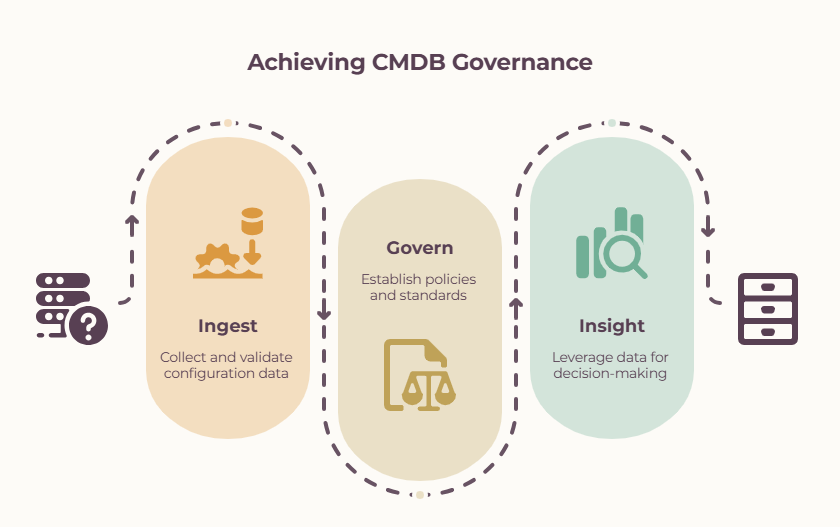
Successful CMDB management relies on three continuous, interdependent activities:
- Ingest: Populating Configuration Items (CIs) using automated tools alongside governed manual inputs for non-discoverable details like ownership, cost center, and business criticality.
- Govern: Establishing clear data ownership, managing asset lifecycles, enforcing reconciliation rules, and running regular audits to prevent duplicate or obsolete records.
- Insight: Applying accurate CI data to evaluate change impacts, map business services, speed up incident resolution, and support security reviews.
Section 3: Could Your Organisation Answer This Question Right Now?
During regulatory audits or internal risk reviews, leadership teams are frequently asked to identify which systems process sensitive data, what software versions are active, and who owns each asset.
When a CMDB has not been continuously maintained, teams are forced to launch emergency manual checks to piece together accurate information. Incomplete or outdated records do not just cause administrative headaches—they expose the organization to compliance penalties, operational delays, and unmanaged security vulnerabilities.
Section 4: The CMDB Has Grown Up
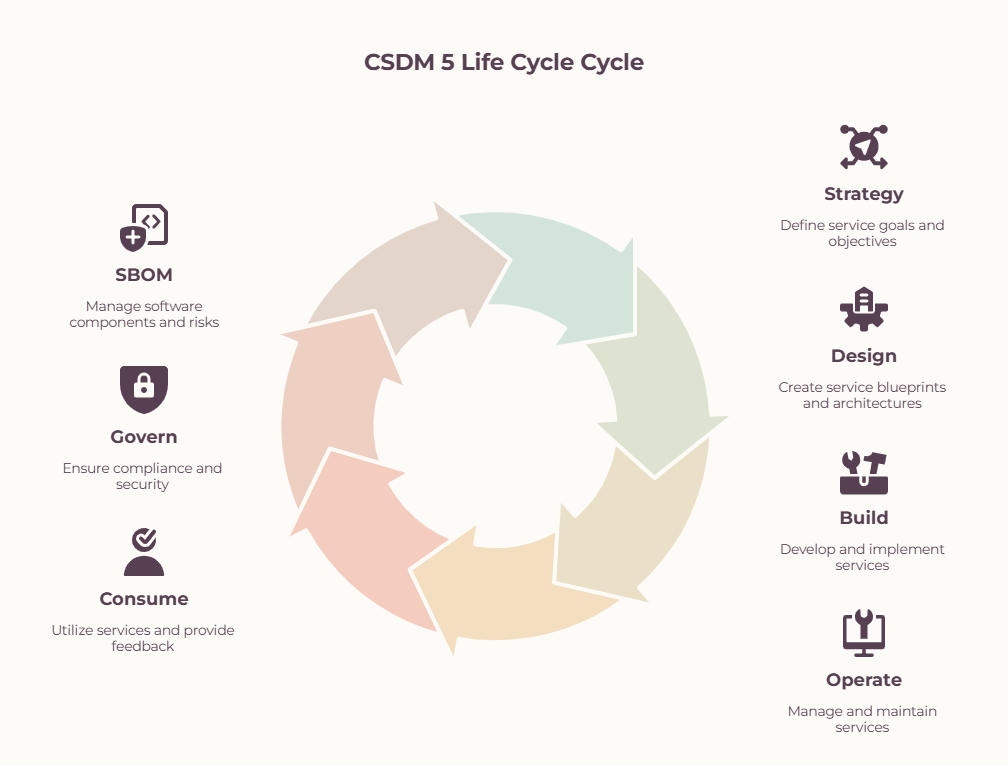
ServiceNow’s Common Service Data Model 5 (CSDM 5) expands traditional configuration tracking by connecting technology assets directly to operational and business outcomes.
- Broad Reach: Extends governance beyond IT into HR, Finance, Legal, Operational Technology (OT), and IoT environments.
- Ideation & Strategy: Links business capabilities and executive goals directly to underlying applications and technical services.
- Software Bill of Materials (SBOM): Tracks internal software components and dependencies to give visibility into supply-chain risks.
- AI Readiness: Provides structured, validated configuration data so automated AI agents can perform tasks accurately without compounding errors.
Section 5: You Don't Have to Boil the Ocean
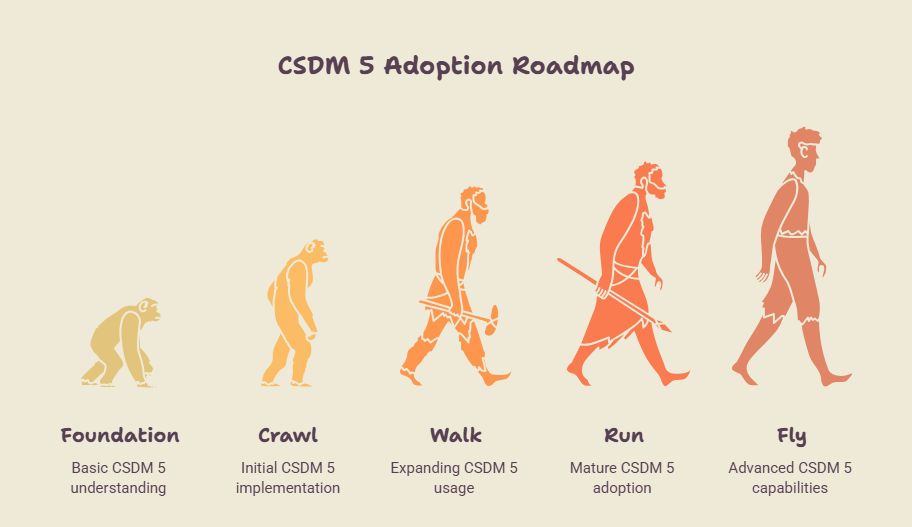
Adopting CSDM 5 can be approached in practical phases, allowing teams to deliver value step-by-step:
- Foundation & Crawl: Organize core data (locations, users, business units) and map Business Applications to Application Services to support basic IT service processes.
- Walk & Run: Define Technical Management Services, set up dynamic groups, and automate change impact analysis to speed up incident handling.
- Fly: Connect value streams to strategic goals, enabling enterprise architecture modeling and strategic portfolio planning.
Section 6: How TinyLoop Can Help
At tinyloop.com.au, we assist teams with everyday CMDB setup and CSDM alignment. We help organize your asset information, establish sensible data habits, and ensure your team can find clear answers when they need them.
Whether you need a simple CMDB Health Check to spot basic gaps or want to use our CSDM Checklist to review where your data stands, we are here to support your team at a comfortable pace. Feel free to get in touch with the tinyloop.com.au team anytime to chat about your environment and see how we can help keep things running smoothly.
Three Key Takeaways
- Ongoing Discipline: CMDB success relies on a continuous operational cycle of Ingest, Govern, and Insight rather than a one-time project.
- Strategic & AI Alignment: CSDM 5 bridges technical assets directly with executive goals, supply-chain risks, and safe AI deployment.
- Phased Value: Organizations achieve faster results by adopting CSDM 5 incrementally across Foundation, Crawl, Walk, Run, and Fly stages.