The contemporary corporate landscape is currently traversing a structural inflexion point that mirrors the transition from manual ledger-based accounting to the initial era of enterprise resource planning. However, the velocity and magnitude of the present shift are unprecedented. As organisations grapple with a projected global labour shortage of 50 million workers by 2030, the imperative for a fundamental reengineering of enterprise work has moved from a technological aspiration to a non-negotiable financial mandate. The strategic partnership between NVIDIA and ServiceNow, articulated through the vision of an "AI Enterprise Operating System," provides the architectural framework for this transformation. For the Chief Financial Officer, this transition represents a shift from an OpEx-heavy model reliant on human labour to a CapEx-leveraged model characterised by "AI Factories" and autonomous agents that operate with a level of precision and speed previously relegated to science fiction.
The core of this partnership rests on the integration of NVIDIA’s accelerated computing infrastructure with the ServiceNow AI Platform. This combined stack is designed to transform "AI chaos", the current state of fragmented, siloed AI experiments, into "AI control". ServiceNow has projected that by 2030, its subscription revenue will exceed $30 billion, with AI-driven capabilities contributing more than 30% of that annual contract value. This is not merely an optimistic sales forecast; it is a reflection of the systemic integration of AI into every core business function, from IT and HR to supply chain and customer service management.
The Architectural Foundation: NVIDIA Blackwell and the New Calculus of Efficiency
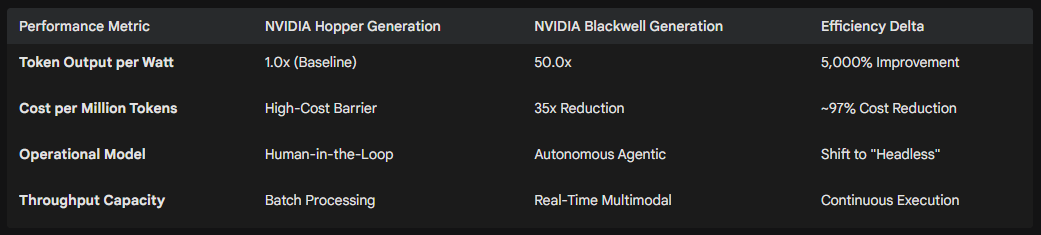
The financial viability of autonomous agents at scale is fundamentally a problem of "tokenomics", the cost and energy required to generate the digital units of thought processed by large language models. Historically, the high cost of computing has acted as a ceiling on the widespread deployment of always-on AI agents. The introduction of the NVIDIA Blackwell platform has fundamentally rewritten this economic equation. The Blackwell architecture delivers more than 50x greater token output per watt compared to its predecessor, the NVIDIA Hopper generation.
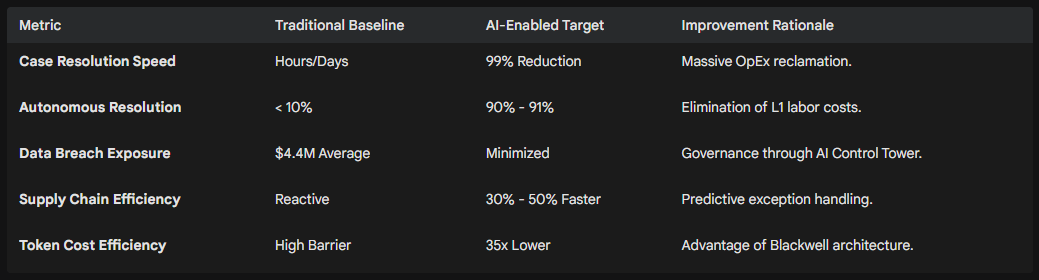
From the perspective of a CFO, this efficiency gain is the primary driver of ROI for large-scale AI deployments. The Blackwell platform facilitates a nearly 35x reduction in the cost per million tokens, effectively commoditising high-order reasoning. When an enterprise is running agents across millions of individual workflows, this efficiency determines whether an AI initiative remains a localised pilot or moves into broad, cost-effective production. These "AI Factories" are not merely data centres; they are production facilities for digital intelligence, optimised for the lowest-cost and most-efficient tokenomics in the industry.
Economic Impact of Generative Computing Architectures
The following comparison illustrates the step-change in performance that enables the "headless" operation of an enterprise:
This infrastructure supports the deployment of "Project Arc," a self-evolving autonomous desktop agent designed to assist knowledge workers by navigating complex, multistep tasks natively within the ServiceNow environment. Unlike traditional automation, which is often brittle and requires rigid API connections, Project Arc can access local file systems, terminals, and installed applications to complete tasks that traditionally required human intervention
The Software Nerve Centre: Action Fabric and the Governance of Intent
The hardware efficiency provided by NVIDIA is complemented by the orchestration capabilities of the ServiceNow AI Platform. A critical innovation in this regard is the "ServiceNow Action Fabric." This layer acts as the connective tissue that allows any AI agent, including third-party models from Anthropic or Microsoft, to securely trigger governed enterprise actions within the ServiceNow ecosystem.
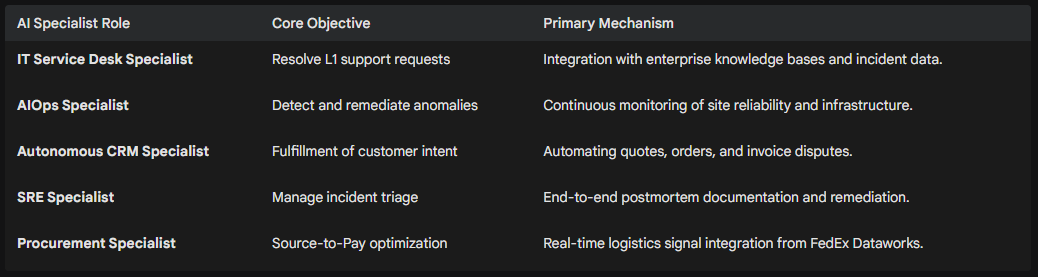
The Action Fabric solves the "orchestration problem" that has caused 95% of AI pilots to fail to reach production. By providing a unified protocol (the Model Context Protocol) for agents to interact with enterprise data and systems, it ensures that every action is grounded in business context and subject to rigorous auditability. This architecture allows for the rise of the "Autonomous Workforce," where specialised AI agents referred to as "AI Specialists" take on entire roles rather than just individual tasks.
Functional Categories of the Autonomous Workforce:
The interaction with these specialists is facilitated by "Otto," a new conversational AI experience that works across the entire ServiceNow platform. Otto is designed to understand intent and orchestrate execution across hundreds of disparate systems, effectively serving as the "conversational front door" for the enterprise. By combining Otto with "EmployeeWorks", which integrates Moveworks’ conversational AI and enterprise search, ServiceNow provides a single point of interaction where natural language requests result in fully automated task execution.
Governance as a Growth Vector: Mitigating the Risks of Autonomy
For the CFO, the excitement of efficiency is often tempered by the reality of risk. The autonomy and scale of AI agents introduce significant enterprise vulnerabilities. One of the most pressing threats is "prompt injection," where malicious inputs manipulate an AI agent into performing unauthorised actions. Statistics from late 2025 and early 2026 indicate that 62% of successful AI exploits in enterprise environments involve indirect injection pathways, where the attack is delivered through trusted sources.
The financial impact of these security breaches is substantial. Data breaches cost businesses an average of $4.4 million in 2025, and enterprises deploying AI agents have experienced up to 2x higher incident response costs when prompt injection was involved. Furthermore, 18% of investigated AI security incidents have been linked to the exposure of credentials or payment data.
The AI Control Tower: A Five-Pillar Security Framework
The ServiceNow AI Control Tower is specifically designed to address these risks, providing the governance needed to secure the "Agentic Business". It revolves around five core components that allow the CFO to sleep at night while the AI Factory runs:
- Discover: It provides visibility into every AI agent, connected device, and application across hybrid environments, including integrations with major cloud providers and enterprise software like SAP, Oracle, and Workday.
- Observe: Through the acquisition of Traceloop, the platform provides continuous monitoring and observability of agent behaviour in real-time.
- Govern: It enables AI-driven risk assessment and remediation, ensuring that every action an agent takes is compliant with enterprise policy and auditable for regulatory purposes.
- Secure: The integration of Veza and Armis provides identity intelligence and visibility into assets across IT and operational technology (OT), ensuring that both human and machine identities are managed under a unified security posture.
- Measure: It tracks the ROI and cost of AI deployments, moving beyond intangible benefits to provide the hard data required for board-level accountability.
This governance layer is further strengthened by "NVIDIA OpenShell," an open-source secure runtime that allows enterprises to define exactly what an agent can see and which tools it can use. OpenShell ensures that agents operate in sandboxed, policy-governed environments, preventing the "hallucinations" or unauthorised data access that could compromise financial integrity.
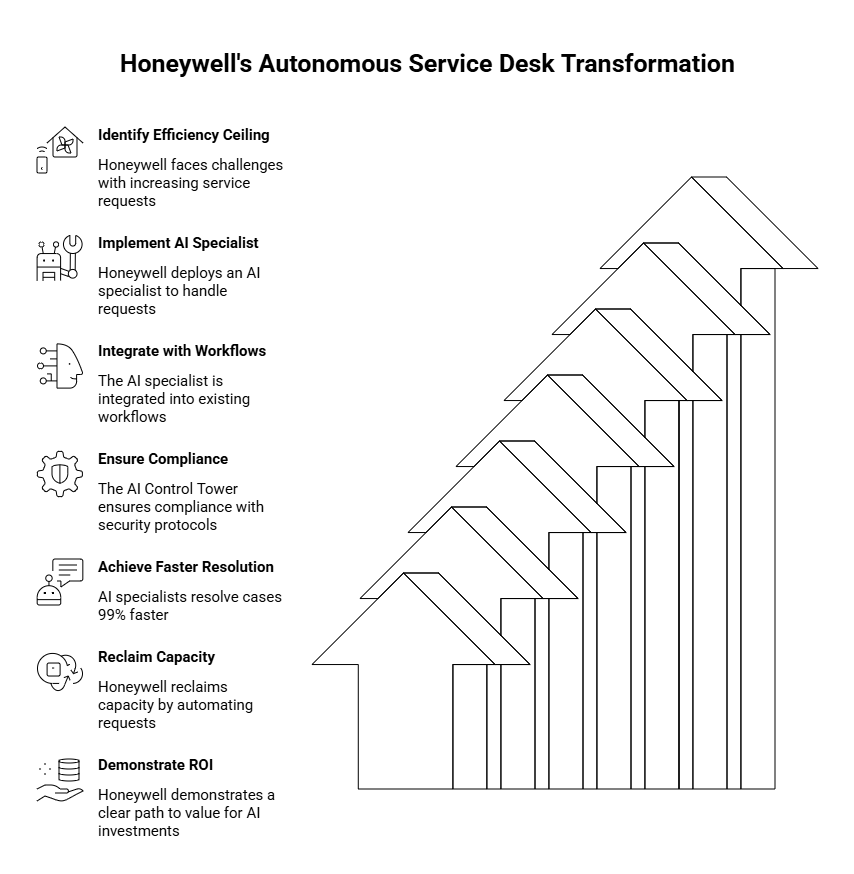
Case Study 1: Honeywell – Architecting the Autonomous Service Desk
Honeywell serves as a benchmark for how a global diversified manufacturer can leverage the ServiceNow and NVIDIA partnership to move from reactive "firefighting" to an autonomous service model.
Problem: The Efficiency Ceiling and Labour Constraints
Honeywell faced a common enterprise challenge: a growing volume of IT and employee service requests that outpaced the capacity of its human service desk. The manual processing of password resets, access provisioning, and network troubleshooting consumed significant bandwidth, preventing the IT team from focusing on strategic initiatives like AI governance and platform scale. The fragmented nature of legacy service management systems resulted in "AI chaos," where investments in individual AI tools failed to deliver holistic business outcomes.
Solution: Deploying the Autonomous Workforce
Working with ServiceNow and NVIDIA, Honeywell implemented the Level 1 IT Service Desk AI Specialist. This autonomous agent was embedded directly into Honeywell's proven workflows, allowing it to interpret requests, decide on the right action using business context, and execute tasks autonomously. The solution utilised the ServiceNow AI Control Tower to ensure that every action taken by the AI specialist was governed and compliant with Honeywell's security protocols.
Outcome: 99% Faster Resolution and Scalable Transformation
The implementation of the Autonomous Workforce delivered transformative results for Honeywell:
- Resolution Velocity: AI specialists resolved assigned IT cases 99% faster than when the same cases were handled by human agents.
- Capacity Reclamation: By automating over 90% of routine employee IT requests, Honeywell unlocked new levels of efficiency, allowing the workforce to focus on higher-value activities.
- Measurable ROI: The use of the AI Control Tower allowed Honeywell to move from the experimentation phase to production-scale autonomy, providing a clear path to value for its AI investments.
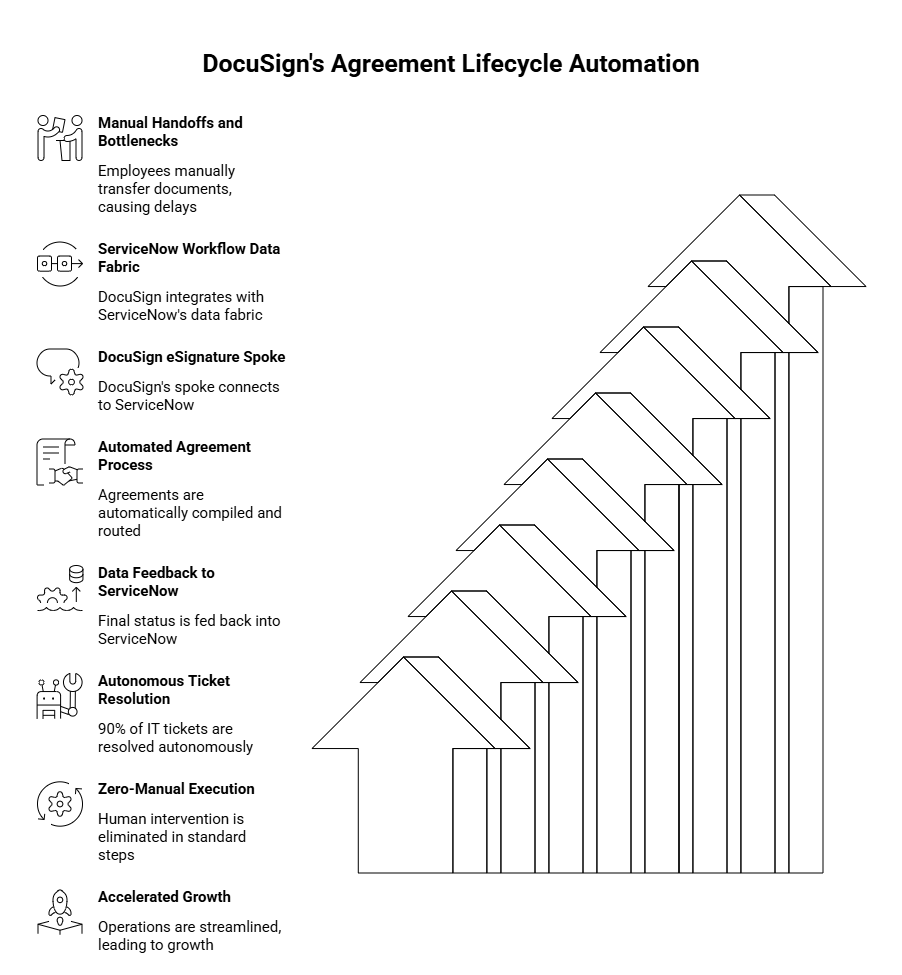
Case Study 2: DocuSign – Eliminating Friction in the Agreement Lifecycle
DocuSign’s partnership with ServiceNow illustrates how AI-driven workflows can solve the persistent problem of bottlenecks in critical business processes.
Problem: Manual Handoffs and Process Traffic Jams
For many organisations, the agreement process is a significant source of friction. IT ticket volume often balloons because of the manual steps involved in preparing, sending, and signing contracts. At DocuSign, the challenge was to eliminate the manual handoffs and "shadow workflows" that occurred when employees deviated from standard processes to meet deadlines. These hidden bottlenecks silently eroded productivity and created data silos that made it difficult to track the status of agreements across the enterprise.
Solution: The Workflow Data Fabric and IAM Integration
DocuSign leveraged the ServiceNow "Workflow Data Fabric" and the "DocuSign eSignature Spoke" to create end-to-end, automated agreement processes. This integration allows a business action in ServiceNow to trigger a DocuSign Intelligent Agreement Management (IAM) workflow. The system automatically compiles the relevant data, generates the agreement, routes it for negotiation and signature, and then feeds the final status back into ServiceNow records.
Outcome: 90% Autonomous Resolution of IT Tickets
The combination of ServiceNow's orchestration and DocuSign's agreement intelligence has redefined operational velocity:
- Ticket Automation: DocuSign is currently targeting the autonomous resolution of 90% of its IT tickets through these technologies.
- Zero-Manual Execution: The integration eliminates the need for human intervention in standard agreement steps, removing redundant work and enhancing accuracy across the enterprise.
- Accelerated Growth: By streamlining its own operations with IAM, DocuSign has demonstrated the power of platform-level orchestration to deliver superior experiences for both employees and customers.
Financial Benchmarks: The CFO’s Roadmap to AI ROI
The difficulty of quantifying AI ROI is a significant barrier to further investment. According to the 2026 Strategic CFO Report, 76% of finance leaders say this difficulty is moderately to significantly hindering their AI initiatives. Most organisations are struggling because they are layering AI onto fragmented data environments, which prevents the technology from producing measurable returns.
The NVIDIA and ServiceNow partnership addresses this by treating ROI not as a reporting exercise, but as a "design decision". By anchoring AI initiatives to the ServiceNow platform, CFOs can leverage built-in metrics and benchmarks to track performance across the entire value chain.
Key Performance Indicators for the Agentic Business
Furthermore, the introduction of "Apriel 2.0"—the next generation of ServiceNow’s open model family—provides a faster, smaller, and more cost-efficient footprint for enterprise reasoning. Engineered with multimodal capabilities, Apriel 2.0 can interpret screenshots, forms, and diagrams, allowing it to be applied to a broader range of complex financial and operational workflows than previous models.
Overcoming the Production Gap: The Forward Deployed Engineering Model
One of the most sobering statistics for any CFO is that only 14% of enterprise technology leaders have successfully scaled an AI agent to organisation-wide use. To address this "production gap," ServiceNow and Accenture have launched a "Forward Deployed Engineering" (FDE) program. Under this model, vendor engineers are embedded directly inside customer environments to build and run agentic AI workflows in production before a wider rollout occurs.
This approach addresses the primary causes of AI failure: legacy system integration, inconsistent output quality, and unclear ownership. By putting engineers inside the environment from the start, the program ensures that AI initiatives move confidently from activation to sustained performance, providing the "hard-wired" success that boardrooms now demand.
Conclusion: The Path to $30 Billion and Beyond
The strategic partnership between NVIDIA and ServiceNow is not merely an alliance of convenience; it is a fundamental reconfiguration of the enterprise technology stack for the era of autonomy. By combining the world's most efficient generative computing hardware with the leading enterprise workflow platform, the two companies have created an "AI Enterprise Operating System" that is safe, scalable, and, most importantly for the CFO, financially transformative.
As ServiceNow moves toward its $30 billion revenue target, the organisations that will thrive are those that recognise that AI is no longer a discretionary budget item, but the core engine of business growth. The transition to an "Agentic Business" is inevitable, driven by a global labour shortage and the relentless pressure for efficiency. The mandate for the modern CFO is clear: move beyond the "AI chaos" of the past and embrace the governed, autonomous future. By leveraging the AI Factory, the Action Fabric, and the AI Control Tower, the modern enterprise can finally deliver on the long-promised potential of artificial intelligence, turning intent into outcomes at the speed of thought.
Here are three key takeaways from the strategic shift toward an AI Enterprise Operating System:
- The NVIDIA Blackwell platform delivers a 35x reduction in the cost of generating AI intelligence, making it economically feasible to move from small-scale pilots to massive "AI Factories".
- ServiceNow’s AI Control Tower serves as the essential governance "nerve centre," turning fragmented and risky AI experiments into secure, policy-driven enterprise workflows.
- The emergence of specialised AI agents is creating a truly "Autonomous Workforce" capable of resolving complex operational tasks 99% faster than traditional manual methods.