
The modern finance and supply chain team faces a brutal truth: they are drowning in manual workflows. Every day, employees navigate islands of disconnected systems, chasing purchase orders across endless spreadsheets and email threads. This friction doesn't just frustrate teams; it actively drains revenue, slows operations and leaves organisations vulnerable to disruption.
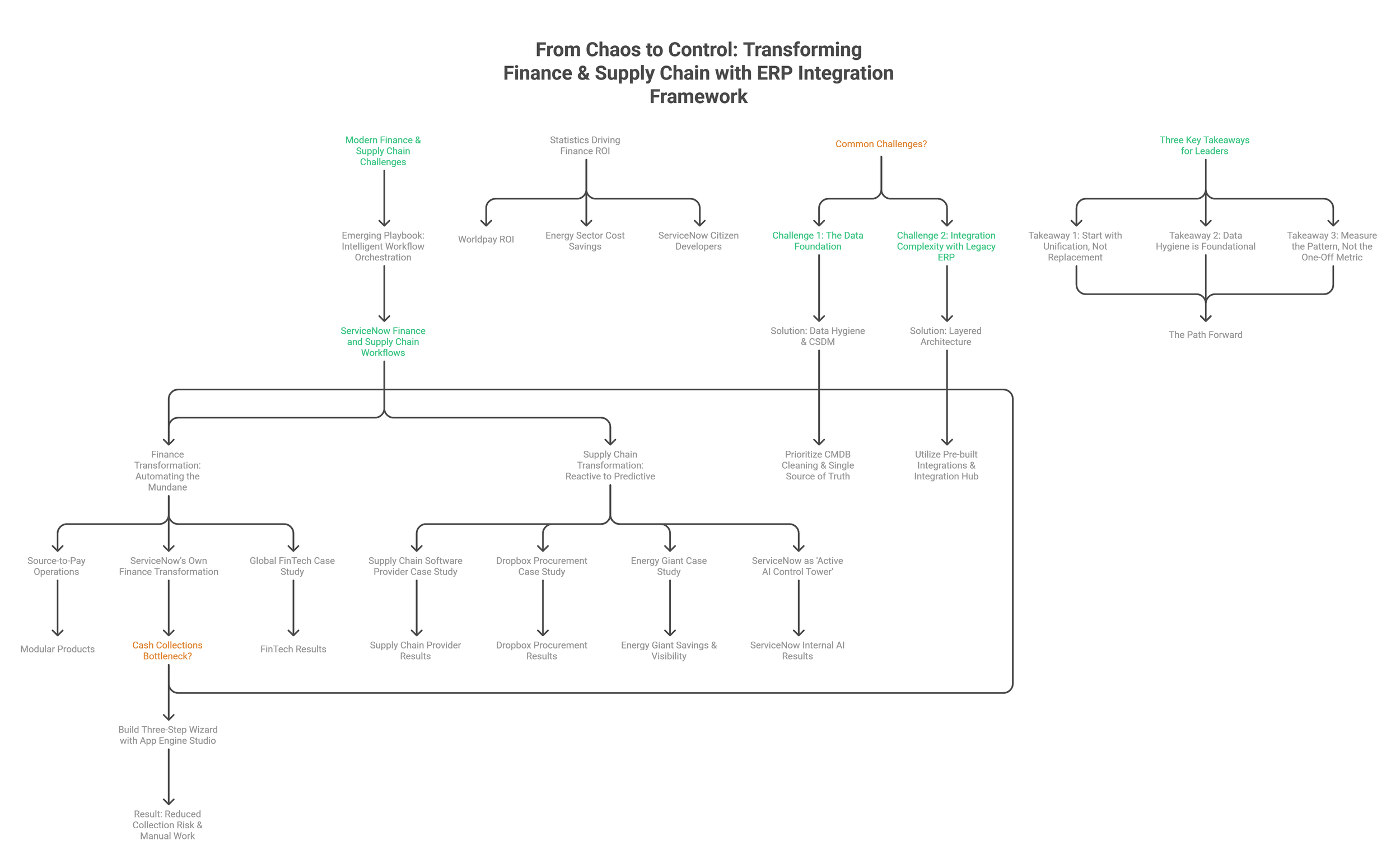
Yet, amidst this chaos, a new playbook is emerging. Leading organisations are discovering that the fastest path to operational agility isn't ripping out their core ERP systems; it's layering intelligent workflow orchestration on top. ServiceNow's Finance and Supply Chain Workflows are proving to be that strategic layer, delivering measurable visibility, control and speed while complementing existing ERP investments.
Quick Summary
- The Problem: Manual processes connecting disconnected finance/supply chain tools.
- The Solution: An ERP Integration Framework on the ServiceNow platform.
- The Top Pattern: Layered architecture (ERP as System of Record, ServiceNow as System of Action).
The Financial Footprint: Automating the "Mundane but Essential"
The finance function is one of the most manual and process-intensive departments. The cost of this fragmentation is staggering; ServiceNow estimates the total addressable market for sourcing and procurement operations alone will reach $11 billion by 2025.
ServiceNow has invested in market-tailored solutions, such as Source-to-Pay Operations, which automates the full procurement workflow from onboarding suppliers and managing indirect procurement requests to confirming receipt of goods and paying vendors.
Stats that matter: Finance ROI
For leaders building a business case, the hard numbers consistently back the investment:
Return on Investment: Worldpay achieved a measured 111% ROI from its ServiceNow Performance Analytics deployment, with a payback period of just 1.8 years.
Cost Savings: In one energy sector implementation, simply centralising the supplier lifecycle on ServiceNow drove over $500,000 in direct operational and software cost savings.
Deployment Speed: The platform empowered 15% of ServiceNow's own finance employees to become citizen developers, managing more than 30 apps in development.
Case Study: Global FinTech Cuts Query Backlog by 80%
By leveraging the ServiceNow platform to standardise and automate financial operations, a major financial services firm achieved an 80% reduction in query volumes, automated over 50,000 requests every quarter, and saved more than 16,800 hours of employee time annually.
The Supply Chain Command Centre: From Reactive to Predictive
Whereas finance transformation focuses on internal efficiency, supply chain transformation is about building resilience in the face of external chaos. For decades, supply chains have been managed reactively, with dashboards that show what happened after the fact. But AI-powered orchestration is changing the game.
Case Study: Dropbox Cuts Its Procurement Cycle by More than 50%
Dropbox, serving 700 million users across 180 countries, freed its teams from manual interventions. By deploying ServiceNow, they achieved over a 50% reduction in the procurement cycle in just eight weeks, automating more than 1,000 ERP and risk assessments, and driving 99% compliance.
The Big Trend: ServiceNow as the "Active AI Control Tower"
The strategic shift is best understood through ServiceNow's partnership with FedEx. The logistics giant's global network generates more than 2 petabytes of data daily. The new collaboration embeds FedEx's data directly into workflows, enabling the supply chain to move from passive tracking (the "what" and "where") to predictive action (triggers that resolve disruptions before they escalate).
ServiceNow's own results from implementing this "active AI control tower" internally are telling: 90% of IT and HR processes at ServiceNow now run through AI agents, liberating human capacity and directly lifting operating margins by three full points. Far from a distant possibility, AI-powered workflow orchestration is delivering substantial operational gains today.
The Most Common Challenges and How Leading Organisations Solve Them
No major transformation is without friction. The organisations that succeed are those that solve the two most common issues.
Challenge 1: The Data Foundation
You cannot orchestrate workflows without a clean, unified data model. A ServiceNow expert put it succinctly: "Without a good CMDB, you will not get the value of AI". Even the AI Control Tower designed for governance depends on it. If CI records are incomplete or stale, "the governance layer enforces policies based on assumptions, not reality". If the CMDB is dirty, the AI will confidently execute on decisively wrong information.
- How Leaders Solve It: Use ServiceNow's Common Service Data Model (CSDM) and invest in cleaning the Configuration Management Database (CMDB) as a prerequisite.
Challenge 2: Integration Complexity with Legacy ERP
Most organisations run diverse legacy systems (e.g., SAP, Oracle). Integrating them requires abstraction, not brute force.
- The Solution: The Zero Copy Connector for ERP acts as a semantic layer. A ServiceNow workflow can "create a vendor in SAP, update a purchase order, or post a journal entry — directly from a flow, no need for middleware in between." This allows a layered architecture where ServiceNow acts as the System of Action while the ERP remains the System of Record.
They might call it "Layered Architecture." But the real magic lies in Data Integrity + Intelligent Triggers.
- Level 1 Functional (Data Layer): The CSDM and CMDB provide a unified data foundation for visibility and lineage.
- Level 2 Strategic (Execution Layer): The Zero Copy Connector allows ServiceNow to trigger live Create/Update operations directly in the ERP, without middleware.
Conclusion & The Path Forward
The organisations that act now, investing in unified, AI-orchestrated workflows atop a clean data foundation, are the ones that will gain an insurmountable advantage in agility, cost structure and resilience.
Three Key Takeaways for Leaders
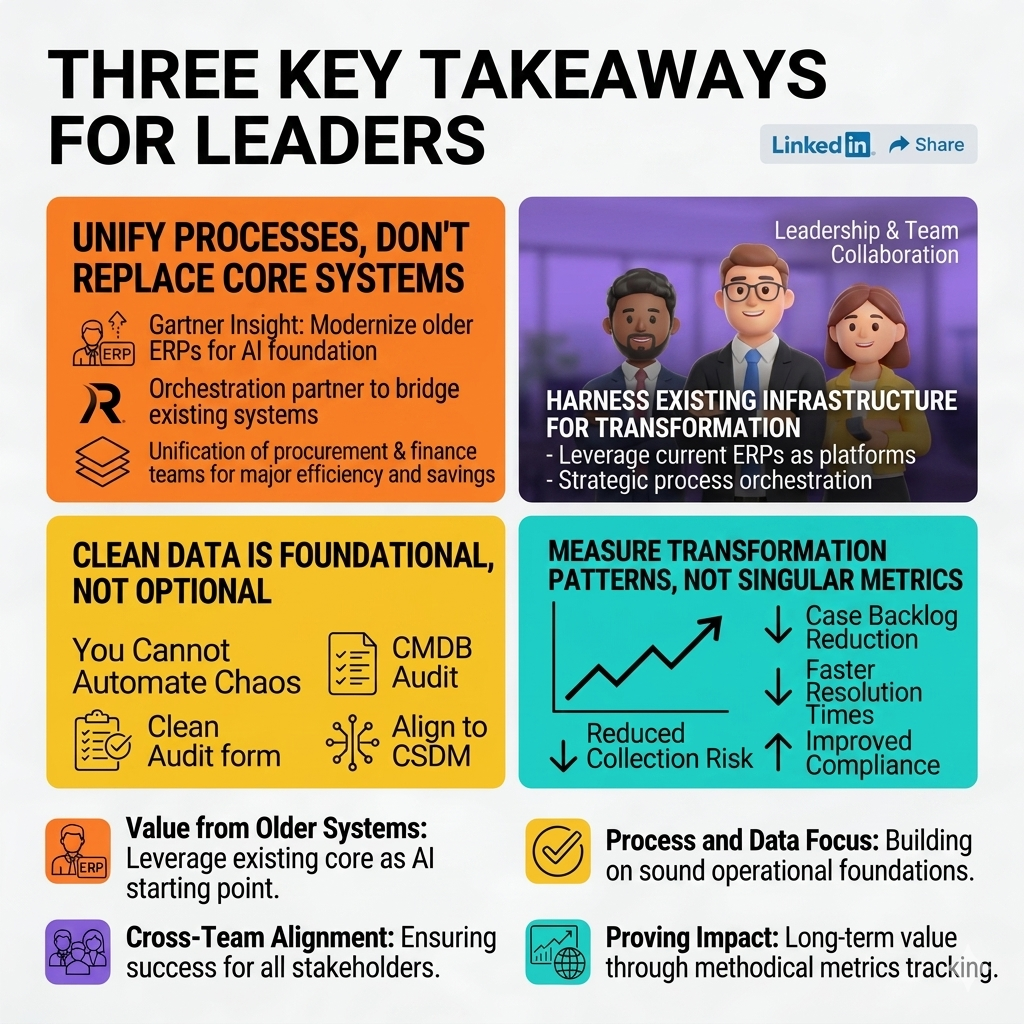
- Start with Unification, Not Replacement. The winning strategy is to layer an orchestration platform on top of existing ERP systems. Gartner notes that partners like Rimini Street allow you to leverage older ERPs as "starting points for AI initiatives" without a costly rip-and-replace.
- Data Hygiene is the Prerequisite for AI. You cannot automate chaos. Before deploying any automation, audit your CMDB and align your data to the CSDM.
- Measure the Pattern. The true return of transformation is seen in a pattern of improvements: lower case backlog, faster resolution times, reduced collection risk, and higher compliance rates.
Deep Dive into how you can make every dollar more productive, while keeping your team focused on strategy.