How TinyLoop + ServiceNow Turn AI Ambition Into Enterprise-Scale Execution
In the first half of 2026, one reality has become impossible for enterprise leaders to ignore: most AI initiatives never make it to production scale.
Despite billions invested in Large Language Models (LLMs), copilots, and intelligent agents, only a small percentage of enterprises have successfully operationalised AI across the organisation. The issue is rarely the intelligence of the model itself. The real challenge is structural. Most enterprises are still operating fragmented systems, disconnected workflows, siloed data, and inconsistent governance models. AI simply amplifies those weaknesses.
At TinyLoop, we call this the AI Production Gap.
This article expands on the Honeywell and DocuSign case studies discussed in our previous post published on 12 May, but focuses on a more important question:
How would TinyLoop help enterprises solve similar challenges using ServiceNow, AI governance, workflow orchestration, and real-time observability?
Why This Matters to the C-Suite
For CTOs, CIOs, and CFOs, the primary focus has shifted away from mere experimentation toward solving complex enterprise challenges. Today’s C-suite must figure out how to scale AI safely, govern autonomous workflows, and reduce operational costs without introducing new risks. Executive leaders need clear methods to ensure AI decisions remain observable, auditable, and measurable while bridging the gap between disconnected pilot projects and meaningful, company-wide outcomes.
Without robust observability, governance, and orchestration, AI initiatives quickly turn into another isolated technology silo. However, when built on the right architecture, AI transforms into a cohesive operating layer for the entire business. TinyLoop engineers this operational foundation by combining the ServiceNow AI Control Tower, ServiceNow Action Fabric, DocuSign IAM, and NVIDIA infrastructure with Zero-Copy integrations, Model Context Protocol (MCP) orchestration, and governance-first workflow design.
Expanding on the Honeywell and DocuSign case studies from our May 12 article, this piece dives deeper into the practical details. Specifically, it explores how TinyLoop directly addresses and resolves these enterprise-scale AI challenges.
The Architecture Behind Enterprise AI Execution
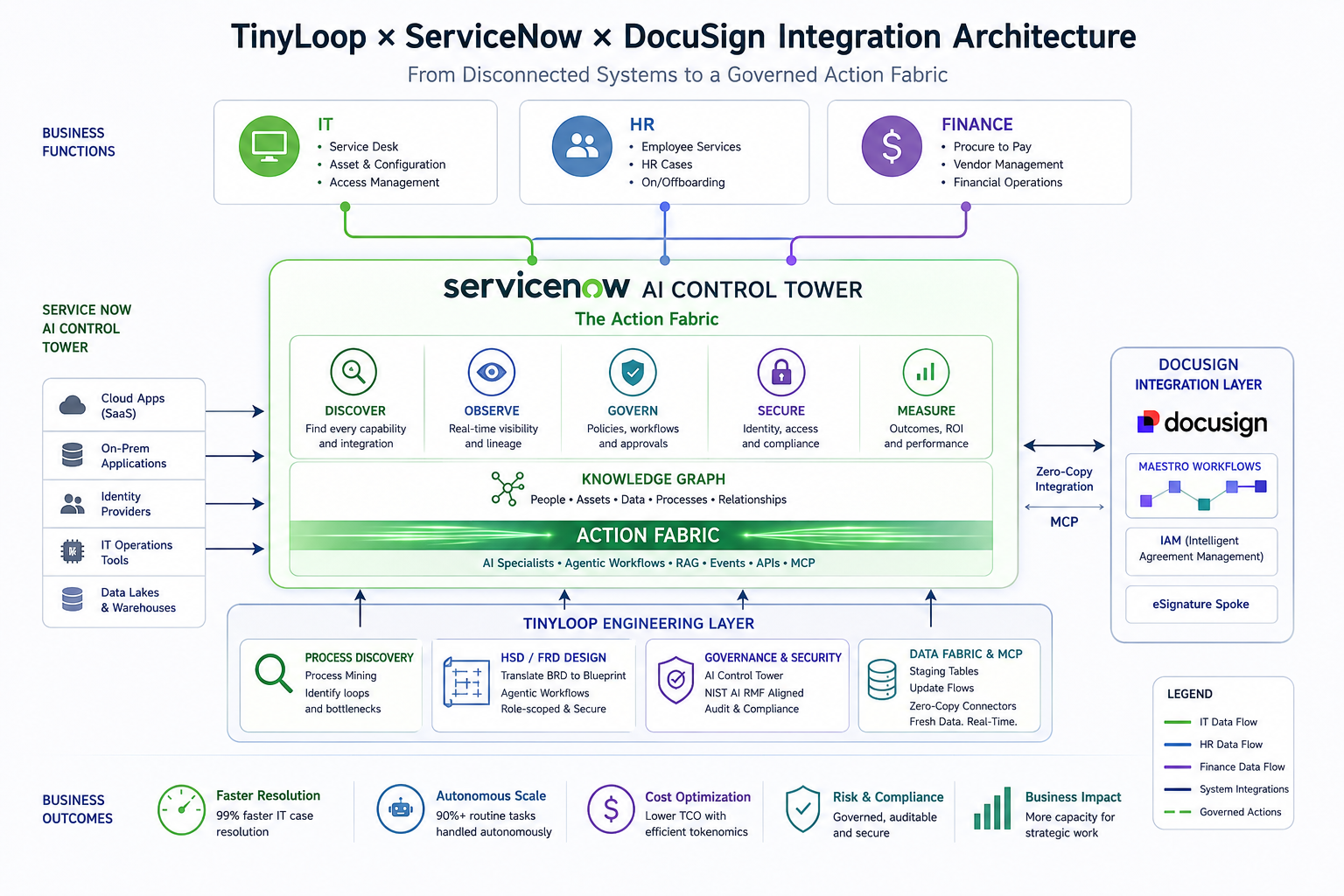
TinyLoop’s governed AI architecture connects IT, HR, Finance, ServiceNow AI Control Tower, and DocuSign into a unified Action Fabric
The Shift to Governed AI Ecosystems
The architecture outlined above represents a major shift occurring across the enterprise market, as organizations move away from disconnected AI tools toward fully governed AI ecosystems. At the center of this model sits the ServiceNow AI Control Tower, which acts as the enterprise command center for discovery, observability, governance, security, and measurement. Positioned directly underneath is the Action Fabric, a real-time orchestration layer that enables secure autonomous workflows across enterprise systems. Together, these technologies help organizations transition from fragmented automation, reactive operations, manual approvals, and siloed data to governed autonomy, real-time orchestration, intelligent workflow execution, and measurable business outcomes. The end result is what ServiceNow refers to as a true System of Action.
Case Study 1: Honeywell — Reclaiming the IT Service Desk
Honeywell faced a challenge many enterprise IT leaders understand all too well: their teams were buried under repetitive L1 support requests, such as password resets, provisioning, and network troubleshooting. Highly skilled staff were spending valuable time managing operational noise rather than driving strategic transformation. The deeper issue, however, was architectural fragmentation, as disconnected systems prevented AI from making business-aware decisions across identity, HR, security, and operational platforms.
Honeywell addressed this by adopting the ServiceNow AI platform. By leveraging the Knowledge Graph, workflow orchestration, runtime visibility, and NVIDIA infrastructure, they significantly improved operational intelligence and automation. This strategic shift resulted in faster case resolution, high levels of autonomous ticket handling, reduced operational overhead, improved scalability, and greater enterprise visibility.
Case Study 2: DocuSign — Eliminating Agreement Friction
DocuSign faced another common enterprise bottleneck: manual agreement workflows and disconnected write-back processes that created constant delays across procurement, HR, finance, and legal teams. In many enterprise environments, data leaves the core system and documents are signed externally, but the completed information never properly returns to the primary system of record. This breakdown leads to shadow workflows, manual reconciliation, reporting inaccuracies, compliance exposure, and fragmented enterprise visibility.
DocuSign resolved these challenges by implementing the ServiceNow Workflow Data Fabric alongside IAM integration, Maestro orchestration, and Action Fabric connectivity. By unifying these components, they significantly improved agreement automation and achieved seamless enterprise synchronization.
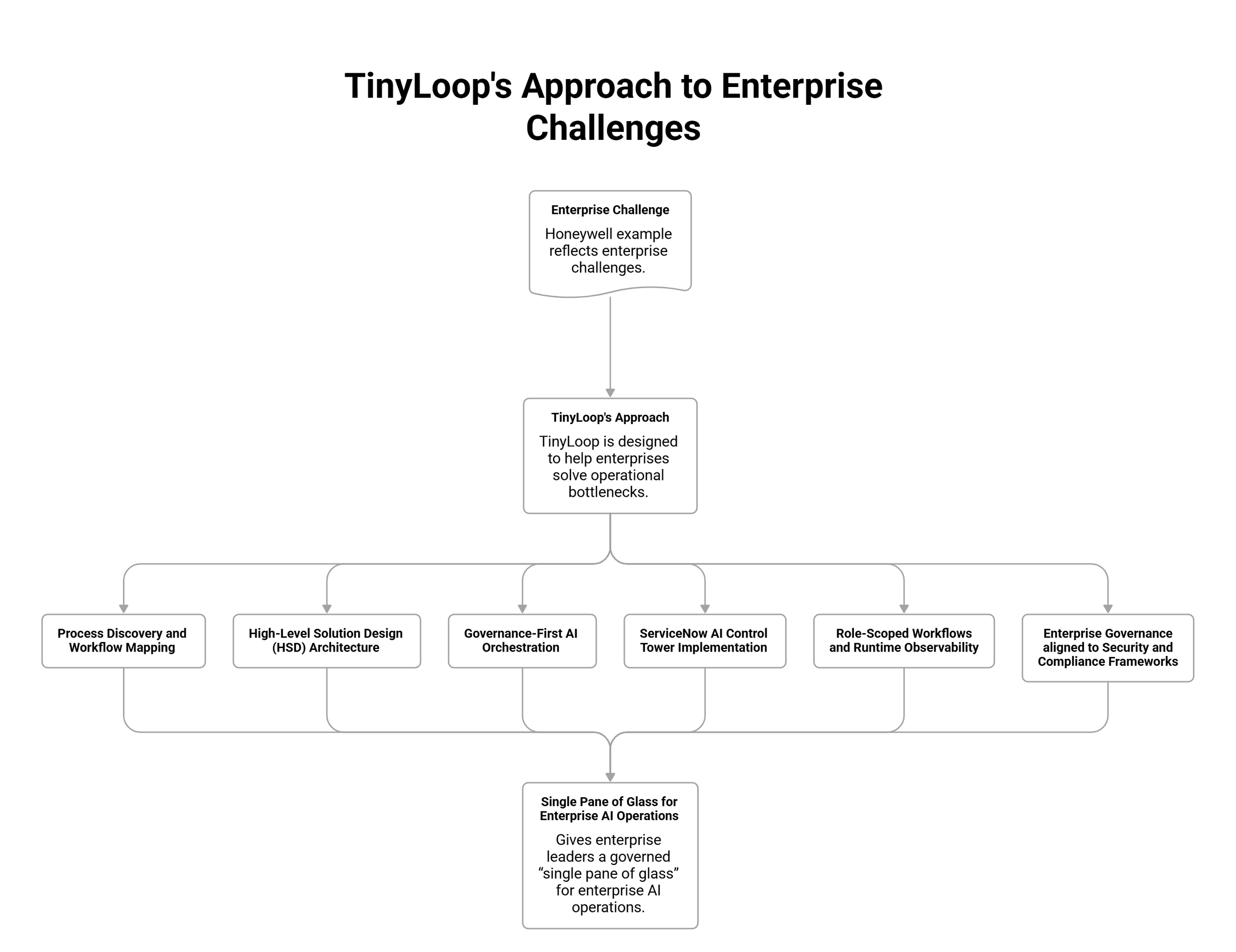
How TinyLoop Would Engineer Similar Agreement Automation Challenges
In similar enterprise environments, TinyLoop would support organisations through:
- Functional Requirements Design (FRD)
- Staging table architecture
- MCP server orchestration
- Zero-Copy enterprise integrations
- Secure workflow automation
- Real-time enterprise data access
- Governed AI workflow execution
The objective is not simply automation.
The objective is governed enterprise orchestration that remains observable, secure, and measurable at scale.
Strategic Governance: The Enterprise AI Kill Switch
One of the biggest concerns for modern CIOs, CTOs, and CFOs is uncontrolled AI behavior. As AI agents gain more autonomy, enterprises must ensure they operate within strict governance and security boundaries.
TinyLoop puts governance at the center of its platform by embedding continuous runtime observability and strict, permission-scoped execution directly into AI workflows. This ensures AI agents operate only within designated security boundaries while providing real-time anomaly detection to catch unexpected actions before they cause damage. By pairing secure AI orchestration with controlled autonomous workflows, organizations can safely delegate complex tasks without sacrificing operational oversight. Furthermore, enterprise-grade auditability guarantees complete visibility into every AI-driven action, making compliance straightforward.
Together, these capabilities allow organizations to scale AI aggressively while maintaining total security, compliance, and operational control. For enterprise leaders, governance is no longer optional, it is foundational to enterprise AI adoption.
The Real Business Outcome
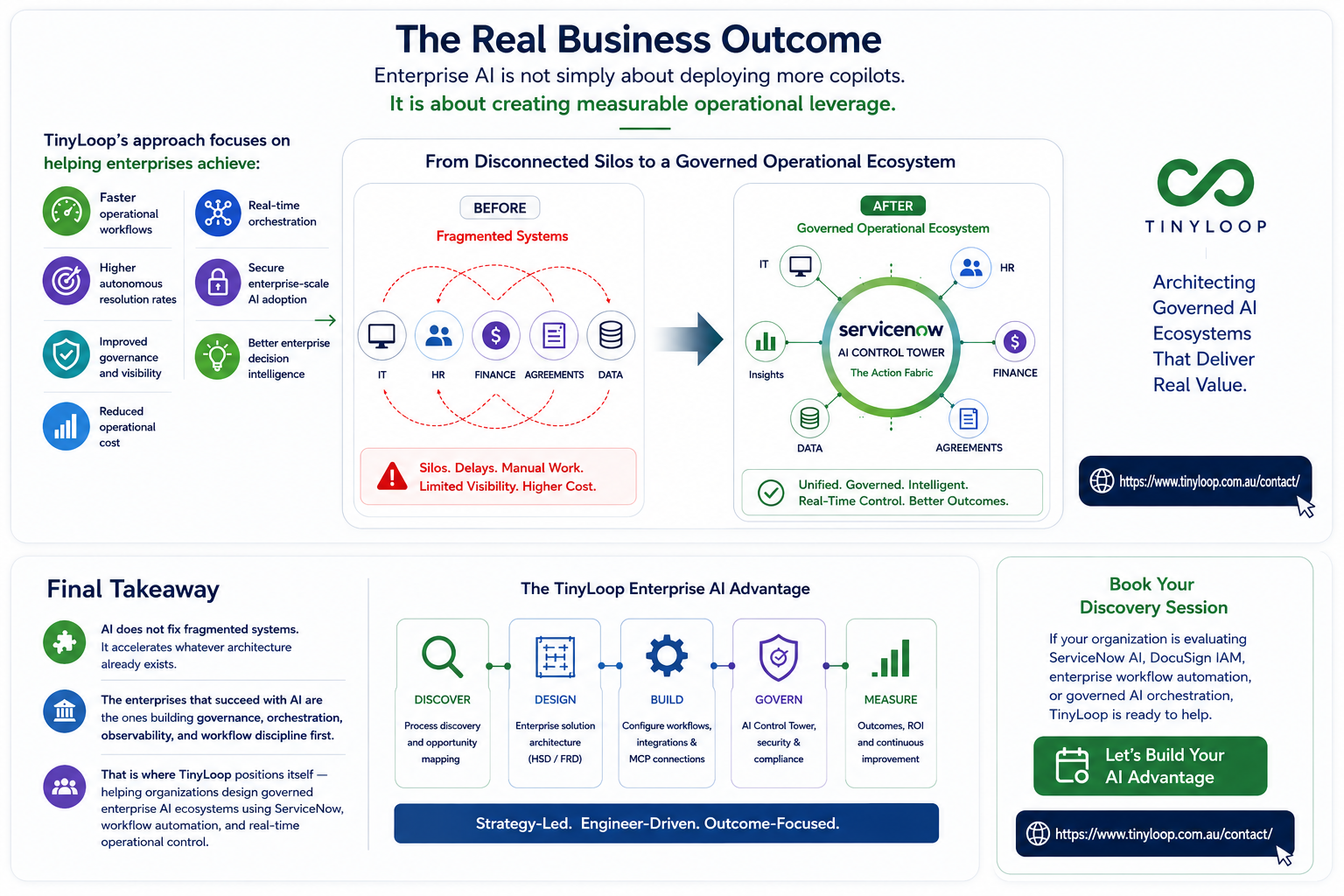
Enterprise AI is not simply about deploying more copilots. It is about creating measurable operational leverage.
TinyLoop’s approach focuses on helping enterprises achieve:
- Faster operational workflows
- Higher autonomous resolution rates
- Improved governance and visibility
- Reduced operational cost
- Real-time orchestration
- Secure enterprise-scale AI adoption
- Better enterprise decision intelligence
The organisations succeeding with AI are the ones building governed operational ecosystems, not isolated AI experiments.
Final Takeaway
AI does not fix fragmented systems. It accelerates whatever architecture already exists. The enterprises that succeed with AI are the ones building governance, orchestration, observability, and workflow discipline first. That is where TinyLoop positions itself, helping organisations design governed enterprise AI ecosystems using ServiceNow, workflow automation, and real-time operational control.
Book Your Discovery Session
If your organisation is evaluating ServiceNow AI, DocuSign IAM, enterprise workflow automation, or governed AI orchestration, TinyLoop is ready to help.
Explore how we can modernise your enterprise operating model: https://www.tinyloop.com.au/contact/