Why Workflow Intelligence Matters to the C-Suite: Driving Growth, Visibility, and Smarter Sales Execution
A CEO recently described a boardroom moment that many leadership teams recognise instantly. The quarterly revenue discussion had just begun.
Within minutes, the room was divided.
- Sales believed pipeline momentum was strong
- Finance questioned the forecast accuracy
- Operations warned that delivery capacity was already stretched
Everyone had data. But no one had a single operational truth. This is where many organisations discover a hard reality:
- Growth problems are rarely about strategy.
- They’re about execution visibility.
As organisations grow, something subtle but important begins to happen. Systems multiply, processes become more layered, and visibility across the business starts to fade. What once felt fast and coordinated gradually turns slower and more complex.
For CEOs trying to push revenue higher, the friction tends to show up in familiar ways. Sales pipelines get scattered across disconnected tools. Deal approvals take longer because they rely on manual steps. Customer onboarding becomes a cross-team effort that’s hard to coordinate. And at the leadership level, it becomes increasingly difficult to get a real-time view of what’s actually happening.
Over time, this isn’t just inefficient; it quietly becomes a ceiling on growth.
A similar challenge appears in financial forecasting. For CFOs, the issue is rarely the financial models themselves. The real problem is fragmented data across the organisation.
When sales, delivery, and operations don’t connect, financial clarity suffers. Forecasts are built in spreadsheets instead of reflecting live workflows. Revenue projections don’t always match delivery capacity. Reporting cycles slow down because of manual reconciliation. And decisions are made using outdated information.
Without connected workflows, forecasting becomes reactive instead of strategic.
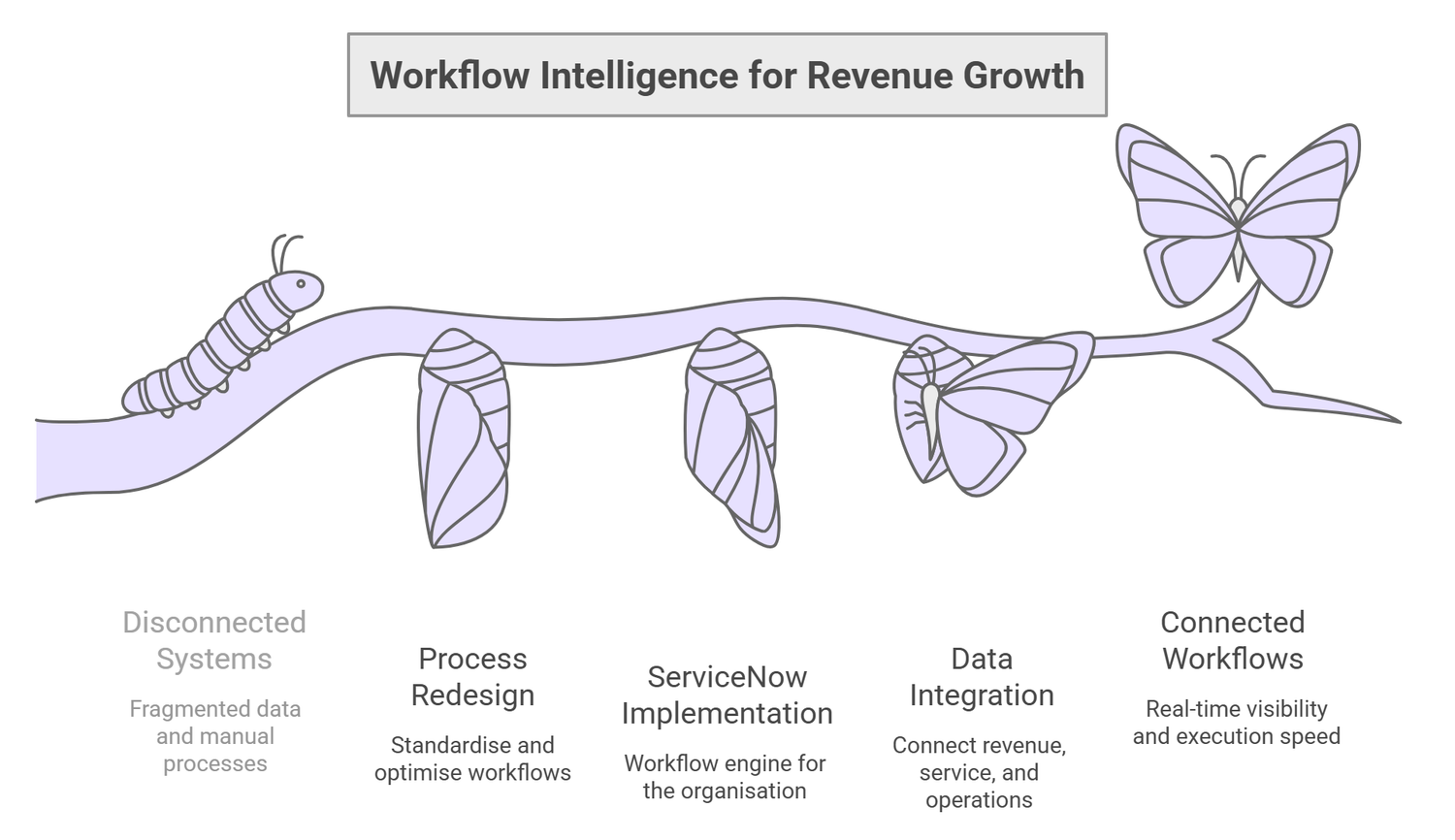
This is where platforms like ServiceNow start to play a much bigger role than many expect. When used strategically, it becomes more than just an IT tool—it acts as the organisation’s workflow engine.
The impact is immediate. Sales processes become more structured, with automated approvals and clear governance. Customer onboarding becomes coordinated instead of fragmented. Operational tasks are routed intelligently, reducing delays and confusion. And leadership gains access to real-time dashboards that reflect the state of the business as it actually is.
Instead of juggling disconnected tools, the organisation begins to operate on a single, unified backbone. However, the companies that see the most value don’t treat ServiceNow as just another piece of technology. They treat it as a platform for business transformation.
They start by standardising their processes before trying to automate them. They align workflows with measurable business outcomes rather than internal habits. They connect revenue, delivery, and operational data so everything reflects the same reality. And they make sure leadership has access to real-time insights that support better decisions.
When this approach is taken, the platform doesn’t just support the business; it speeds up execution across the board.
One lesson comes up again and again in real-world implementations: start with outcomes, not features.
The strongest transformations focus on solving specific problems, like shortening the sales cycle, improving forecast accuracy, reducing friction in onboarding, and increasing transparency for leadership. Technology then becomes the enabler of those outcomes, not the goal itself.
There’s also a common mistake that many organisations make during digital transformation. They automate their existing processes without rethinking them.
The result is predictable. Inefficient workflows get digitised instead of improved. Systems become overly complex. Teams struggle to adopt new tools. And the overall business impact remains limited.
A better approach is much simpler: redesign the workflow first, then automate it.
Finally, the role of the right partner can make a significant difference. Turning a platform like ServiceNow into a true driver of growth requires more than technical configuration. It requires thoughtful process design, strong workflow architecture, and alignment across the organisation.
That’s why experienced teams focus on standardising and optimising processes, mapping business needs into workflows, designing systems that can scale, and supporting adoption through change management. When all of this comes together, the outcome is straightforward: ServiceNow becomes more than a system—it becomes a platform that actively accelerates growth.
Final Thought for the C-Suite
Revenue growth today is no longer just about closing deals.
It depends on how efficiently your organisation executes every step between opportunity and customer value. That requires:
- Connected workflows
- Operational transparency
- Intelligent automation
- Platforms like ServiceNow make this possible.
But the real advantage comes from how well those workflows are designed.
A Simple Question for Leaders
If revenue growth slowed tomorrow, would you know exactly which workflow is causing the friction?
If the answer isn’t clear, it may be time to rethink how your organisation connects its processes.
That’s a conversation organisations often begin with TinyLoop. Because when workflows work, growth follows.