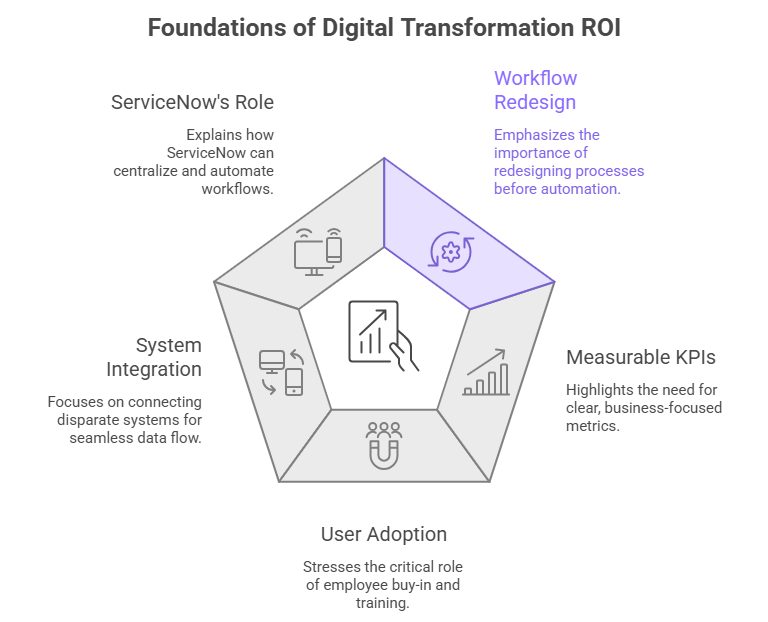
Why Your Digital Transformation Strategy Isn’t Delivering Results
A CIO recently shared a story that many IT leaders recognise. Two years earlier, the organisation had invested millions into a digital transformation programme.
New platforms were deployed. Automation tools were introduced. Dashboards were created. Yet daily operations still looked familiar. Approvals moved slowly through email chains. Teams maintained spreadsheets to track work. Leadership still lacked real-time visibility into operational performance. The technology had changed. But the way work actually happened inside the organisation had not.
This is where many digital transformation initiatives lose their return on investment.
Why Digital Transformation ROI Often Falls Short:
Most organisations don’t struggle because they chose the wrong technology.
They struggle because the transformation focused on tools instead of workflows.
Here are the most common reasons digital transformation initiatives fail to deliver measurable business value.
Technology Was Implemented, But Processes Stayed the Same:
- Many organisations digitise existing processes without redesigning them.
- Manual approvals become digital forms. Spreadsheets become dashboards. Email requests become tickets.
- But the underlying workflow remains inefficient. Automation only amplifies exciting problems.
Lack of Measurable Business KPIs
Another common issue is how transformation projects are measured. Success is often defined by:
- systems deployed
- integrations completed
- users trained
But executives care about different metrics:
- faster revenue cycles
- reduced operational costs
- improved service delivery
- better forecasting accuracy
Without linking transformation to measurable outcomes, ROI becomes difficult to prove.
One of the biggest challenges organisations face isn’t the technology itself—it’s getting people to actually use it.
Even the most well-designed platforms can fail if teams don’t adopt them. This usually happens in subtle ways. Workflows may feel more complicated than the old way of doing things. Employees may not clearly understand how the system helps them in their day-to-day work. And in many cases, change management simply doesn’t get enough attention.
When that happens, people fall back on what they know. They return to emails, spreadsheets, and informal processes. And once that shift happens, the value of the platform quickly starts to disappear.
Another common issue is fragmentation across systems. Many organisations introduce new tools over time, but don’t fully connect them into a single workflow.
Sales might be working in one platform, operations in another, and service teams in a third. On the surface, each system may work well on its own. But across the organisation, the result is disconnected data and limited visibility.
This makes it difficult for leadership to see the full picture. Instead of relying on real-time insights, decisions often depend on manual reports that are already outdated by the time they’re reviewed.
At the core of these challenges is a deeper issue: digital transformation without a clear workflow strategy.
Successful transformation doesn’t begin with software. It begins with understanding how work should flow across the organisation. When workflows are designed properly, systems can be connected in a way that removes friction instead of creating more of it.
This is where enterprise workflow platforms like ServiceNow become especially valuable. They allow organisations to orchestrate workflows across teams, systems, and data in a structured way.
Instead of operating through a collection of disconnected tools, the business starts to run on unified digital workflows.
When implemented with the right strategy, ServiceNow becomes much more than an IT system. It becomes the operational backbone that connects processes across the entire organisation, making digital transformation scalable, coordinated, and far more effective.
Unified Workflow Management
ServiceNow centralises workflows across departments such as IT, HR, customer service, and operations. Requests, approvals, and tasks follow structured processes rather than informal coordination through email. This improves consistency and accountability across teams.
As organisations grow, many of their internal processes begin to slow down, not because people aren’t working hard, but because too much relies on manual coordination.
Think about everyday workflows like service request approvals, employee onboarding, resolving customer issues, or managing system changes. Each of these often involves multiple teams, back-and-forth communication, and waiting for the next step to happen. Over time, these small delays add up and start to impact overall performance.
This is where automation makes a real difference. Platforms like ServiceNow help streamline these high-friction processes by turning them into structured, automated workflows. Instead of chasing approvals or manually coordinating tasks, work moves forward automatically. As a result, delays are reduced, and teams can spend more time on meaningful, high-value work.
Another major benefit of a workflow platform is visibility. In many organisations, it’s difficult for leaders to see what’s really happening day to day. Problems often stay hidden until they become serious.
With the right system in place, that changes. Leaders get access to real-time dashboards that show how processes are performing, where bottlenecks are forming, how work is distributed across teams, and how services are being delivered. This kind of visibility makes it much easier to spot issues early and take action before they escalate.
Finally, one of the reasons ServiceNow stands out is that it isn’t just a single-purpose tool—it’s built as a scalable platform.
Many organisations start with a specific use case, like IT service management. But over time, they expand into other areas of the business, such as employee workflows, customer operations, security, and broader enterprise services. Because everything runs on the same platform, this expansion feels connected rather than fragmented.
This means transformation doesn’t have to happen all at once. It can grow step by step, alongside the business, while still maintaining a consistent and unified way of working.
Best Practices for Achieving Digital Transformation ROI
Organisations that successfully deliver ROI from transformation initiatives follow several consistent principles. Start with business outcomes, not technology features.
Define the operational improvements you want before selecting tools. Standardise processes before automation. Automating inconsistent workflows only increases complexity.
Connect operational and financial metrics. Transformation should improve measurable business outcomes. Design for adoption. Workflows must simplify work for employees, not add additional steps.
Pro Tip from Real Implementations
Start with a small number of high-impact workflows rather than attempting enterprise-wide transformation immediately. For example:
- service request automation
- onboarding workflows
- approval processes
Early success builds momentum and helps teams see the value of the platform quickly.
Common Pitfall: Automating Inefficient Processes
One mistake organisations frequently make is automating workflows that were never designed properly in the first place. This leads to:
- complex service catalogues
- unnecessary approval layers
- low adoption rates
- limited productivity gains
The smarter approach is simple: Redesign the workflow first. Then automate it.
Turning Transformation into Real Business Value
Technology alone cannot transform an organisation. Real transformation happens when platforms, processes, and people align. This is why many organisations partner with specialists who understand both workflow architecture and platform implementation.
Teams like TinyLoop help organisations translate business goals into scalable workflows by:
- redesigning inefficient processes
- building structured ServiceNow workflows
- creating measurable operational dashboards
- driving adoption through change management
The goal is not just implementing technology. It’s building systems that improve how work actually gets done.
Final Thought for IT Leaders
Digital transformation should make work simpler, faster, and more transparent. If your transformation initiatives haven’t delivered the expected ROI, the problem may not be the technology. It may be the workflows surrounding it.
A useful question to ask is: Are your systems simply digitising work, or are they improving how work flows across your organisation?