Rolling out ServiceNow isn’t just another IT project; it’s a full-blown transformation journey. Imagine unlocking a smoother, smarter way to deliver services across your organisation, where manual tasks fade, and automated workflows take over. But here’s the catch: while some teams go live in a few months, others find themselves knee-deep in delays that stretch for over a year.
So, what makes the difference? The secret lies in scope, preparation, and the way you move through each stage of the implementation. Let’s take a walk through the ServiceNow journey phase by phase and uncover what separates smooth, on-schedule deployments from the ones that drag on.
The Six Stages of a Successful ServiceNow Implementation
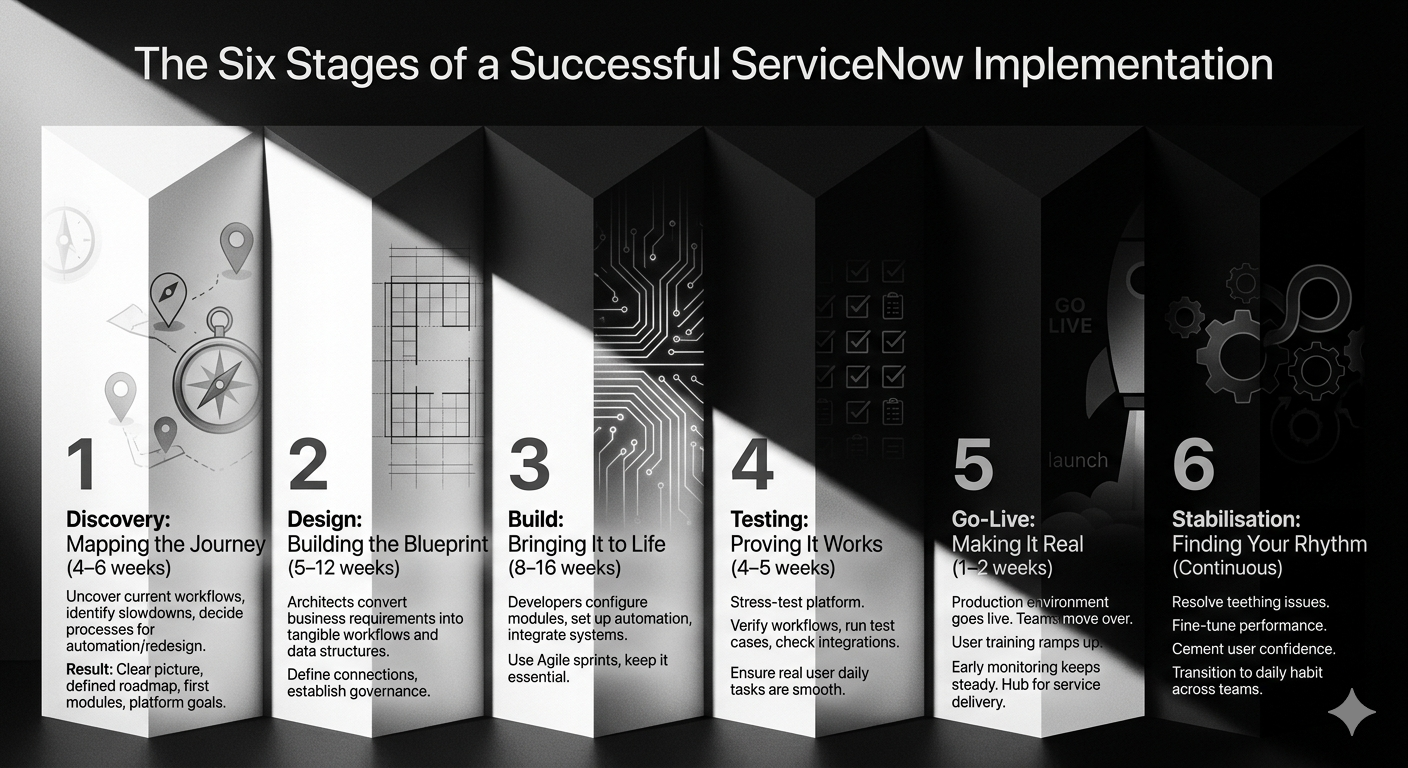
Think of a ServiceNow rollout as a six-stop expedition. Each phase builds on the last, guiding your organisation from early discovery to full adoption and long-term stability.
1. Discovery: Mapping the Journey (4–6 weeks)
It all begins with uncovering how your organisation actually works. During Discovery, teams dig into your current workflows, identify where things slow down, and decide which processes need automation or redesign. By the end of this stage, you’ll have a clear picture—a roadmap that defines what success looks like, which modules to roll out first, and how the platform fits your goals.
2. Design: Building the Blueprint (5–12 weeks)
This phase is where ideas take shape. Architects convert your business requirements into tangible workflows and data structures. It’s also when you decide how different systems will connect and how governance will keep everything on track. The goal here: create a design strong enough to evolve as your business grows.
3. Build: Bringing It to Life (8–16 weeks)
Now the action begins. Developers configure modules, set up automation, and integrate systems. Agile sprint cycles keep everyone aligned, allowing you to test features as they’re built. Simplicity is your best friend in this stage—building what’s essential, not everything at once.
4. Testing: Proving It Works (4–5 weeks)
Before you flip the switch, the platform gets stress-tested. This includes verifying workflows, running test cases, and making sure integrations behave as expected.
It’s not just about technical checks; it’s about ensuring real users can perform their daily tasks smoothly in the new setup.
5. Go-Live: Making It Real (1–2 weeks)
Here’s where the excitement peaks. Your production environment goes live, teams move over to ServiceNow, and you begin operating in the real world.
User training ramps up, and early monitoring keeps everything steady. Within days, ServiceNow becomes your organisation’s central hub for service delivery.
6. Stabilisation: Finding Your Rhythm (Continuous)
Even after launch, the journey continues. The stabilisation or “hypercare” phase focuses on resolving teething issues, fine-tuning performance, and cementing user confidence.
This is the stage where ServiceNow transitions from a new tool into a daily habit across teams.
Why Some Implementations Take 3 Months, and Others Take a Year
Every ServiceNow rollout is unique, but a few key factors shape its pace:
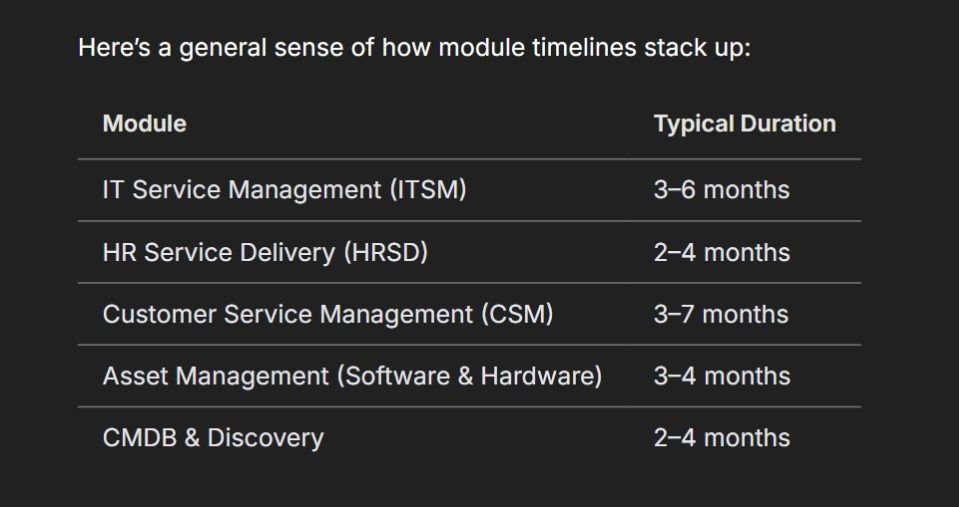
- Scope & Complexity: A single ITSM module might wrap up in three months, while a multi-department rollout (HRSD, CSM, and Asset Management combined) easily extends beyond a year.
- Integrations: The more systems you need to connect—like HR platforms, CRMs, or asset databases—the longer it takes to fine-tune data flow.
- Data Readiness: A clean, structured CMDB saves months of pain later.
- Change Management: Even the perfect build can fail if users aren’t prepared for new ways of working.
The Hidden Superpower: Good Governance
Behind every smooth ServiceNow rollout is a well-defined governance model.
It’s what keeps decisions timely, responsibilities clear, and priorities aligned.
Best-performing enterprises usually have:
- An executive sponsor who clears roadblocks and drives alignment.
- Defined roles using a RACI model so everyone knows their part.
- Regular steering reviews to keep phases on track.
- Certified ServiceNow experts guiding design and risk management.
Governance might not sound glamorous, but it’s the unsung hero of timely delivery.
Building Long-Term Value, Not Just a Launch
A successful ServiceNow journey doesn’t end with go-live; it evolves. The best rollouts grow phase by phase, expanding capabilities as teams become more comfortable.
To build lasting value:
- Keep configuration clean and close to out-of-the-box standards.
- Set clear KPIs to measure business value, not just system uptime.
- Roll out features in stages to give teams breathing space.
- Track adoption and user feedback continuously during hypercare.
When planning and governance work in harmony, ServiceNow becomes more than a platform; it’s the backbone of a more agile and efficient organisation.
Rolling out ServiceNow is as much about people as it is about technology. With the right roadmap, steady leadership, and an expert implementation partner, your rollout can stay on schedule and deliver tangible value faster.
Tinyloop helps enterprises accelerate ServiceNow deployments, streamline multi-module rollouts, and build scalable platforms that grow with your business.
Transform your workflows with confidence. Your ServiceNow success story starts here.
Here are three clear takeaways from the blog:
- Success starts before kickoff: Clear goals, stakeholder alignment, and defined processes are critical; without them, implementations quickly become messy and inefficient.
- It’s a business journey, not just a tech project: ServiceNow success depends on aligning workflows with real business needs, not just deploying features or tools.
- Ongoing optimisation is what drives real value: The journey doesn’t end at go-live; continuous improvement, governance, and adoption are key to long-term ROI and success.