The Evolution of Workflow Intelligence Across Modern Businesses
A CFO recently described a frustrating leadership meeting.
The company had invested heavily in automation over the past few years. Systems were modernised, dashboards were built, and several operational processes were digitised.
Yet when a service disruption occurred, the leadership team still learned about it after customers had already complained.
The information existed somewhere in the organisation’s systems. But no one saw the issue early enough to act. This is a challenge many enterprises are facing today.
Automation has improved efficiency, but it hasn’t always improved decision-making.
That’s why many organisations are now shifting their focus toward something more powerful: workflow intelligence.
Why Enterprises Are Moving Beyond Basic Automation
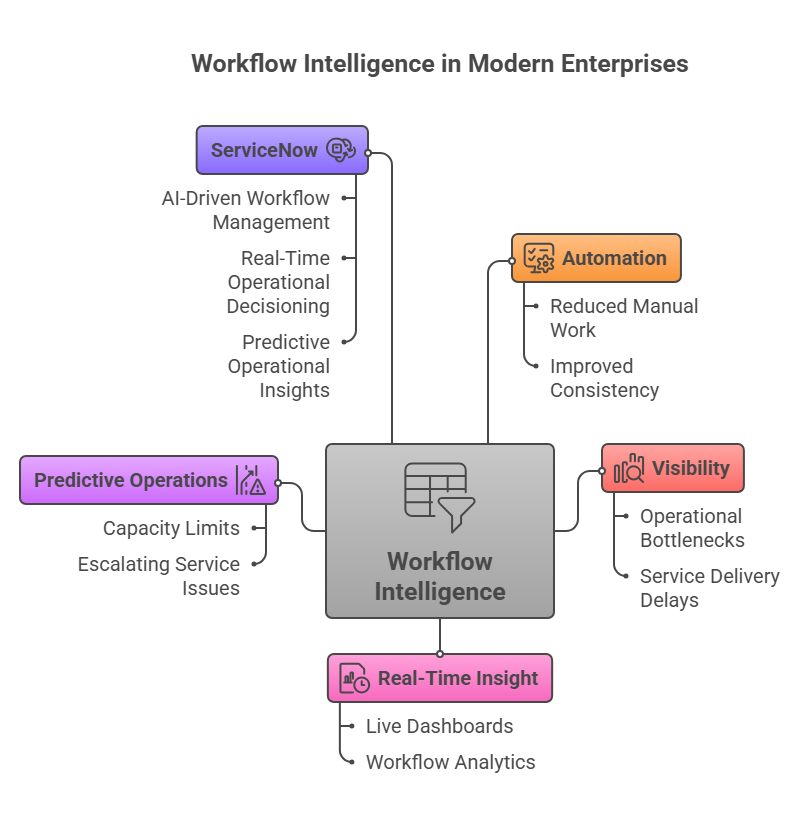
Automation was an important step forward for many organisations. It helped reduce manual work and improved consistency in day-to-day operations. But automation alone doesn’t solve the bigger operational challenge: visibility.
Automation Improved Efficiency, But Not Insight
Many companies have automated tasks like service requests, approvals, and incident management.
But the systems simply processed work faster. They didn’t always help leaders understand:
- Where operational bottlenecks exist
- Which processes slow down service delivery
- When workloads become unsustainable
Without this visibility, leaders are often reacting to problems rather than anticipating them.
Decision-Making Still Relies on Historical Data
In many organisations, leadership teams still rely on reports that reflect what happened yesterday or last week. By the time an issue appears in a report, it has often already impacted customers or revenue. Modern enterprises need operational systems that provide real-time insight, not delayed reporting.
Businesses Need Predictive Operations
Today’s leadership teams want more than operational dashboards.
They want systems that can help answer questions such as:
- Where will the next operational bottleneck appear?
- Which teams are approaching capacity limits?
- Which service issues are likely to escalate?
This is where workflow intelligence becomes valuable.
What Workflow Intelligence Means for Business Leaders
For CEOs and CFOs, workflow intelligence changes how organisations manage operations.
Instead of simply tracking activity, systems begin to support smarter decision-making.
This has several practical benefits:
1. Faster response to operational issues
Teams can identify problems before they affect customers.
2. Better forecasting and planning
Operational data becomes part of financial and capacity planning.
3. Reduced process friction
AI-driven workflows automatically prioritise work and route tasks to the right teams.
Ultimately, organisations move from reactive operations to proactive operational management.
How ServiceNow Enables Workflow Intelligence
Platforms like ServiceNow are helping enterprises make this transition.
Rather than operating through disconnected systems, organisations can manage workflows, operational data, and automation within a single platform.
AI-Driven Workflow Management
ServiceNow can intelligently route tasks and prioritise requests based on workload, urgency, and service impact.
This ensures the most critical work receives attention first without relying on manual coordination.
Real-Time Operational Decisioning
Leaders gain visibility into operational performance through live dashboards and workflow analytics.
Instead of waiting for periodic reports, teams can monitor how work moves through the organisation in real time.
This allows issues to be identified and resolved earlier.
Predictive Operational Insights
With the right data in place, workflow platforms can help detect patterns that indicate emerging problems.
For example:
- Repeated service delays
- Rising incident volumes
- Operational bottlenecks in specific teams
Identifying these patterns early allows organisations to address problems before they escalate.
Pro Tip from Real Implementations
One lesson we consistently see in transformation projects is that workflow intelligence works best when applied to high-volume operational processes first.
Examples include:
- service request management
- employee onboarding
- internal approval workflows
Improving visibility and automation in these areas often delivers immediate operational gains.
A Common Pitfall to Avoid
Many organisations attempt to introduce AI into their systems without redesigning the underlying workflows.
This creates complexity rather than improvement.
If workflows are unclear or inconsistent, adding automation or AI simply accelerates the confusion.
The more effective approach is to first simplify and standardise workflows, then apply intelligent automation.
Final Thought
The next stage of enterprise transformation isn’t just about automating work. It’s about making workflows intelligent enough to support better operational decisions.
A useful question for leadership teams is this:
Do your systems simply record work, or do they help the organisation act on operational insight?
Next Step
At TinyLoop, we work with organisations to design intelligent workflows and implement platforms like ServiceNow so operational data becomes a strategic advantage.
If you're exploring how workflow intelligence could improve visibility, decision-making, and operational performance, the first step is understanding where your current processes create friction.
That conversation often begins with a workflow assessment.