
The Black Hole problem
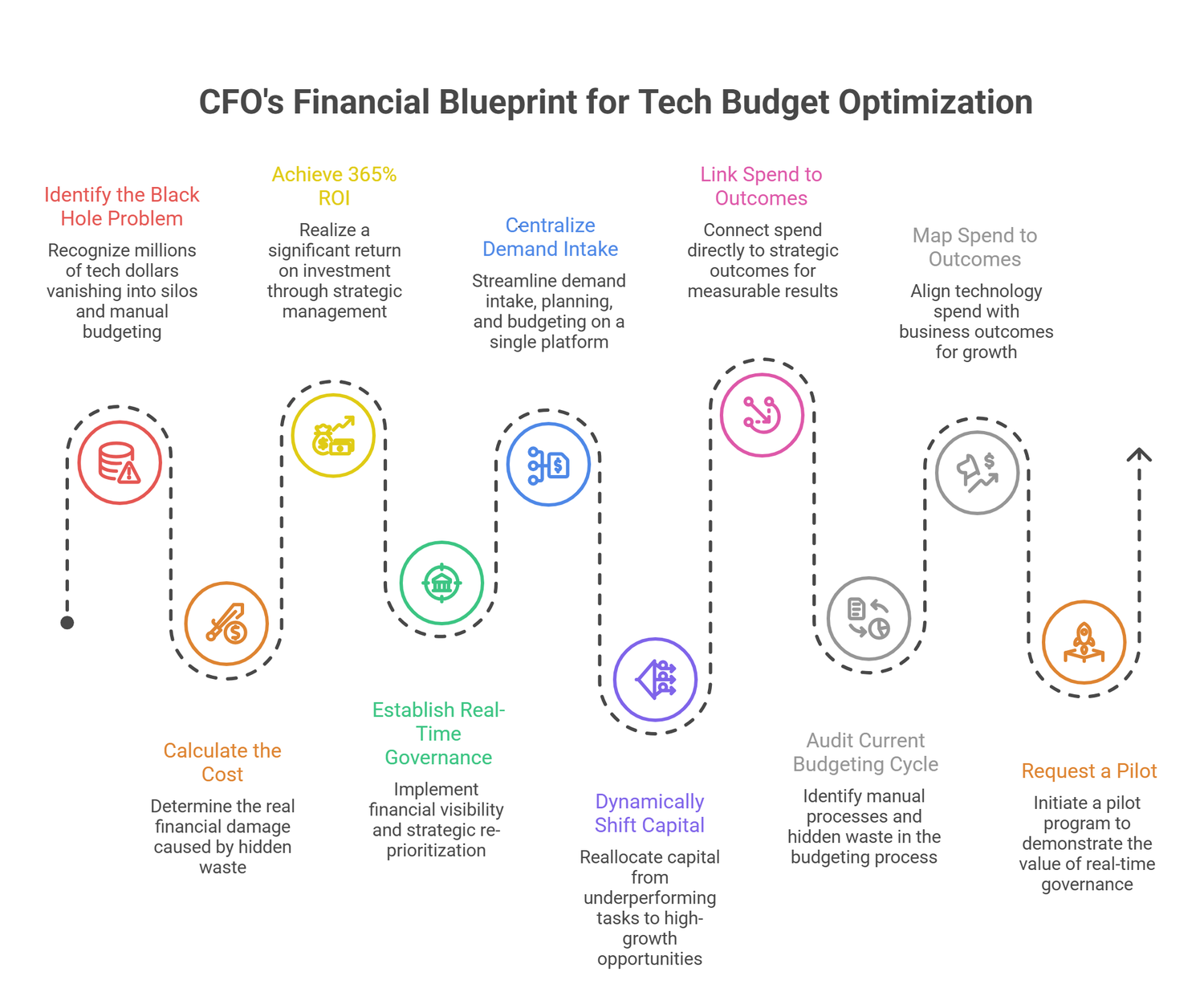
Every year, millions of technology dollars vanish into a black hole: disconnected silos and manual budgeting cycles that quietly fund zombie projects.
These projects burn cash. They consume resources. Yet they deliver almost no growth.
For CFOs and financial controllers, the damage is real:
- No clear governance. Budgets flow into initiatives without ongoing strategic validation.
- Hidden waste persists. Underperforming work stays funded year after year.
- Agility is sacrificed. Capital gets locked in low‑value efforts instead of being reallocated to high‑growth opportunities.
The result is a tech budget that leaks value, and that leak is costing you millions.
The cost is real
This isn’t theoretical. In a commissioned Forrester Consulting Total Economic Impact study, a composite organisation using ServiceNow Strategic Portfolio Management (SPM) achieved a 365% return on investment over three years, while simultaneously reducing nonproductive spend by $10.2 million. Several other analyses have confirmed the same 365% three‑year ROI benchmark.
What’s more, enterprises that establish a single source of truth for demand, capacity, and project management gain real‑time visibility. Leadership can see investment trade‑offs, managers can plan capacity with data, and teams can execute with clarity.
The resolution: real‑time financial governance
The fix is surprisingly straightforward. It rests on two pillars: financial visibility and strategic re‑prioritisation.
- Move from static, reactive spreadsheets to real‑time financial governance.
- Centralise demand intake, planning, and budgeting on a single platform.
- Gain a complete, always‑up‑to‑date view of every dollar committed.
2. Strategic re‑prioritisation
- Dynamically shift capital from underperforming tasks to high‑growth opportunities.
- Link spending directly to strategic outcomes.
- Stop funding zombie projects and start investing in what truly drives growth.
When you close the gap between strategy and execution, every dollar starts working on measurable goals.
A real‑world example
Consider Envision Healthcare. By centralising demand and implementing ServiceNow SPM, the organisation rebuilt its demand intake, financial visibility, and portfolio governance. The result was a 100% transparent view of the budget, allowing leaders to pivot with confidence rather than guessing. This kind of clarity transforms finance from a reactive scorekeeper into a strategic partner that actively drives business growth.
Why this matters for CFOs
You already have the authority to demand better visibility and governance. Here is what you can accomplish with a modern approach to financial governance:
- Stop the invisible leak of millions in tech spend.
- Redirect capital to high‑growth opportunities in real time.
- Earn trust from the board by delivering predictable, transparent financial outcomes.
- Turn finance into a driver of strategy, not just a keeper of records.
Practical next steps
- Audit your current budgeting cycle. Identify where manual processes create delays or hide waste.
- Map your technology spend to business outcomes. If you cannot clearly see which dollars are driving growth, that is a red flag.
- Ask your IT and portfolio teams one question: “Do we have a single source of truth for all demand, budgets, and project status?”
- Request a real‑time governance pilot. Start with a single portfolio or cost centre to prove the value before expanding.
Going further
- If you are ready to close the gap between strategy and execution, here are additional resources to guide your next move:
- Forrester’s Total Economic Impact study on ServiceNow SPM (provides the detailed 365% ROI model)
- ServiceNow SPM modules overview (demand intake, resource allocation, financial planning, and performance analytics)
- Case studies of peer organisations that have eliminated zombie projects and reallocated millions to growth initiatives
Three key takeaways
- Zombie projects bleed millions. Manual budgeting and disconnected silos quietly fund low‑value work. Real‑time governance stops the leak.
- 365% ROI is achievable. The Forrester TEI study proves that strategic portfolio management delivers a 365% return over three years while cutting nonproductive spend by over $10M.
- Visibility creates agility. Envision Healthcare gained 100% budget transparency, enabling confident pivots instead of guesswork. You can too.