Why Most Enterprises Are Flying Blind (And How to Fix It)
The AI wave isn’t coming; it’s already here.
But while enterprises rush to deploy copilots and agents, most are missing a critical layer: control.
The result? A fast-growing number of organisations are flying blind.
The Illusion of Progress
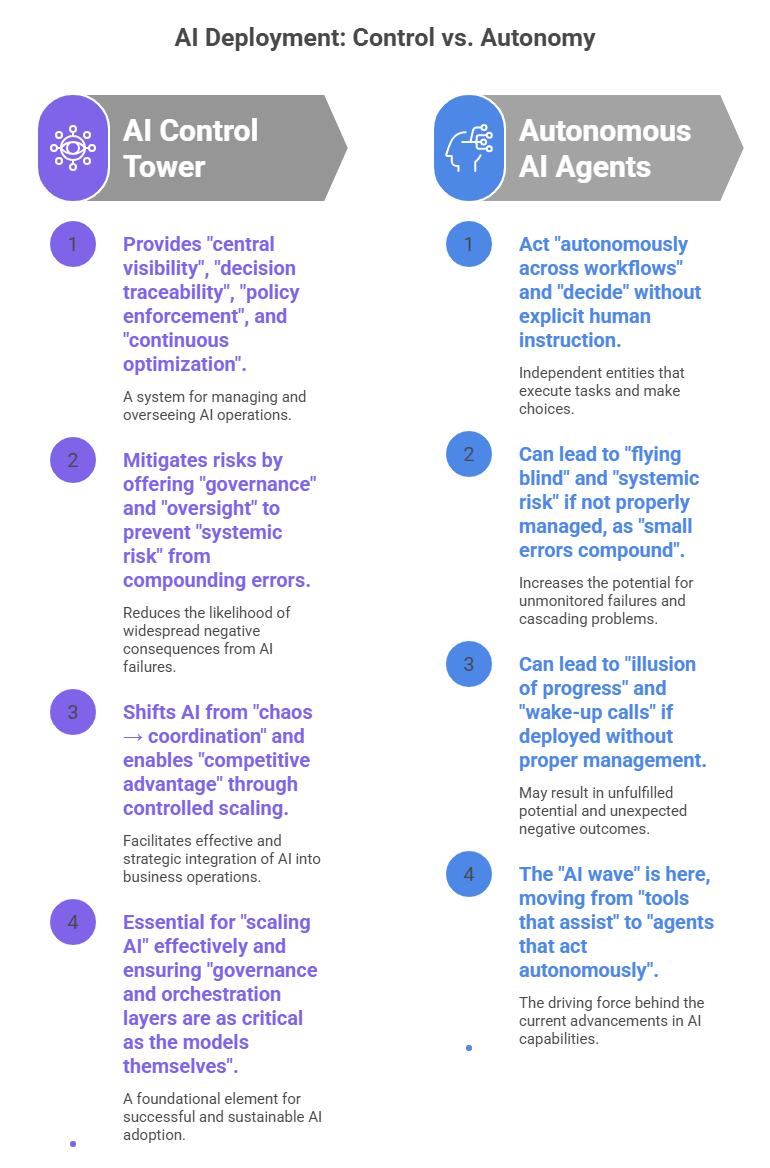
Recent thinking from The Great Consulting Reinvention highlights a major shift: AI is moving from “tools that assist” to agents that act autonomously across workflows.
But here’s the problem:
Enterprises are adopting agents without a unified way to:
- Track decisions
- Measure outcomes
- Govern actions
In other words, AI is scaling faster than oversight.
Even in early benchmarks, AI agents struggle with complex, multi-step tasks, succeeding less than half the time even after multiple attempts.
Now imagine dozens of these agents running across finance, operations, and customer workflows—with no central visibility.
The $10B Wake-Up Call
The “wake-up call” many leaders are starting to recognise is simple:
AI doesn’t fail loudly, it fails silently.
Unlike traditional software, agentic systems don’t just execute—they decide. And without governance, small errors compound into systemic risk.
We’ve already seen early signals:
- AI-driven automation triggering market panic in SaaS stocks after demonstrating it could replace high-value workflows at a fraction of the cost
- Enterprises are underestimating integration complexity and rising costs when scaling AI systems
The issue isn’t AI capability: It’s A Lack Of Orchestration.
What an AI Control Tower Actually Means
Think of it like aviation. You wouldn’t launch dozens of autonomous aircraft without a control tower. Yet that’s exactly what many enterprises are doing with AI.
An AI Control Tower provides:
- Central visibility: What agents are doing, where, and why
- Decision traceability: How outcomes were generated
- Policy enforcement: Guardrails across all workflows
- Continuous optimisation: Feedback loops to improve performance
It shifts AI from chaos → coordination.
Real-World Direction of Travel
Forward-thinking organisations are already moving this way:
- Large enterprises investing heavily in AI infrastructure (hundreds of billions globally) are realising that governance and orchestration layers are as critical as the models themselves
- Leaders like NVIDIA emphasise that AI doesn’t replace systems—it depends on strong software layers and orchestration platforms
Even consulting—traditionally human-led—is being reshaped into AI + orchestration models, where humans supervise systems rather than execute tasks.
How to Fix the Blind Spot
Enterprises don’t need more AI tools. They need control infrastructure.
Three practical steps:
- Map your agent ecosystem
Identify where AI is making or influencing decisions.
- Introduce orchestration early
Don’t wait for scale—governance must precede autonomy.
- Measure outcomes, not activity
Shift from “what AI did” to “what value it created.”
The Bottom Line
The next phase of AI isn’t about smarter models. It’s about who can control them at scale.
Because in the agentic era, competitive advantage won’t come from deploying AI fastest, it will come from not flying blind.
References
CIO Insights – The Great Consulting Reinvention: What AI Agents Mean for a $700B Industry
CIO Insights – The $10B Wake-Up Call Nobody is Ignoring (style reference)
Mercor / Business Insider – AI agent performance benchmarks
Rajesh Jain – AI-first SaaS transformation & cost/complexity challenges
LinkedIn (ADMS / Agentic AI evolution insights)
NVIDIA's perspective on AI + software dependency