Fix Your Fragmented Revenue Engine, Before It Costs You
It’s 6:30 pm. The board pack goes out tomorrow. Sales show one number. Finance shows another. Marketing claims pipeline velocity is rising. Customer Success flags renewals at risk. Meanwhile, IT is exporting CSV files and reconciling spreadsheets, again.
This isn’t a tooling problem. It’s an architecture problem.
Across growing organisations, the revenue engine breaks down into:
- Disconnected data silos
- Manual, email-driven workflows
- Increasing technical debt
- Heavy IT dependency for reporting
Adding more systems only compounds the chaos.
The fix? A unified, AI-enabled CRM and intelligent workflow layer powered by ServiceNow — connecting systems, orchestrating handoffs, embedding governance, and shifting revenue management from reactive reporting to predictive control. Because revenue complexity isn’t solved with more tools. It’s solved with the right architecture.
Why Revenue Engine Fails in Growing Organisations
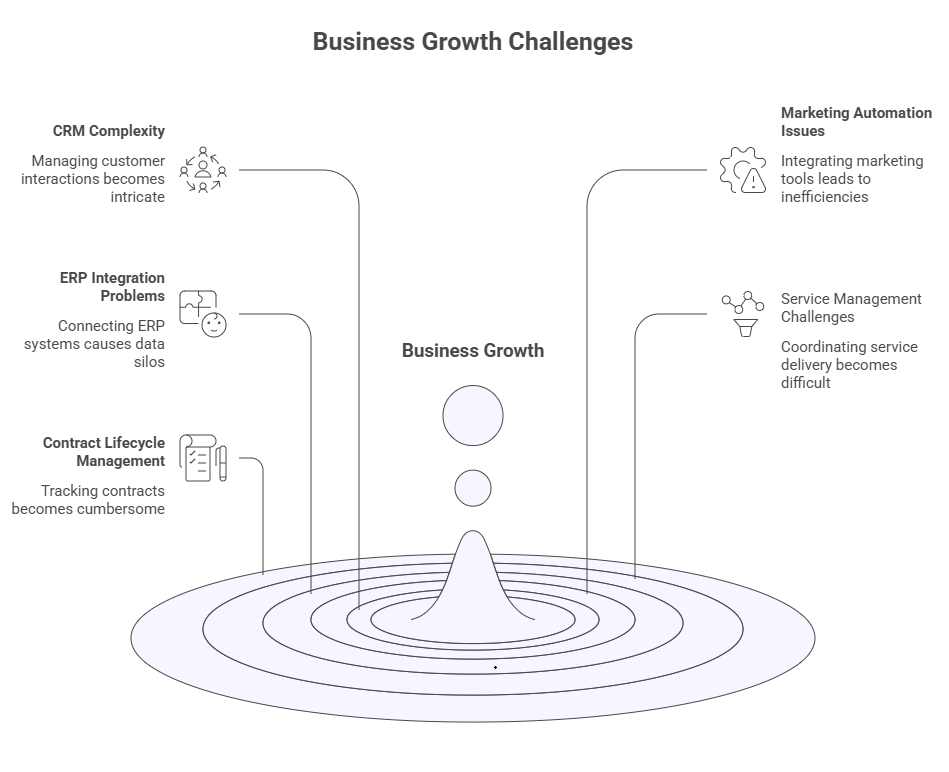
As organisations scale, systems multiply. CRM, marketing automation, ERP, service management, contract lifecycle management — each introduced to solve a problem at the time.
Over time, this creates three critical issues:
1. Fragmented Data Silos
Each platform becomes its own version of the truth. Integration turns reactive instead of strategic. Reporting requires reconciliation rather than real insight.
2. Manual Workflow Inefficiencies
Approvals happen via email. Contracts move through attachments. Renewal reminders live in spreadsheets. What should take hours takes days.
3. Technical Debt & IT Dependency
Every new workflow demands IT involvement. Custom scripts accumulate. Documentation fades. Change becomes risky and slow.
Revenue engine transformation doesn’t fail because teams lack effort. It fails because the underlying architecture can’t scale.
The Business Case for Unified, AI-Driven Revenue Engine
Before discussing technology, consider the business impact:
A single source of truth across lead-to-renewal
- Reduced cost-to-serve
- Faster deal velocity
- Improved forecast accuracy
- Stronger compliance and governance
- Higher customer retention
When data, workflows and AI operate within a single orchestrated platform, the revenue engine shifts from reactive to predictive. That’s where a ServiceNow-led strategy becomes powerful.
What Is a Unified Data Architecture and Why It Matters
A Unified Data Architecture doesn’t replace every system. It orchestrates them intelligently.
Instead of duplicating data across platforms, ServiceNow acts as the workflow and orchestration layer, enabling:
- Real-time data integration
- Clear system-of-record vs system-of-engagement roles
- Structured governance and ownership
- Controlled API management
The result: less redundancy, fewer reconciliations, reduced technical debt and greater confidence in decision-making.
How Intelligent Workflow Automation Removes Bottlenecks
Enterprise revenue rarely falls within a single function. A typical deal moves through Sales → Legal → Finance → Delivery → Customer Success.
Without orchestration, handovers create delays and risk.
Intelligent automation enables:
- SLA-driven approvals
- Automated contract routing
- Compliance validation
- Role-based cross-functional visibility
- Self-service request portals
Teams stop chasing emails and start operating within governed, auditable workflows — shortening cycles and reducing surprises.
How AI Transforms the Lead-to-Renewal Lifecycle
AI should be embedded into execution, not layered on top as reporting.
With AI integrated into CRM workflows, organisations can:
- Predict conversion probability
- Flag at-risk opportunities early
- Trigger automated renewals
- Monitor customer health
- Prioritise accounts by risk and value
The shift is significant: from hindsight to foresight — understanding what will happen next and what action to take.
Implementation Best Practices:
- Standardise before automating
- Focus first on the lead-to-renewal value stream
- Establish governance early
- Deliver measurable wins in phases
- Prioritise process ownership over platform features
- Treat transformation as cross-functional, not IT-only
Unify Revenue and Unlock Predictable Growth
If your organisation is battling fragmented systems, manual workarounds and IT-heavy dependencies, the solution isn’t another point tool. It’s a unified, ServiceNow-led architecture that connects systems, orchestrates workflows and embeds intelligence across the entire lifecycle. Revenue complexity doesn’t resolve itself, but with the right structure and governance, it becomes scalable, controllable and ultimately profitable.