ServiceNow’s Quiet Rise as the OS Powering Agentic Enterprises
Most conversations about ServiceNow are still stuck in an older frame:
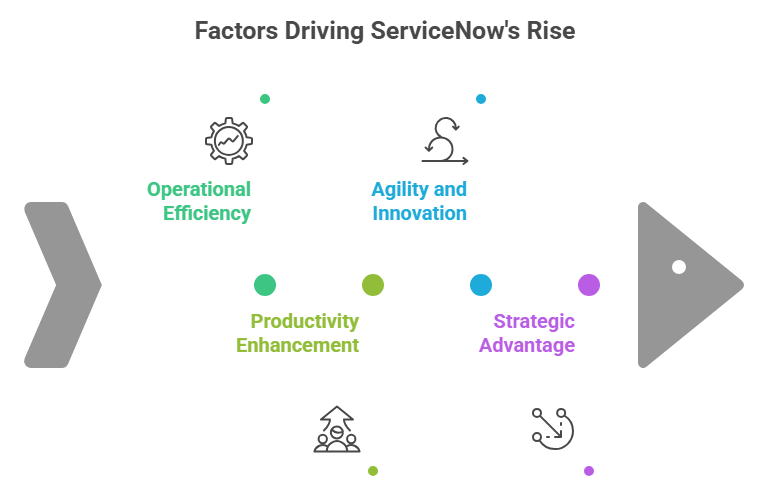
Workflows, Automation and Ticketing Efficiency. That story is now incomplete. If you step back and look at ServiceNow’s recent moves, including acquisitions like Moveworks, Veza, and Armis, a different picture starts to emerge. This isn’t about improving workflows anymore; it’s about building the foundation for how enterprises will operate in an Agentic AI-driven world.
The Shift: From Automating Work to Orchestrating It
As Bill McDermott put it:
“The future belongs to companies that connect everything and automate anything.”
That statement hits a little differently when you take a closer look at what ServiceNow is actually building. Think about it this way. Moveworks makes it incredibly easy to start work, just by asking the way you would in a normal conversation. No friction, no complicated steps. Veza works quietly in the background, making sure everyone, whether it’s a person or an AI agent, has exactly the access they need, nothing more, nothing less. And Armis? It widens the lens. It gives organisations visibility across their entire digital environment, not just the usual IT boundaries. On their own, each of these moves makes sense. They’re smart, strategic additions.
But together, they tell a much bigger story. This isn’t just about adding features. It’s about building a platform that can actually coordinate how work flows across an entire organisation—smoothly, securely, and intelligently.
Why This Matters Now: The Rise of Agentic AI
We’re entering a phase where AI doesn’t just assist, it acts.
AI agents will:
- Execute workflows
- Make decisions within defined boundaries
- Interact across multiple systems
At that point, the challenge is no longer capability.
It becomes:
- Coordination – Who does what, and when?
- Trust – Can this action be allowed?
- Governance – Who is accountable?
Most enterprises aren’t structured for this.
They’re built around:
“Most enterprises aren’t structured for this. They’re built around siloed systems, fragmented ownership, and static workflows.”
The urgency behind this shift is already visible in the data. According to CB Insights, 72% of enterprise leaders cite integration complexity and 67% point to security and compliance as the primary blockers to AI agent deployment, with nearly half still stuck in evaluation. This isn’t just a technology gap; it’s an orchestration failure. As hyperscalers like Microsoft, Google Cloud, and Amazon Web Services move rapidly to embed AI execution directly into their platforms, the window for fragmented, tool-based approaches is closing fast. The competitive advantage is shifting toward platforms that can coordinate, govern, and operationalise AI at scale, not just deploy it.
At the same time, a new control layer is emerging as the real battleground: governance and data. Leading firms are investing heavily to own this layer, whether it’s KPMG strengthening data pipelines, McKinsey & Company investing in MLOps platforms, or Accenture building end-to-end data ecosystems. The implication for ServiceNow is clear: its opportunity isn’t just workflow orchestration, but becoming the system where AI agents are governed, monitored, and trusted. In an Agentic AI world, the platform that controls access, visibility, and decision flows doesn’t just support the enterprise; it defines how it runs.
The Real Strategy: Platform Gravity
ServiceNow’s expansion across:
- IT
- HR
- Customer operations
- Security
- Industry workflows
…is often interpreted as product expansion. It’s not. It’s platform gravity.
Each new workflow pulled into ServiceNow does two things:
- Centralizes execution
- Standardizes decision-making
Over time, this creates a powerful effect:
- Work doesn’t just flow through ServiceNow
- It starts to depend on ServiceNow
A More Concrete Example
Consider a large enterprise onboarding an AI-powered customer support agent.
Without a unifying platform:
- IT handles deployment
- Security reviews access separately
- Risk evaluates compliance in isolation
- Business teams define usage independently
The result:
- Delays
- Gaps in governance
- Conflicting decisions
Now contrast that with a platform-centric model:
- The request is initiated conversationally (Moveworks-style experience)
- Access and entitlements are validated dynamically (Veza layer)
- Asset and risk visibility are continuously monitored (Armis capability)
- Execution is routed through unified workflows (ServiceNow core)
This isn’t just more efficient. It’s coordinated by design.
From Platform to Operating Model
This is the part many organisations are underestimating. ServiceNow is no longer just supporting enterprise processes. It’s positioning itself as the operating model itself:
- The place where work is initiated
- The layer where decisions are governed
- The system where execution is orchestrated
As McDermott puts it:
“We are building the platform for the 21st century enterprise.”
The Strategic Implication for Leaders
The AI era will not be won by:
- The Most Features
- The Most Pilots
- The Most Tools
It will be won by: The platforms organisations choose to run on
Because three things will define success:
- The platform that connects work
- The platform that governs AI
- The platform that executes at scale
ServiceNow is assembling all three.
The Bottom Line
At some point, ServiceNow stops being “another enterprise platform.”
What’s emerging here is something more foundational than it might seem at first glance.
At its core, it’s becoming a coordination layer where humans and AI can actually work together—naturally, without friction, and in real time. Not as separate systems, but as part of the same flow of work.
At the same time, it’s shaping up to be a kind of control centre for the enterprise. The place where risk is understood, decisions are guided, and the right boundaries are quietly enforced in the background. And then there’s the execution side of it. Because ideas and decisions don’t mean much without action. This is where everything comes together—turning intent into real, end-to-end work that actually gets done.
Put it all together, and it starts to look less like a collection of capabilities and more like the backbone of how modern organisations operate.
In other words:
- It shifts from supporting the enterprise
- To become the foundation the enterprise runs on
What Should You Do Next?
If you’re already investing in AI, the question isn’t what tools to add next. It’s: Where will all of this be orchestrated, governed, and run?
That’s the decision that will define whether your AI strategy scales or stalls.