Reimagining Virtual Agent Success: 3 Practical Strategies for Modern ITSM
The promise of Artificial Intelligence and Machine Learning in service management is no longer theoretical; it is operational. With the evolution of the ServiceNow platform, organisations today can leverage advanced capabilities through the Now Assist and AI-powered features embedded within ITSM Pro. These include Virtual Agent, Predictive Intelligence, and Performance Analytics, all designed to enhance service delivery, reduce operational costs, and improve user experience.
At Tinyloop, we see this shift not as a technology upgrade, but as an opportunity to rethink how IT services are consumed. However, unlocking the full value of Virtual Agent requires more than activation; it requires a structured, experience-led approach.
Why User Adoption Remains the Core Success Factor
Modern AI capabilities within ServiceNow have made implementation more accessible than ever. Organisations no longer need deep data science expertise to deploy intelligent workflows or conversational interfaces. While the technology is easier to configure, achieving meaningful outcomes is still dependent on one critical factor: user adoption.
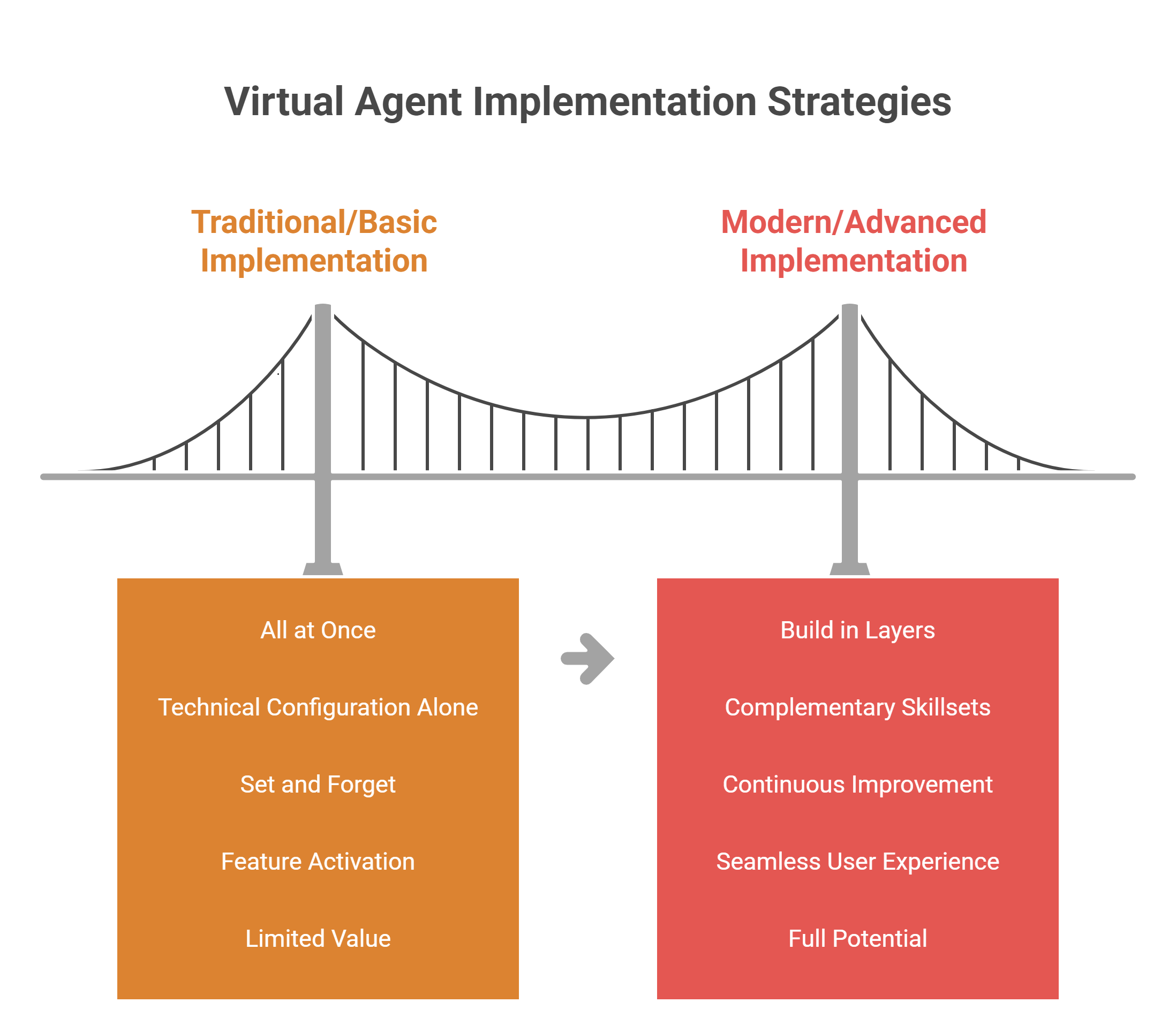
Virtual Agent is not just another ITSM feature; it is a new channel of interaction. If users do not trust or engage with it, the investment delivers limited value. The quality of the experience, from conversation flow to resolution speed, directly determines whether users adopt the platform or revert to traditional channels such as email or phone.
Strategy 1: Build Integration in Layers, Not All at Once
A successful Virtual Agent implementation is best approached in structured layers rather than attempting full automation from day one.
The first layer focuses on enabling basic interactions such as incident logging, service requests, and ticket tracking. Using out-of-the-box capabilities within ServiceNow, organisations can quickly introduce Virtual Agent as an alternative channel with minimal risk. This helps users transition comfortably while maintaining familiarity with existing processes.
The second layer involves designing tailored conversational topics aligned to key business services. This is where organisations begin to see measurable improvements in metrics such as resolution time and service efficiency. By analysing service desk interactions and ticket trends, businesses can prioritise high-impact use cases for self-service.
The final layer is where Virtual Agent delivers its full value, end-to-end automation. At this stage, workflows are fully integrated, allowing users to resolve issues instantly without human intervention. Achieving this requires tight alignment between Virtual Agent, backend workflows, and the Configuration Management Database (CMDB).
At Tinyloop, we emphasise a phased approach to ensure stability, scalability, and a consistent user experience at each stage.
Strategy 2: Align the Right Skillsets for Implementation
One of the most common challenges we observe is the assumption that a Virtual Agent can be successfully deployed through technical configuration alone. While ServiceNow developers play a critical role, they represent only one part of the equation.
A successful implementation requires two complementary skillsets. The first is business process analysis—understanding how services are delivered, where inefficiencies exist, and how users interact with IT. The second is technical expertise in configuring Virtual Agent, workflows, and AI capabilities within the platform.
Relying solely on technical teams often leads to underwhelming results, where the Virtual Agent is functional but fails to deliver a meaningful user experience. At Tinyloop, we bridge this gap by combining process design with technical execution, ensuring that the solution reflects real-world service interactions rather than theoretical workflows.
Strategy 3: Commit to Continuous Improvement
Virtual Agent is not a “set and forget” solution. Its effectiveness depends on ongoing monitoring, refinement, and optimisation. As user behaviour evolves, so must the conversational flows and automation logic.
ServiceNow provides built-in tools such as Performance Analytics and continuous improvement frameworks to track usage, identify drop-off points, and refine interactions. These insights enable organisations to continuously enhance the Virtual Agent experience, ensuring it remains relevant and effective.
At Tinyloop, we embed continuous improvement into every implementation. This includes setting up performance dashboards, defining success metrics, and establishing feedback loops that allow organisations to evolve their ITSM capabilities over time.
Conclusion
The evolution of AI within ServiceNow has made Virtual Agent a powerful enabler of modern IT service delivery. However, technology alone does not guarantee success. Organisations must focus on user adoption, structured implementation, and continuous improvement to realise their full potential. From our experience at Tinyloop, the most successful Virtual Agent implementations combine strong process design, technical expertise, and a clear focus on delivering value to end users. When executed correctly, Virtual Agent becomes more than a chatbot—it becomes a critical driver of efficiency, experience, and scalable service delivery.
Three main takeaways:
- Successful Virtual Agent implementations depend on user adoption driven by a seamless and intuitive user experience.
- A phased approach, starting with basic use cases and evolving into full automation, ensures scalable and effective ITSM transformation.
- Continuous improvement, backed by analytics and the right skill sets, is essential to maximise long-term value from ServiceNow ITSM.